Xingyun Li , Jingjing Gu , Ziqiang Hong , Zhaoxi Shen , Zheng Ji , Ruonan Tan , Rui Jia , Jiu Yang , Suixin Zhang , Zongliang Wan , Jin Ran , Peipei Zuo
{"title":"微孔型超交联聚氧吲哚-联苯阴离子交换膜提高酸/碱回收率","authors":"Xingyun Li , Jingjing Gu , Ziqiang Hong , Zhaoxi Shen , Zheng Ji , Ruonan Tan , Rui Jia , Jiu Yang , Suixin Zhang , Zongliang Wan , Jin Ran , Peipei Zuo","doi":"10.1016/j.memsci.2025.123910","DOIUrl":null,"url":null,"abstract":"<div><div>Membrane processes are vital to acid/alkali recovery in an energy-saving and environmentally friendly way, and their performance hinges largely on the ion exchange membranes (IEMs) that are preferentially permeated by the small ions of H<sup>+</sup> and OH<sup>−</sup> over other larger ions. However, it remains challenging to design IEMs with both high H<sup>+</sup>/OH<sup>−</sup> permeation rates and high ion selectivity. We here report anion exchange membranes with microporosity (HC–P3P) fabricated by a simple hypercrosslinking of side-chain type poly(oxindole biphenylene) membrane (P3P). This hypercrosslinking reaction turns linear backbones into hypercrosslinked networks and thus enhances the anti-swelling property. Benefitting from their micropore confinement imposed by micropore channels, they can efficiently separate H<sup>+</sup> and OH<sup>−</sup> from other larger ions. The excellent performance of acid recovery of these hypercrosslinked membranes is demonstrated by a diffusion dialysis process, with an extremely high H<sup>+</sup>/Fe<sup>2+</sup> selectivity of 5160 (278.92 times for the commercial membrane DF-120, 7.22 times of the original P3P membrane) and a comparable H<sup>+</sup> dialysis coefficient of 4.53 × 10<sup>−3</sup> m h<sup>−1</sup>. Besides, the HC-P3P membranes also exhibit superiority in electrodialysis base recovery, showing a very high OH<sup>−</sup>/WO<sub>4</sub><sup>2−</sup> selectivity of 491.41 (41.19 times for the commercial membrane Neosepta® ACS) and a competitive OH<sup>−</sup> flux of 7.14 mol m<sup>−2</sup> h<sup>−1</sup>. Importantly, HC-P3P membranes perform much better than typically reported membranes in terms of striking an excellent balance between H<sup>+</sup>/OH<sup>−</sup> transport rate and ion selectivity. This work suggests the great potential of hypercrosslinked IEMs for resource recovery beyond acid/alkali recovery.</div></div>","PeriodicalId":368,"journal":{"name":"Journal of Membrane Science","volume":"722 ","pages":"Article 123910"},"PeriodicalIF":9.0000,"publicationDate":"2025-04-01","publicationTypes":"Journal Article","fieldsOfStudy":null,"isOpenAccess":false,"openAccessPdf":"","citationCount":"0","resultStr":"{\"title\":\"Hypercrosslinked poly(oxindole biphenylene) anion exchange membranes with microporosity boosting acid/alkali recovery\",\"authors\":\"Xingyun Li , Jingjing Gu , Ziqiang Hong , Zhaoxi Shen , Zheng Ji , Ruonan Tan , Rui Jia , Jiu Yang , Suixin Zhang , Zongliang Wan , Jin Ran , Peipei Zuo\",\"doi\":\"10.1016/j.memsci.2025.123910\",\"DOIUrl\":null,\"url\":null,\"abstract\":\"<div><div>Membrane processes are vital to acid/alkali recovery in an energy-saving and environmentally friendly way, and their performance hinges largely on the ion exchange membranes (IEMs) that are preferentially permeated by the small ions of H<sup>+</sup> and OH<sup>−</sup> over other larger ions. However, it remains challenging to design IEMs with both high H<sup>+</sup>/OH<sup>−</sup> permeation rates and high ion selectivity. We here report anion exchange membranes with microporosity (HC–P3P) fabricated by a simple hypercrosslinking of side-chain type poly(oxindole biphenylene) membrane (P3P). This hypercrosslinking reaction turns linear backbones into hypercrosslinked networks and thus enhances the anti-swelling property. Benefitting from their micropore confinement imposed by micropore channels, they can efficiently separate H<sup>+</sup> and OH<sup>−</sup> from other larger ions. The excellent performance of acid recovery of these hypercrosslinked membranes is demonstrated by a diffusion dialysis process, with an extremely high H<sup>+</sup>/Fe<sup>2+</sup> selectivity of 5160 (278.92 times for the commercial membrane DF-120, 7.22 times of the original P3P membrane) and a comparable H<sup>+</sup> dialysis coefficient of 4.53 × 10<sup>−3</sup> m h<sup>−1</sup>. Besides, the HC-P3P membranes also exhibit superiority in electrodialysis base recovery, showing a very high OH<sup>−</sup>/WO<sub>4</sub><sup>2−</sup> selectivity of 491.41 (41.19 times for the commercial membrane Neosepta® ACS) and a competitive OH<sup>−</sup> flux of 7.14 mol m<sup>−2</sup> h<sup>−1</sup>. Importantly, HC-P3P membranes perform much better than typically reported membranes in terms of striking an excellent balance between H<sup>+</sup>/OH<sup>−</sup> transport rate and ion selectivity. This work suggests the great potential of hypercrosslinked IEMs for resource recovery beyond acid/alkali recovery.</div></div>\",\"PeriodicalId\":368,\"journal\":{\"name\":\"Journal of Membrane Science\",\"volume\":\"722 \",\"pages\":\"Article 123910\"},\"PeriodicalIF\":9.0000,\"publicationDate\":\"2025-04-01\",\"publicationTypes\":\"Journal Article\",\"fieldsOfStudy\":null,\"isOpenAccess\":false,\"openAccessPdf\":\"\",\"citationCount\":\"0\",\"resultStr\":null,\"platform\":\"Semanticscholar\",\"paperid\":null,\"PeriodicalName\":\"Journal of Membrane Science\",\"FirstCategoryId\":\"5\",\"ListUrlMain\":\"https://www.sciencedirect.com/science/article/pii/S0376738825002236\",\"RegionNum\":1,\"RegionCategory\":\"工程技术\",\"ArticlePicture\":[],\"TitleCN\":null,\"AbstractTextCN\":null,\"PMCID\":null,\"EPubDate\":\"2025/2/25 0:00:00\",\"PubModel\":\"Epub\",\"JCR\":\"Q1\",\"JCRName\":\"ENGINEERING, CHEMICAL\",\"Score\":null,\"Total\":0}","platform":"Semanticscholar","paperid":null,"PeriodicalName":"Journal of Membrane Science","FirstCategoryId":"5","ListUrlMain":"https://www.sciencedirect.com/science/article/pii/S0376738825002236","RegionNum":1,"RegionCategory":"工程技术","ArticlePicture":[],"TitleCN":null,"AbstractTextCN":null,"PMCID":null,"EPubDate":"2025/2/25 0:00:00","PubModel":"Epub","JCR":"Q1","JCRName":"ENGINEERING, CHEMICAL","Score":null,"Total":0}
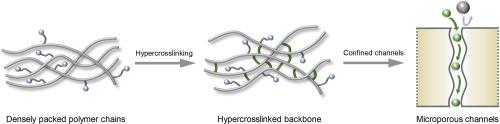
Membrane processes are vital to acid/alkali recovery in an energy-saving and environmentally friendly way, and their performance hinges largely on the ion exchange membranes (IEMs) that are preferentially permeated by the small ions of H+ and OH− over other larger ions. However, it remains challenging to design IEMs with both high H+/OH− permeation rates and high ion selectivity. We here report anion exchange membranes with microporosity (HC–P3P) fabricated by a simple hypercrosslinking of side-chain type poly(oxindole biphenylene) membrane (P3P). This hypercrosslinking reaction turns linear backbones into hypercrosslinked networks and thus enhances the anti-swelling property. Benefitting from their micropore confinement imposed by micropore channels, they can efficiently separate H+ and OH− from other larger ions. The excellent performance of acid recovery of these hypercrosslinked membranes is demonstrated by a diffusion dialysis process, with an extremely high H+/Fe2+ selectivity of 5160 (278.92 times for the commercial membrane DF-120, 7.22 times of the original P3P membrane) and a comparable H+ dialysis coefficient of 4.53 × 10⁻³ m h−1. Besides, the HC-P3P membranes also exhibit superiority in electrodialysis base recovery, showing a very high OH−/WO42− selectivity of 491.41 (41.19 times for the commercial membrane Neosepta® ACS) and a competitive OH− flux of 7.14 mol m−2 h−1. Importantly, HC-P3P membranes perform much better than typically reported membranes in terms of striking an excellent balance between H+/OH− transport rate and ion selectivity. This work suggests the great potential of hypercrosslinked IEMs for resource recovery beyond acid/alkali recovery.
期刊介绍:
The Journal of Membrane Science is a publication that focuses on membrane systems and is aimed at academic and industrial chemists, chemical engineers, materials scientists, and membranologists. It publishes original research and reviews on various aspects of membrane transport, membrane formation/structure, fouling, module/process design, and processes/applications. The journal primarily focuses on the structure, function, and performance of non-biological membranes but also includes papers that relate to biological membranes. The Journal of Membrane Science publishes Full Text Papers, State-of-the-Art Reviews, Letters to the Editor, and Perspectives.




 京公网安备 11010802042870号
京ICP备2023020795号-1
京公网安备 11010802042870号
京ICP备2023020795号-1

 分享
分享
 求助内容:
求助内容: 应助结果提醒方式:
 扫码关注我们
