Yang Yang, Xiaoyi She*, Zhongyang Liu, Ni Zhang, Yang Shen and Chongjun Jin*,
{"title":"基于无序钯纳米粒子的可调谐等离子系统及其在光学氢传感器中的应用","authors":"Yang Yang, Xiaoyi She*, Zhongyang Liu, Ni Zhang, Yang Shen and Chongjun Jin*, ","doi":"10.1021/acsmaterialslett.4c02219","DOIUrl":null,"url":null,"abstract":"<p >Plasmonic systems based on metallic nanostructures have special properties for light localization, photon transportation, and energy harvesting and have been widely applied in various optical applications. Here, we propose a tunable plasmonic system composed of disordered palladium (Pd) nanoparticles (NPs) on a planar optical cavity. We manipulate optical absorption intensity and bandwidth by controlling the effective thickness of the Pd NPs, which achieve an ultralow reflectance of 0.06%. Furthermore, the optical absorption mode of the plasmonic system can be modulated by the hydrogen absorption of the Pd NPs. The tunable optical absorption of the plasmonic system can be explained by the coupled-mode theory. This Pd-based plasmonic system will not only facilitate a further understanding of the optical properties of disordered systems but also provide a novel platform for practical applications such as visual hydrogen sensing.</p>","PeriodicalId":19,"journal":{"name":"ACS Materials Letters","volume":"7 3","pages":"804–810 804–810"},"PeriodicalIF":8.6000,"publicationDate":"2025-01-31","publicationTypes":"Journal Article","fieldsOfStudy":null,"isOpenAccess":false,"openAccessPdf":"","citationCount":"0","resultStr":"{\"title\":\"Tunable Plasmonic System Based on Disordered Palladium Nanoparticles and Its Application to Optical Hydrogen Sensors\",\"authors\":\"Yang Yang, Xiaoyi She*, Zhongyang Liu, Ni Zhang, Yang Shen and Chongjun Jin*, \",\"doi\":\"10.1021/acsmaterialslett.4c02219\",\"DOIUrl\":null,\"url\":null,\"abstract\":\"<p >Plasmonic systems based on metallic nanostructures have special properties for light localization, photon transportation, and energy harvesting and have been widely applied in various optical applications. Here, we propose a tunable plasmonic system composed of disordered palladium (Pd) nanoparticles (NPs) on a planar optical cavity. We manipulate optical absorption intensity and bandwidth by controlling the effective thickness of the Pd NPs, which achieve an ultralow reflectance of 0.06%. Furthermore, the optical absorption mode of the plasmonic system can be modulated by the hydrogen absorption of the Pd NPs. The tunable optical absorption of the plasmonic system can be explained by the coupled-mode theory. This Pd-based plasmonic system will not only facilitate a further understanding of the optical properties of disordered systems but also provide a novel platform for practical applications such as visual hydrogen sensing.</p>\",\"PeriodicalId\":19,\"journal\":{\"name\":\"ACS Materials Letters\",\"volume\":\"7 3\",\"pages\":\"804–810 804–810\"},\"PeriodicalIF\":8.6000,\"publicationDate\":\"2025-01-31\",\"publicationTypes\":\"Journal Article\",\"fieldsOfStudy\":null,\"isOpenAccess\":false,\"openAccessPdf\":\"\",\"citationCount\":\"0\",\"resultStr\":null,\"platform\":\"Semanticscholar\",\"paperid\":null,\"PeriodicalName\":\"ACS Materials Letters\",\"FirstCategoryId\":\"92\",\"ListUrlMain\":\"https://pubs.acs.org/doi/10.1021/acsmaterialslett.4c02219\",\"RegionNum\":1,\"RegionCategory\":\"化学\",\"ArticlePicture\":[],\"TitleCN\":null,\"AbstractTextCN\":null,\"PMCID\":null,\"EPubDate\":\"\",\"PubModel\":\"\",\"JCR\":\"Q1\",\"JCRName\":\"MATERIALS SCIENCE, MULTIDISCIPLINARY\",\"Score\":null,\"Total\":0}","platform":"Semanticscholar","paperid":null,"PeriodicalName":"ACS Materials Letters","FirstCategoryId":"92","ListUrlMain":"https://pubs.acs.org/doi/10.1021/acsmaterialslett.4c02219","RegionNum":1,"RegionCategory":"化学","ArticlePicture":[],"TitleCN":null,"AbstractTextCN":null,"PMCID":null,"EPubDate":"","PubModel":"","JCR":"Q1","JCRName":"MATERIALS SCIENCE, MULTIDISCIPLINARY","Score":null,"Total":0}
Tunable Plasmonic System Based on Disordered Palladium Nanoparticles and Its Application to Optical Hydrogen Sensors
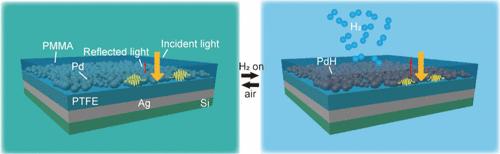
Plasmonic systems based on metallic nanostructures have special properties for light localization, photon transportation, and energy harvesting and have been widely applied in various optical applications. Here, we propose a tunable plasmonic system composed of disordered palladium (Pd) nanoparticles (NPs) on a planar optical cavity. We manipulate optical absorption intensity and bandwidth by controlling the effective thickness of the Pd NPs, which achieve an ultralow reflectance of 0.06%. Furthermore, the optical absorption mode of the plasmonic system can be modulated by the hydrogen absorption of the Pd NPs. The tunable optical absorption of the plasmonic system can be explained by the coupled-mode theory. This Pd-based plasmonic system will not only facilitate a further understanding of the optical properties of disordered systems but also provide a novel platform for practical applications such as visual hydrogen sensing.
期刊介绍:
ACS Materials Letters is a journal that publishes high-quality and urgent papers at the forefront of fundamental and applied research in the field of materials science. It aims to bridge the gap between materials and other disciplines such as chemistry, engineering, and biology. The journal encourages multidisciplinary and innovative research that addresses global challenges. Papers submitted to ACS Materials Letters should clearly demonstrate the need for rapid disclosure of key results. The journal is interested in various areas including the design, synthesis, characterization, and evaluation of emerging materials, understanding the relationships between structure, property, and performance, as well as developing materials for applications in energy, environment, biomedical, electronics, and catalysis. The journal has a 2-year impact factor of 11.4 and is dedicated to publishing transformative materials research with fast processing times. The editors and staff of ACS Materials Letters actively participate in major scientific conferences and engage closely with readers and authors. The journal also maintains an active presence on social media to provide authors with greater visibility.




 京公网安备 11010802042870号
京ICP备2023020795号-1
京公网安备 11010802042870号
京ICP备2023020795号-1

 分享
分享
 求助内容:
求助内容: 应助结果提醒方式:
 扫码关注我们
