{"title":"具有聚集诱导磷光发射(AIPE)特性的三羰基铼配合物在肝素及其主要污染物选择性检测中的应用","authors":"Corinne Vanucci-Bacqué , Valentine Guilbaud , Maëlle Deleuzière , Charles-Louis Serpentini , Florence Bedos-Belval , Eric Benoist , Suzanne Fery-Forgues","doi":"10.1016/j.saa.2025.125932","DOIUrl":null,"url":null,"abstract":"<div><div>Phosphorescent tricarbonylrhenium(I) complexes that are more emissive in the aggregate state than in solution could be very valuable probes for biological analyses, but their development is delicate. The present work focuses on the synthesis and spectroscopic study of three new complexes that differ by the nature of their positively charged substituent. The dissolved complexes were very weakly emissive. Due to electrostatic interaction and aggregation, they showed a strong aggregation-induced phosphorescence enhancement (AIPE) effect in the presence of heparin, a polyanionic macromolecule of biological interest, and a weaker effect in the presence of chondroitin sulfate, which contains fewer negative charges. The magnitude of the AIPE effect depended on the nature and number of the cationic groups borne by the complex. However, it was weaker than expected from the behavior of the parent neutral complex studied in a conventional acetonitrile/water system, which highlights the challenge of accurately predicting solid-state emission properties for this class of molecules. This work introduces rhenium(I) complexes in the field of AIPE-active probes for the detection of polyanionic biomolecules.</div></div>","PeriodicalId":433,"journal":{"name":"Spectrochimica Acta Part A: Molecular and Biomolecular Spectroscopy","volume":"334 ","pages":"Article 125932"},"PeriodicalIF":4.8000,"publicationDate":"2025-06-05","publicationTypes":"Journal Article","fieldsOfStudy":null,"isOpenAccess":false,"openAccessPdf":"","citationCount":"0","resultStr":"{\"title\":\"Tricarbonylrhenium(I) complexes with aggregation-induced phosphorescence emission (AIPE) properties: Application to the selective detection of heparin and its main contaminant\",\"authors\":\"Corinne Vanucci-Bacqué , Valentine Guilbaud , Maëlle Deleuzière , Charles-Louis Serpentini , Florence Bedos-Belval , Eric Benoist , Suzanne Fery-Forgues\",\"doi\":\"10.1016/j.saa.2025.125932\",\"DOIUrl\":null,\"url\":null,\"abstract\":\"<div><div>Phosphorescent tricarbonylrhenium(I) complexes that are more emissive in the aggregate state than in solution could be very valuable probes for biological analyses, but their development is delicate. The present work focuses on the synthesis and spectroscopic study of three new complexes that differ by the nature of their positively charged substituent. The dissolved complexes were very weakly emissive. Due to electrostatic interaction and aggregation, they showed a strong aggregation-induced phosphorescence enhancement (AIPE) effect in the presence of heparin, a polyanionic macromolecule of biological interest, and a weaker effect in the presence of chondroitin sulfate, which contains fewer negative charges. The magnitude of the AIPE effect depended on the nature and number of the cationic groups borne by the complex. However, it was weaker than expected from the behavior of the parent neutral complex studied in a conventional acetonitrile/water system, which highlights the challenge of accurately predicting solid-state emission properties for this class of molecules. This work introduces rhenium(I) complexes in the field of AIPE-active probes for the detection of polyanionic biomolecules.</div></div>\",\"PeriodicalId\":433,\"journal\":{\"name\":\"Spectrochimica Acta Part A: Molecular and Biomolecular Spectroscopy\",\"volume\":\"334 \",\"pages\":\"Article 125932\"},\"PeriodicalIF\":4.8000,\"publicationDate\":\"2025-06-05\",\"publicationTypes\":\"Journal Article\",\"fieldsOfStudy\":null,\"isOpenAccess\":false,\"openAccessPdf\":\"\",\"citationCount\":\"0\",\"resultStr\":null,\"platform\":\"Semanticscholar\",\"paperid\":null,\"PeriodicalName\":\"Spectrochimica Acta Part A: Molecular and Biomolecular Spectroscopy\",\"FirstCategoryId\":\"92\",\"ListUrlMain\":\"https://www.sciencedirect.com/science/article/pii/S1386142525002380\",\"RegionNum\":2,\"RegionCategory\":\"化学\",\"ArticlePicture\":[],\"TitleCN\":null,\"AbstractTextCN\":null,\"PMCID\":null,\"EPubDate\":\"2025/2/19 0:00:00\",\"PubModel\":\"Epub\",\"JCR\":\"Q1\",\"JCRName\":\"SPECTROSCOPY\",\"Score\":null,\"Total\":0}","platform":"Semanticscholar","paperid":null,"PeriodicalName":"Spectrochimica Acta Part A: Molecular and Biomolecular Spectroscopy","FirstCategoryId":"92","ListUrlMain":"https://www.sciencedirect.com/science/article/pii/S1386142525002380","RegionNum":2,"RegionCategory":"化学","ArticlePicture":[],"TitleCN":null,"AbstractTextCN":null,"PMCID":null,"EPubDate":"2025/2/19 0:00:00","PubModel":"Epub","JCR":"Q1","JCRName":"SPECTROSCOPY","Score":null,"Total":0}
Tricarbonylrhenium(I) complexes with aggregation-induced phosphorescence emission (AIPE) properties: Application to the selective detection of heparin and its main contaminant
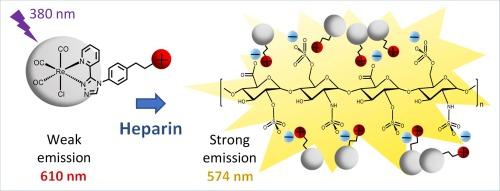
Phosphorescent tricarbonylrhenium(I) complexes that are more emissive in the aggregate state than in solution could be very valuable probes for biological analyses, but their development is delicate. The present work focuses on the synthesis and spectroscopic study of three new complexes that differ by the nature of their positively charged substituent. The dissolved complexes were very weakly emissive. Due to electrostatic interaction and aggregation, they showed a strong aggregation-induced phosphorescence enhancement (AIPE) effect in the presence of heparin, a polyanionic macromolecule of biological interest, and a weaker effect in the presence of chondroitin sulfate, which contains fewer negative charges. The magnitude of the AIPE effect depended on the nature and number of the cationic groups borne by the complex. However, it was weaker than expected from the behavior of the parent neutral complex studied in a conventional acetonitrile/water system, which highlights the challenge of accurately predicting solid-state emission properties for this class of molecules. This work introduces rhenium(I) complexes in the field of AIPE-active probes for the detection of polyanionic biomolecules.
期刊介绍:
Spectrochimica Acta, Part A: Molecular and Biomolecular Spectroscopy (SAA) is an interdisciplinary journal which spans from basic to applied aspects of optical spectroscopy in chemistry, medicine, biology, and materials science.
The journal publishes original scientific papers that feature high-quality spectroscopic data and analysis. From the broad range of optical spectroscopies, the emphasis is on electronic, vibrational or rotational spectra of molecules, rather than on spectroscopy based on magnetic moments.
Criteria for publication in SAA are novelty, uniqueness, and outstanding quality. Routine applications of spectroscopic techniques and computational methods are not appropriate.
Topics of particular interest of Spectrochimica Acta Part A include, but are not limited to:
Spectroscopy and dynamics of bioanalytical, biomedical, environmental, and atmospheric sciences,
Novel experimental techniques or instrumentation for molecular spectroscopy,
Novel theoretical and computational methods,
Novel applications in photochemistry and photobiology,
Novel interpretational approaches as well as advances in data analysis based on electronic or vibrational spectroscopy.




 京公网安备 11010802042870号
京ICP备2023020795号-1
京公网安备 11010802042870号
京ICP备2023020795号-1

 分享
分享
 求助内容:
求助内容: 应助结果提醒方式:
 扫码关注我们
