{"title":"混合动力有机朗肯蒸汽压缩系统的热力学和涡轮力学分析","authors":"Bennett Platt, Derek Young, Todd Bandhauer","doi":"10.1016/j.apenergy.2025.125554","DOIUrl":null,"url":null,"abstract":"<div><div>Thermally activated chillers, like absorption and organic Rankine vapor compression (ORVC) systems, are solutions to improve efficiency and meet decarbonization goals in the heating, ventilation, and air-conditioning (HVAC) industry. However, technical limitations prevent these chillers from providing steady cooling power under variable operating parameters. This work evaluated an electrified ORVC system that can address the limitations of thermally activated chillers, by utilizing both thermal and electric input. Three different configurations (one with parallel compressors and two with series compressors) were evaluated using coupled thermodynamic and turbomachinery analysis. The highest performing configuration (series with the thermal compressor first) was simulated at 175 kW scale under industry standard operating conditions, and across a range of parameter studies to characterize off design performance. Simulation results indicated efficient performance, with compression load being shifted between the thermally and electrically driven compressors. With the compression load balanced, the thermal COP was 0.69 and the electric COP was 10.1 at design conditions. Simulations showed a wide operating range, with acceptable heat input ranging from 100 kW – 327 kW in hybrid operation, in addition to purely electric or thermal operation. Parametric results also indicated large operating ranges for heat supply inlet temperature (85 °C – 117 °C), chilled water delivery temperature (2.1 °C – 10.7 °C), and heat rejection inlet temperature (26.6 °C – 30.9 °C). Turbomachinery analysis indicated a mismatch between the thermal and electric devices, which impacted the performance of the system. Simulations with a properly sized electric device increased the capacity to 268.3 kW, highlighting the importance of turbomachinery analysis for this technology.</div></div>","PeriodicalId":246,"journal":{"name":"Applied Energy","volume":"387 ","pages":"Article 125554"},"PeriodicalIF":11.0000,"publicationDate":"2025-06-01","publicationTypes":"Journal Article","fieldsOfStudy":null,"isOpenAccess":false,"openAccessPdf":"","citationCount":"0","resultStr":"{\"title\":\"Thermodynamic and turbomachinery analysis of a hybrid electric organic Rankine vapor compression system\",\"authors\":\"Bennett Platt, Derek Young, Todd Bandhauer\",\"doi\":\"10.1016/j.apenergy.2025.125554\",\"DOIUrl\":null,\"url\":null,\"abstract\":\"<div><div>Thermally activated chillers, like absorption and organic Rankine vapor compression (ORVC) systems, are solutions to improve efficiency and meet decarbonization goals in the heating, ventilation, and air-conditioning (HVAC) industry. However, technical limitations prevent these chillers from providing steady cooling power under variable operating parameters. This work evaluated an electrified ORVC system that can address the limitations of thermally activated chillers, by utilizing both thermal and electric input. Three different configurations (one with parallel compressors and two with series compressors) were evaluated using coupled thermodynamic and turbomachinery analysis. The highest performing configuration (series with the thermal compressor first) was simulated at 175 kW scale under industry standard operating conditions, and across a range of parameter studies to characterize off design performance. Simulation results indicated efficient performance, with compression load being shifted between the thermally and electrically driven compressors. With the compression load balanced, the thermal COP was 0.69 and the electric COP was 10.1 at design conditions. Simulations showed a wide operating range, with acceptable heat input ranging from 100 kW – 327 kW in hybrid operation, in addition to purely electric or thermal operation. Parametric results also indicated large operating ranges for heat supply inlet temperature (85 °C – 117 °C), chilled water delivery temperature (2.1 °C – 10.7 °C), and heat rejection inlet temperature (26.6 °C – 30.9 °C). Turbomachinery analysis indicated a mismatch between the thermal and electric devices, which impacted the performance of the system. Simulations with a properly sized electric device increased the capacity to 268.3 kW, highlighting the importance of turbomachinery analysis for this technology.</div></div>\",\"PeriodicalId\":246,\"journal\":{\"name\":\"Applied Energy\",\"volume\":\"387 \",\"pages\":\"Article 125554\"},\"PeriodicalIF\":11.0000,\"publicationDate\":\"2025-06-01\",\"publicationTypes\":\"Journal Article\",\"fieldsOfStudy\":null,\"isOpenAccess\":false,\"openAccessPdf\":\"\",\"citationCount\":\"0\",\"resultStr\":null,\"platform\":\"Semanticscholar\",\"paperid\":null,\"PeriodicalName\":\"Applied Energy\",\"FirstCategoryId\":\"5\",\"ListUrlMain\":\"https://www.sciencedirect.com/science/article/pii/S0306261925002843\",\"RegionNum\":1,\"RegionCategory\":\"工程技术\",\"ArticlePicture\":[],\"TitleCN\":null,\"AbstractTextCN\":null,\"PMCID\":null,\"EPubDate\":\"2025/3/3 0:00:00\",\"PubModel\":\"Epub\",\"JCR\":\"Q1\",\"JCRName\":\"ENERGY & FUELS\",\"Score\":null,\"Total\":0}","platform":"Semanticscholar","paperid":null,"PeriodicalName":"Applied Energy","FirstCategoryId":"5","ListUrlMain":"https://www.sciencedirect.com/science/article/pii/S0306261925002843","RegionNum":1,"RegionCategory":"工程技术","ArticlePicture":[],"TitleCN":null,"AbstractTextCN":null,"PMCID":null,"EPubDate":"2025/3/3 0:00:00","PubModel":"Epub","JCR":"Q1","JCRName":"ENERGY & FUELS","Score":null,"Total":0}
Thermodynamic and turbomachinery analysis of a hybrid electric organic Rankine vapor compression system
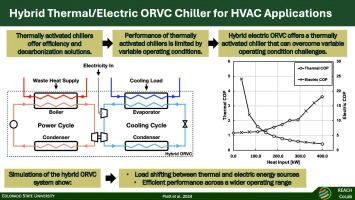
Thermally activated chillers, like absorption and organic Rankine vapor compression (ORVC) systems, are solutions to improve efficiency and meet decarbonization goals in the heating, ventilation, and air-conditioning (HVAC) industry. However, technical limitations prevent these chillers from providing steady cooling power under variable operating parameters. This work evaluated an electrified ORVC system that can address the limitations of thermally activated chillers, by utilizing both thermal and electric input. Three different configurations (one with parallel compressors and two with series compressors) were evaluated using coupled thermodynamic and turbomachinery analysis. The highest performing configuration (series with the thermal compressor first) was simulated at 175 kW scale under industry standard operating conditions, and across a range of parameter studies to characterize off design performance. Simulation results indicated efficient performance, with compression load being shifted between the thermally and electrically driven compressors. With the compression load balanced, the thermal COP was 0.69 and the electric COP was 10.1 at design conditions. Simulations showed a wide operating range, with acceptable heat input ranging from 100 kW – 327 kW in hybrid operation, in addition to purely electric or thermal operation. Parametric results also indicated large operating ranges for heat supply inlet temperature (85 °C – 117 °C), chilled water delivery temperature (2.1 °C – 10.7 °C), and heat rejection inlet temperature (26.6 °C – 30.9 °C). Turbomachinery analysis indicated a mismatch between the thermal and electric devices, which impacted the performance of the system. Simulations with a properly sized electric device increased the capacity to 268.3 kW, highlighting the importance of turbomachinery analysis for this technology.
期刊介绍:
Applied Energy serves as a platform for sharing innovations, research, development, and demonstrations in energy conversion, conservation, and sustainable energy systems. The journal covers topics such as optimal energy resource use, environmental pollutant mitigation, and energy process analysis. It welcomes original papers, review articles, technical notes, and letters to the editor. Authors are encouraged to submit manuscripts that bridge the gap between research, development, and implementation. The journal addresses a wide spectrum of topics, including fossil and renewable energy technologies, energy economics, and environmental impacts. Applied Energy also explores modeling and forecasting, conservation strategies, and the social and economic implications of energy policies, including climate change mitigation. It is complemented by the open-access journal Advances in Applied Energy.




 京公网安备 11010802042870号
京ICP备2023020795号-1
京公网安备 11010802042870号
京ICP备2023020795号-1

 分享
分享
 求助内容:
求助内容: 应助结果提醒方式:
 扫码关注我们
