Yiming Huo , Renata Ristic , Maxime Savoie , Richard Muhlack , Markus Herderich , Kerry Wilkinson
{"title":"用于去除酒中烟味化合物的分子印迹聚合物的吸附特性","authors":"Yiming Huo , Renata Ristic , Maxime Savoie , Richard Muhlack , Markus Herderich , Kerry Wilkinson","doi":"10.1016/j.foodres.2025.116048","DOIUrl":null,"url":null,"abstract":"<div><div>The presence of elevated concentrations of smoke-derived volatile phenols (and their glycoconjugates) in wine after grapevine exposure to wildfire smoke can give wine unpleasant smoky and ashy characters. To date, options for remediation of ‘smoke taint’ are limited, therefore, this study evaluated the potential for a commercially developed molecularly imprinted polymer (MIP) to remove smoke taint compounds from wine. A single-solute adsorption study was conducted in model wine and demonstrated adsorption of guaiacol, phenol and <em>m</em>-cresol by a diverse range of binding sites on the MIP surface. The adsorption capacity of the MIP towards guaiacol was estimated to be 1.2 μmol/g, with a higher capacity and affinity estimated for <em>m</em>-cresol (being 1.7 μmol/g). When a fixed-bed column packed with MIPs was used to treat smoke tainted Chardonnay, rosé and Cabernet Sauvignon wines the MIP column removed up to 47 % of the volatile phenols present in wine (but not volatile phenol glycoconjugates), with no detrimental effect on wine colour density and phenolic composition. Experiments evaluating column break-through and the reusability of MIPs were also performed to further establish the application potential of MIPs for remediation of smoke taint in wine.</div></div>","PeriodicalId":323,"journal":{"name":"Food Research International","volume":"206 ","pages":"Article 116048"},"PeriodicalIF":8.0000,"publicationDate":"2025-04-01","publicationTypes":"Journal Article","fieldsOfStudy":null,"isOpenAccess":false,"openAccessPdf":"","citationCount":"0","resultStr":"{\"title\":\"Adsorption properties of molecularly imprinted polymers designed for removal of smoke taint compounds from wine\",\"authors\":\"Yiming Huo , Renata Ristic , Maxime Savoie , Richard Muhlack , Markus Herderich , Kerry Wilkinson\",\"doi\":\"10.1016/j.foodres.2025.116048\",\"DOIUrl\":null,\"url\":null,\"abstract\":\"<div><div>The presence of elevated concentrations of smoke-derived volatile phenols (and their glycoconjugates) in wine after grapevine exposure to wildfire smoke can give wine unpleasant smoky and ashy characters. To date, options for remediation of ‘smoke taint’ are limited, therefore, this study evaluated the potential for a commercially developed molecularly imprinted polymer (MIP) to remove smoke taint compounds from wine. A single-solute adsorption study was conducted in model wine and demonstrated adsorption of guaiacol, phenol and <em>m</em>-cresol by a diverse range of binding sites on the MIP surface. The adsorption capacity of the MIP towards guaiacol was estimated to be 1.2 μmol/g, with a higher capacity and affinity estimated for <em>m</em>-cresol (being 1.7 μmol/g). When a fixed-bed column packed with MIPs was used to treat smoke tainted Chardonnay, rosé and Cabernet Sauvignon wines the MIP column removed up to 47 % of the volatile phenols present in wine (but not volatile phenol glycoconjugates), with no detrimental effect on wine colour density and phenolic composition. Experiments evaluating column break-through and the reusability of MIPs were also performed to further establish the application potential of MIPs for remediation of smoke taint in wine.</div></div>\",\"PeriodicalId\":323,\"journal\":{\"name\":\"Food Research International\",\"volume\":\"206 \",\"pages\":\"Article 116048\"},\"PeriodicalIF\":8.0000,\"publicationDate\":\"2025-04-01\",\"publicationTypes\":\"Journal Article\",\"fieldsOfStudy\":null,\"isOpenAccess\":false,\"openAccessPdf\":\"\",\"citationCount\":\"0\",\"resultStr\":null,\"platform\":\"Semanticscholar\",\"paperid\":null,\"PeriodicalName\":\"Food Research International\",\"FirstCategoryId\":\"97\",\"ListUrlMain\":\"https://www.sciencedirect.com/science/article/pii/S0963996925003850\",\"RegionNum\":1,\"RegionCategory\":\"农林科学\",\"ArticlePicture\":[],\"TitleCN\":null,\"AbstractTextCN\":null,\"PMCID\":null,\"EPubDate\":\"2025/2/23 0:00:00\",\"PubModel\":\"Epub\",\"JCR\":\"Q1\",\"JCRName\":\"FOOD SCIENCE & TECHNOLOGY\",\"Score\":null,\"Total\":0}","platform":"Semanticscholar","paperid":null,"PeriodicalName":"Food Research International","FirstCategoryId":"97","ListUrlMain":"https://www.sciencedirect.com/science/article/pii/S0963996925003850","RegionNum":1,"RegionCategory":"农林科学","ArticlePicture":[],"TitleCN":null,"AbstractTextCN":null,"PMCID":null,"EPubDate":"2025/2/23 0:00:00","PubModel":"Epub","JCR":"Q1","JCRName":"FOOD SCIENCE & TECHNOLOGY","Score":null,"Total":0}
Adsorption properties of molecularly imprinted polymers designed for removal of smoke taint compounds from wine
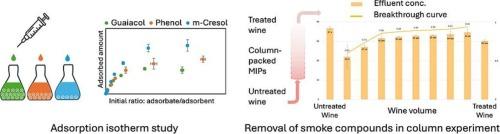
The presence of elevated concentrations of smoke-derived volatile phenols (and their glycoconjugates) in wine after grapevine exposure to wildfire smoke can give wine unpleasant smoky and ashy characters. To date, options for remediation of ‘smoke taint’ are limited, therefore, this study evaluated the potential for a commercially developed molecularly imprinted polymer (MIP) to remove smoke taint compounds from wine. A single-solute adsorption study was conducted in model wine and demonstrated adsorption of guaiacol, phenol and m-cresol by a diverse range of binding sites on the MIP surface. The adsorption capacity of the MIP towards guaiacol was estimated to be 1.2 μmol/g, with a higher capacity and affinity estimated for m-cresol (being 1.7 μmol/g). When a fixed-bed column packed with MIPs was used to treat smoke tainted Chardonnay, rosé and Cabernet Sauvignon wines the MIP column removed up to 47 % of the volatile phenols present in wine (but not volatile phenol glycoconjugates), with no detrimental effect on wine colour density and phenolic composition. Experiments evaluating column break-through and the reusability of MIPs were also performed to further establish the application potential of MIPs for remediation of smoke taint in wine.
期刊介绍:
Food Research International serves as a rapid dissemination platform for significant and impactful research in food science, technology, engineering, and nutrition. The journal focuses on publishing novel, high-quality, and high-impact review papers, original research papers, and letters to the editors across various disciplines in the science and technology of food. Additionally, it follows a policy of publishing special issues on topical and emergent subjects in food research or related areas. Selected, peer-reviewed papers from scientific meetings, workshops, and conferences on the science, technology, and engineering of foods are also featured in special issues.




 京公网安备 11010802042870号
京ICP备2023020795号-1
京公网安备 11010802042870号
京ICP备2023020795号-1

 分享
分享
 求助内容:
求助内容: 应助结果提醒方式:
 扫码关注我们
