Yanan Shi , Zhiming Li , Shaojie Lu , Puxuan Zhao , Xin Wang , Fei Jia , Hao Chang
{"title":"用于长期治疗特应性皮炎的甲氨蝶呤持续给药的微球集成水凝胶微针贴片","authors":"Yanan Shi , Zhiming Li , Shaojie Lu , Puxuan Zhao , Xin Wang , Fei Jia , Hao Chang","doi":"10.1016/j.eurpolymj.2025.113877","DOIUrl":null,"url":null,"abstract":"<div><div>Atopic dermatitis (AD) is a chronic inflammatory skin condition requiring long-term management. Methotrexate (MTX) is an effective treatment for moderate-to-severe AD, but traditional administration methods suffer from low bioavailability, frequent dosing, and side effects. This study presents a microsphere-integrated hydrogel microneedle (MP-HMN) patch for localized and sustained MTX delivery. Fabricated using a two-casting micromolding, this patch consisting of microneedle arrays made from MTX-loaded poly (lactic-co-glycolic acid) microspheres and photo-crosslinked gelatin methacryloyl (GelMA), supported by a hyaluronic acid (HA) backing. The integration of microspheres enhances mechanical strength of microneedles, while crosslinked GelMA minimizes the burst release of MTX. The MP-HMNs penetrates the skin easily and separates from the HA backing as the HA rapidly dissolves on contact with skin interstitial fluid. The implanted MP-HMNs degrades gradually within the skin, allowing for a 12-day release of MTX. In an AD mouse model, this patch demonstrated superior therapeutic efficacy and reduced dosing frequency, compared to oral and subcutaneous MTX administration, offering a promising strategy for long-term management of AD and other chronic skin diseases.</div></div>","PeriodicalId":315,"journal":{"name":"European Polymer Journal","volume":"229 ","pages":"Article 113877"},"PeriodicalIF":6.3000,"publicationDate":"2025-04-16","publicationTypes":"Journal Article","fieldsOfStudy":null,"isOpenAccess":false,"openAccessPdf":"","citationCount":"0","resultStr":"{\"title\":\"Microsphere-integrated hydrogel microneedle patch for sustained methotrexate delivery in the long-term management of atopic dermatitis\",\"authors\":\"Yanan Shi , Zhiming Li , Shaojie Lu , Puxuan Zhao , Xin Wang , Fei Jia , Hao Chang\",\"doi\":\"10.1016/j.eurpolymj.2025.113877\",\"DOIUrl\":null,\"url\":null,\"abstract\":\"<div><div>Atopic dermatitis (AD) is a chronic inflammatory skin condition requiring long-term management. Methotrexate (MTX) is an effective treatment for moderate-to-severe AD, but traditional administration methods suffer from low bioavailability, frequent dosing, and side effects. This study presents a microsphere-integrated hydrogel microneedle (MP-HMN) patch for localized and sustained MTX delivery. Fabricated using a two-casting micromolding, this patch consisting of microneedle arrays made from MTX-loaded poly (lactic-co-glycolic acid) microspheres and photo-crosslinked gelatin methacryloyl (GelMA), supported by a hyaluronic acid (HA) backing. The integration of microspheres enhances mechanical strength of microneedles, while crosslinked GelMA minimizes the burst release of MTX. The MP-HMNs penetrates the skin easily and separates from the HA backing as the HA rapidly dissolves on contact with skin interstitial fluid. The implanted MP-HMNs degrades gradually within the skin, allowing for a 12-day release of MTX. In an AD mouse model, this patch demonstrated superior therapeutic efficacy and reduced dosing frequency, compared to oral and subcutaneous MTX administration, offering a promising strategy for long-term management of AD and other chronic skin diseases.</div></div>\",\"PeriodicalId\":315,\"journal\":{\"name\":\"European Polymer Journal\",\"volume\":\"229 \",\"pages\":\"Article 113877\"},\"PeriodicalIF\":6.3000,\"publicationDate\":\"2025-04-16\",\"publicationTypes\":\"Journal Article\",\"fieldsOfStudy\":null,\"isOpenAccess\":false,\"openAccessPdf\":\"\",\"citationCount\":\"0\",\"resultStr\":null,\"platform\":\"Semanticscholar\",\"paperid\":null,\"PeriodicalName\":\"European Polymer Journal\",\"FirstCategoryId\":\"92\",\"ListUrlMain\":\"https://www.sciencedirect.com/science/article/pii/S001430572500165X\",\"RegionNum\":2,\"RegionCategory\":\"化学\",\"ArticlePicture\":[],\"TitleCN\":null,\"AbstractTextCN\":null,\"PMCID\":null,\"EPubDate\":\"2025/2/28 0:00:00\",\"PubModel\":\"Epub\",\"JCR\":\"Q1\",\"JCRName\":\"POLYMER SCIENCE\",\"Score\":null,\"Total\":0}","platform":"Semanticscholar","paperid":null,"PeriodicalName":"European Polymer Journal","FirstCategoryId":"92","ListUrlMain":"https://www.sciencedirect.com/science/article/pii/S001430572500165X","RegionNum":2,"RegionCategory":"化学","ArticlePicture":[],"TitleCN":null,"AbstractTextCN":null,"PMCID":null,"EPubDate":"2025/2/28 0:00:00","PubModel":"Epub","JCR":"Q1","JCRName":"POLYMER SCIENCE","Score":null,"Total":0}
Microsphere-integrated hydrogel microneedle patch for sustained methotrexate delivery in the long-term management of atopic dermatitis
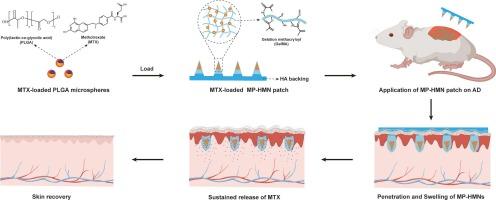
Atopic dermatitis (AD) is a chronic inflammatory skin condition requiring long-term management. Methotrexate (MTX) is an effective treatment for moderate-to-severe AD, but traditional administration methods suffer from low bioavailability, frequent dosing, and side effects. This study presents a microsphere-integrated hydrogel microneedle (MP-HMN) patch for localized and sustained MTX delivery. Fabricated using a two-casting micromolding, this patch consisting of microneedle arrays made from MTX-loaded poly (lactic-co-glycolic acid) microspheres and photo-crosslinked gelatin methacryloyl (GelMA), supported by a hyaluronic acid (HA) backing. The integration of microspheres enhances mechanical strength of microneedles, while crosslinked GelMA minimizes the burst release of MTX. The MP-HMNs penetrates the skin easily and separates from the HA backing as the HA rapidly dissolves on contact with skin interstitial fluid. The implanted MP-HMNs degrades gradually within the skin, allowing for a 12-day release of MTX. In an AD mouse model, this patch demonstrated superior therapeutic efficacy and reduced dosing frequency, compared to oral and subcutaneous MTX administration, offering a promising strategy for long-term management of AD and other chronic skin diseases.
期刊介绍:
European Polymer Journal is dedicated to publishing work on fundamental and applied polymer chemistry and macromolecular materials. The journal covers all aspects of polymer synthesis, including polymerization mechanisms and chemical functional transformations, with a focus on novel polymers and the relationships between molecular structure and polymer properties. In addition, we welcome submissions on bio-based or renewable polymers, stimuli-responsive systems and polymer bio-hybrids. European Polymer Journal also publishes research on the biomedical application of polymers, including drug delivery and regenerative medicine. The main scope is covered but not limited to the following core research areas:
Polymer synthesis and functionalization
• Novel synthetic routes for polymerization, functional modification, controlled/living polymerization and precision polymers.
Stimuli-responsive polymers
• Including shape memory and self-healing polymers.
Supramolecular polymers and self-assembly
• Molecular recognition and higher order polymer structures.
Renewable and sustainable polymers
• Bio-based, biodegradable and anti-microbial polymers and polymeric bio-nanocomposites.
Polymers at interfaces and surfaces
• Chemistry and engineering of surfaces with biological relevance, including patterning, antifouling polymers and polymers for membrane applications.
Biomedical applications and nanomedicine
• Polymers for regenerative medicine, drug delivery molecular release and gene therapy
The scope of European Polymer Journal no longer includes Polymer Physics.




 京公网安备 11010802042870号
京ICP备2023020795号-1
京公网安备 11010802042870号
京ICP备2023020795号-1

 分享
分享
 求助内容:
求助内容: 应助结果提醒方式:
 扫码关注我们
