{"title":"整合消融前和消融后b型利钠肽,识别持续性房颤长期不良事件和心律失常复发的高危人群。","authors":"Hironori Ishiguchi, Yasuhiro Yoshiga, Masakazu Fukuda, Shohei Fujii, Masahiro Hisaoka, Shintaro Hashimoto, Takuya Omuro, Noriko Fukue, Shigeki Kobayashi, Motoaki Sano","doi":"10.1136/openhrt-2025-003251","DOIUrl":null,"url":null,"abstract":"<p><strong>Background: </strong>Pre-procedural and post-procedural plasma B-type natriuretic peptide (BNP) levels can predict rhythm outcomes after catheter ablation for atrial fibrillation (AF). However, the significance of long-term events remains unclear. Therefore, this study aimed to investigate the significance of integrating pre-ablation and post-ablation BNP levels on major adverse cardiovascular events (MACE) and arrhythmic recurrence in patients with persistent AF undergoing catheter ablation.</p><p><strong>Methods: </strong>We analysed 392 patients who underwent first catheter ablation. Patients were stratified into four subgroups based on pre-ablation plasma BNP level and its relative change after ablation (ΔBNP) using their respective median values (pre-ablation BNP: 148.0 pg/mL, ΔBNP: -52.6%): Low-Low (pre-ablation<148.0 pg/mL, ΔBNP<-52.6%), Low-High (pre-ablation<148.0 pg/mL, ΔBNP≥-52.6%), High-Low (pre-ablation≥148.0 pg/mL, ΔBNP<-52.6%) and High-High (pre-ablation≥148.0 pg/mL, ΔBNP≥-52.6%). The primary endpoint was MACE, which included all-cause death, heart failure hospitalisation and other cardiovascular hospitalisations. The secondary endpoint involved arrhythmic recurrence.</p><p><strong>Results: </strong>Of the 392 patients, 101 were classified as Low-Low, 91 as Low-High, 97 as High-Low and 103 as High-High. During a median follow-up of 5.3 (IQR: 3.2-7.2) years, 63 patients (16%) experienced MACE. Heart failure hospitalisation accounted for the majority of events (63%). The High-High subgroup showed significantly higher MACE rates than others (cumulative incidence (95% CI): 26.3% (16.2% to 35.2%), p<0.001). Low-High and High-High subgroups demonstrated a higher arrhythmic recurrence (p<0.001). After multivariate adjustment, the High-Low and High-High subgroups demonstrated progressively higher risks of MACE incidence compared with the Low-Low and Low-High subgroups. Both Low-High and High-High subgroups showed an elevated arrhythmic recurrence risk (both p<0.001).</p><p><strong>Conclusions: </strong>Integrating pre-ablation and post-ablation BNP levels can be useful for identifying patients with persistent AF at high risk of MACE and arrhythmic recurrence during long-term follow-up.</p>","PeriodicalId":19505,"journal":{"name":"Open Heart","volume":"12 1","pages":""},"PeriodicalIF":2.8000,"publicationDate":"2025-02-27","publicationTypes":"Journal Article","fieldsOfStudy":null,"isOpenAccess":false,"openAccessPdf":"https://www.ncbi.nlm.nih.gov/pmc/articles/PMC11873341/pdf/","citationCount":"0","resultStr":"{\"title\":\"Integrating pre-ablation and post-ablation B-type natriuretic peptide to identify high-risk population for long-term adverse events and arrhythmic recurrence in persistent atrial fibrillation.\",\"authors\":\"Hironori Ishiguchi, Yasuhiro Yoshiga, Masakazu Fukuda, Shohei Fujii, Masahiro Hisaoka, Shintaro Hashimoto, Takuya Omuro, Noriko Fukue, Shigeki Kobayashi, Motoaki Sano\",\"doi\":\"10.1136/openhrt-2025-003251\",\"DOIUrl\":null,\"url\":null,\"abstract\":\"<p><strong>Background: </strong>Pre-procedural and post-procedural plasma B-type natriuretic peptide (BNP) levels can predict rhythm outcomes after catheter ablation for atrial fibrillation (AF). However, the significance of long-term events remains unclear. Therefore, this study aimed to investigate the significance of integrating pre-ablation and post-ablation BNP levels on major adverse cardiovascular events (MACE) and arrhythmic recurrence in patients with persistent AF undergoing catheter ablation.</p><p><strong>Methods: </strong>We analysed 392 patients who underwent first catheter ablation. Patients were stratified into four subgroups based on pre-ablation plasma BNP level and its relative change after ablation (ΔBNP) using their respective median values (pre-ablation BNP: 148.0 pg/mL, ΔBNP: -52.6%): Low-Low (pre-ablation<148.0 pg/mL, ΔBNP<-52.6%), Low-High (pre-ablation<148.0 pg/mL, ΔBNP≥-52.6%), High-Low (pre-ablation≥148.0 pg/mL, ΔBNP<-52.6%) and High-High (pre-ablation≥148.0 pg/mL, ΔBNP≥-52.6%). The primary endpoint was MACE, which included all-cause death, heart failure hospitalisation and other cardiovascular hospitalisations. The secondary endpoint involved arrhythmic recurrence.</p><p><strong>Results: </strong>Of the 392 patients, 101 were classified as Low-Low, 91 as Low-High, 97 as High-Low and 103 as High-High. During a median follow-up of 5.3 (IQR: 3.2-7.2) years, 63 patients (16%) experienced MACE. Heart failure hospitalisation accounted for the majority of events (63%). The High-High subgroup showed significantly higher MACE rates than others (cumulative incidence (95% CI): 26.3% (16.2% to 35.2%), p<0.001). Low-High and High-High subgroups demonstrated a higher arrhythmic recurrence (p<0.001). After multivariate adjustment, the High-Low and High-High subgroups demonstrated progressively higher risks of MACE incidence compared with the Low-Low and Low-High subgroups. Both Low-High and High-High subgroups showed an elevated arrhythmic recurrence risk (both p<0.001).</p><p><strong>Conclusions: </strong>Integrating pre-ablation and post-ablation BNP levels can be useful for identifying patients with persistent AF at high risk of MACE and arrhythmic recurrence during long-term follow-up.</p>\",\"PeriodicalId\":19505,\"journal\":{\"name\":\"Open Heart\",\"volume\":\"12 1\",\"pages\":\"\"},\"PeriodicalIF\":2.8000,\"publicationDate\":\"2025-02-27\",\"publicationTypes\":\"Journal Article\",\"fieldsOfStudy\":null,\"isOpenAccess\":false,\"openAccessPdf\":\"https://www.ncbi.nlm.nih.gov/pmc/articles/PMC11873341/pdf/\",\"citationCount\":\"0\",\"resultStr\":null,\"platform\":\"Semanticscholar\",\"paperid\":null,\"PeriodicalName\":\"Open Heart\",\"FirstCategoryId\":\"1085\",\"ListUrlMain\":\"https://doi.org/10.1136/openhrt-2025-003251\",\"RegionNum\":0,\"RegionCategory\":null,\"ArticlePicture\":[],\"TitleCN\":null,\"AbstractTextCN\":null,\"PMCID\":null,\"EPubDate\":\"\",\"PubModel\":\"\",\"JCR\":\"Q2\",\"JCRName\":\"CARDIAC & CARDIOVASCULAR SYSTEMS\",\"Score\":null,\"Total\":0}","platform":"Semanticscholar","paperid":null,"PeriodicalName":"Open Heart","FirstCategoryId":"1085","ListUrlMain":"https://doi.org/10.1136/openhrt-2025-003251","RegionNum":0,"RegionCategory":null,"ArticlePicture":[],"TitleCN":null,"AbstractTextCN":null,"PMCID":null,"EPubDate":"","PubModel":"","JCR":"Q2","JCRName":"CARDIAC & CARDIOVASCULAR SYSTEMS","Score":null,"Total":0}
Integrating pre-ablation and post-ablation B-type natriuretic peptide to identify high-risk population for long-term adverse events and arrhythmic recurrence in persistent atrial fibrillation.
Background: Pre-procedural and post-procedural plasma B-type natriuretic peptide (BNP) levels can predict rhythm outcomes after catheter ablation for atrial fibrillation (AF). However, the significance of long-term events remains unclear. Therefore, this study aimed to investigate the significance of integrating pre-ablation and post-ablation BNP levels on major adverse cardiovascular events (MACE) and arrhythmic recurrence in patients with persistent AF undergoing catheter ablation.
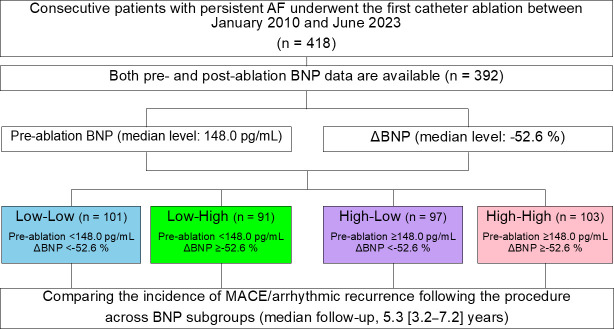
Methods: We analysed 392 patients who underwent first catheter ablation. Patients were stratified into four subgroups based on pre-ablation plasma BNP level and its relative change after ablation (ΔBNP) using their respective median values (pre-ablation BNP: 148.0 pg/mL, ΔBNP: -52.6%): Low-Low (pre-ablation<148.0 pg/mL, ΔBNP<-52.6%), Low-High (pre-ablation<148.0 pg/mL, ΔBNP≥-52.6%), High-Low (pre-ablation≥148.0 pg/mL, ΔBNP<-52.6%) and High-High (pre-ablation≥148.0 pg/mL, ΔBNP≥-52.6%). The primary endpoint was MACE, which included all-cause death, heart failure hospitalisation and other cardiovascular hospitalisations. The secondary endpoint involved arrhythmic recurrence.
Results: Of the 392 patients, 101 were classified as Low-Low, 91 as Low-High, 97 as High-Low and 103 as High-High. During a median follow-up of 5.3 (IQR: 3.2-7.2) years, 63 patients (16%) experienced MACE. Heart failure hospitalisation accounted for the majority of events (63%). The High-High subgroup showed significantly higher MACE rates than others (cumulative incidence (95% CI): 26.3% (16.2% to 35.2%), p<0.001). Low-High and High-High subgroups demonstrated a higher arrhythmic recurrence (p<0.001). After multivariate adjustment, the High-Low and High-High subgroups demonstrated progressively higher risks of MACE incidence compared with the Low-Low and Low-High subgroups. Both Low-High and High-High subgroups showed an elevated arrhythmic recurrence risk (both p<0.001).
Conclusions: Integrating pre-ablation and post-ablation BNP levels can be useful for identifying patients with persistent AF at high risk of MACE and arrhythmic recurrence during long-term follow-up.
期刊介绍:
Open Heart is an online-only, open access cardiology journal that aims to be “open” in many ways: open access (free access for all readers), open peer review (unblinded peer review) and open data (data sharing is encouraged). The goal is to ensure maximum transparency and maximum impact on research progress and patient care. The journal is dedicated to publishing high quality, peer reviewed medical research in all disciplines and therapeutic areas of cardiovascular medicine. Research is published across all study phases and designs, from study protocols to phase I trials to meta-analyses, including small or specialist studies. Opinionated discussions on controversial topics are welcomed. Open Heart aims to operate a fast submission and review process with continuous publication online, to ensure timely, up-to-date research is available worldwide. The journal adheres to a rigorous and transparent peer review process, and all articles go through a statistical assessment to ensure robustness of the analyses. Open Heart is an official journal of the British Cardiovascular Society.







 京公网安备 11010802042870号
京ICP备2023020795号-1
京公网安备 11010802042870号
京ICP备2023020795号-1

 分享
分享
 求助内容:
求助内容: 应助结果提醒方式:
 扫码关注我们
