Xiao Xu, Xiang Wang, Yu-Pei Liao, Lijia Luo, Andre E. Nel
{"title":"通过脂质纳米颗粒递送STING激动剂和突变KRAS mRNA,重编程针对胰腺癌转移的耐受性免疫反应","authors":"Xiao Xu, Xiang Wang, Yu-Pei Liao, Lijia Luo, Andre E. Nel","doi":"10.1021/acsnano.4c14102","DOIUrl":null,"url":null,"abstract":"We demonstrate reprogramming of the tolerogenic immune environment in the liver for mounting an effective immune response against often-fatal pancreatic cancer metastases. This was achieved by engineering a lipid nanoparticle (LNP) to deliver mRNA encoding the KRAS G12D neoantigenic epitope along with cGAMP, a dinucleotide agonist of the stimulator of the interferon genes (STING) pathway, capable of activating a type I interferon response. cGAMP/mKRAS/LNP were synthesized by a microfluidics approach involving nanoprecipitation of mRNA and cGAMP by an ionizable lipid, MC3. Controls included nanoparticles delivering individual components or a wild-type RAS sequence. The dual delivery carrier successfully activated the type I interferon pathway <i>in vitro</i> as well as <i>in vivo</i>, with reprogramming of costimulatory receptor (CD80 and CD86) and MHC-I expression on liver antigen-presenting cells (APC). This allowed the generation of IFN-γ producing cytotoxic T cells, capable of mounting an effective immune response in the metastatic KRAS pancreatic cancer (KPC) mouse model. Noteworthy, intravenous injection of cGAMP/mKRAS/LNP suppressed metastatic growth significantly and prolonged animal survival, both prophylactically and during treatment of established metastases. The protective immune response was mediated by the generation of perforin-releasing CD8<sup>+</sup> cytotoxic T cells, engaged in pancreatic cancer cell killing. Importantly, the immune response could also be adoptively transferred by injecting splenocytes (containing memory T cells) from treated into nontreated recipient mice. This study demonstrates that reprogramming the immune-protective niche for metastatic pancreatic cancer can be achieved by the delivery of a STING agonist and mutant KRAS mRNA via ionizable LNPs, offering both prophylactic and therapeutic advantages.","PeriodicalId":21,"journal":{"name":"ACS Nano","volume":"67 1","pages":""},"PeriodicalIF":16.0000,"publicationDate":"2025-03-02","publicationTypes":"Journal Article","fieldsOfStudy":null,"isOpenAccess":false,"openAccessPdf":"","citationCount":"0","resultStr":"{\"title\":\"Reprogramming the Tolerogenic Immune Response Against Pancreatic Cancer Metastases by Lipid Nanoparticles Delivering a STING Agonist Plus Mutant KRAS mRNA\",\"authors\":\"Xiao Xu, Xiang Wang, Yu-Pei Liao, Lijia Luo, Andre E. Nel\",\"doi\":\"10.1021/acsnano.4c14102\",\"DOIUrl\":null,\"url\":null,\"abstract\":\"We demonstrate reprogramming of the tolerogenic immune environment in the liver for mounting an effective immune response against often-fatal pancreatic cancer metastases. This was achieved by engineering a lipid nanoparticle (LNP) to deliver mRNA encoding the KRAS G12D neoantigenic epitope along with cGAMP, a dinucleotide agonist of the stimulator of the interferon genes (STING) pathway, capable of activating a type I interferon response. cGAMP/mKRAS/LNP were synthesized by a microfluidics approach involving nanoprecipitation of mRNA and cGAMP by an ionizable lipid, MC3. Controls included nanoparticles delivering individual components or a wild-type RAS sequence. The dual delivery carrier successfully activated the type I interferon pathway <i>in vitro</i> as well as <i>in vivo</i>, with reprogramming of costimulatory receptor (CD80 and CD86) and MHC-I expression on liver antigen-presenting cells (APC). This allowed the generation of IFN-γ producing cytotoxic T cells, capable of mounting an effective immune response in the metastatic KRAS pancreatic cancer (KPC) mouse model. Noteworthy, intravenous injection of cGAMP/mKRAS/LNP suppressed metastatic growth significantly and prolonged animal survival, both prophylactically and during treatment of established metastases. The protective immune response was mediated by the generation of perforin-releasing CD8<sup>+</sup> cytotoxic T cells, engaged in pancreatic cancer cell killing. Importantly, the immune response could also be adoptively transferred by injecting splenocytes (containing memory T cells) from treated into nontreated recipient mice. This study demonstrates that reprogramming the immune-protective niche for metastatic pancreatic cancer can be achieved by the delivery of a STING agonist and mutant KRAS mRNA via ionizable LNPs, offering both prophylactic and therapeutic advantages.\",\"PeriodicalId\":21,\"journal\":{\"name\":\"ACS Nano\",\"volume\":\"67 1\",\"pages\":\"\"},\"PeriodicalIF\":16.0000,\"publicationDate\":\"2025-03-02\",\"publicationTypes\":\"Journal Article\",\"fieldsOfStudy\":null,\"isOpenAccess\":false,\"openAccessPdf\":\"\",\"citationCount\":\"0\",\"resultStr\":null,\"platform\":\"Semanticscholar\",\"paperid\":null,\"PeriodicalName\":\"ACS Nano\",\"FirstCategoryId\":\"88\",\"ListUrlMain\":\"https://doi.org/10.1021/acsnano.4c14102\",\"RegionNum\":1,\"RegionCategory\":\"材料科学\",\"ArticlePicture\":[],\"TitleCN\":null,\"AbstractTextCN\":null,\"PMCID\":null,\"EPubDate\":\"\",\"PubModel\":\"\",\"JCR\":\"Q1\",\"JCRName\":\"CHEMISTRY, MULTIDISCIPLINARY\",\"Score\":null,\"Total\":0}","platform":"Semanticscholar","paperid":null,"PeriodicalName":"ACS Nano","FirstCategoryId":"88","ListUrlMain":"https://doi.org/10.1021/acsnano.4c14102","RegionNum":1,"RegionCategory":"材料科学","ArticlePicture":[],"TitleCN":null,"AbstractTextCN":null,"PMCID":null,"EPubDate":"","PubModel":"","JCR":"Q1","JCRName":"CHEMISTRY, MULTIDISCIPLINARY","Score":null,"Total":0}
Reprogramming the Tolerogenic Immune Response Against Pancreatic Cancer Metastases by Lipid Nanoparticles Delivering a STING Agonist Plus Mutant KRAS mRNA
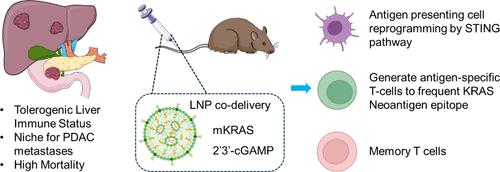
We demonstrate reprogramming of the tolerogenic immune environment in the liver for mounting an effective immune response against often-fatal pancreatic cancer metastases. This was achieved by engineering a lipid nanoparticle (LNP) to deliver mRNA encoding the KRAS G12D neoantigenic epitope along with cGAMP, a dinucleotide agonist of the stimulator of the interferon genes (STING) pathway, capable of activating a type I interferon response. cGAMP/mKRAS/LNP were synthesized by a microfluidics approach involving nanoprecipitation of mRNA and cGAMP by an ionizable lipid, MC3. Controls included nanoparticles delivering individual components or a wild-type RAS sequence. The dual delivery carrier successfully activated the type I interferon pathway in vitro as well as in vivo, with reprogramming of costimulatory receptor (CD80 and CD86) and MHC-I expression on liver antigen-presenting cells (APC). This allowed the generation of IFN-γ producing cytotoxic T cells, capable of mounting an effective immune response in the metastatic KRAS pancreatic cancer (KPC) mouse model. Noteworthy, intravenous injection of cGAMP/mKRAS/LNP suppressed metastatic growth significantly and prolonged animal survival, both prophylactically and during treatment of established metastases. The protective immune response was mediated by the generation of perforin-releasing CD8+ cytotoxic T cells, engaged in pancreatic cancer cell killing. Importantly, the immune response could also be adoptively transferred by injecting splenocytes (containing memory T cells) from treated into nontreated recipient mice. This study demonstrates that reprogramming the immune-protective niche for metastatic pancreatic cancer can be achieved by the delivery of a STING agonist and mutant KRAS mRNA via ionizable LNPs, offering both prophylactic and therapeutic advantages.
期刊介绍:
ACS Nano, published monthly, serves as an international forum for comprehensive articles on nanoscience and nanotechnology research at the intersections of chemistry, biology, materials science, physics, and engineering. The journal fosters communication among scientists in these communities, facilitating collaboration, new research opportunities, and advancements through discoveries. ACS Nano covers synthesis, assembly, characterization, theory, and simulation of nanostructures, nanobiotechnology, nanofabrication, methods and tools for nanoscience and nanotechnology, and self- and directed-assembly. Alongside original research articles, it offers thorough reviews, perspectives on cutting-edge research, and discussions envisioning the future of nanoscience and nanotechnology.




 京公网安备 11010802042870号
京ICP备2023020795号-1
京公网安备 11010802042870号
京ICP备2023020795号-1

 分享
分享
 求助内容:
求助内容: 应助结果提醒方式:
 扫码关注我们
