Qiying Yang, Changhui Sun, Lanju Sun, Hangning Liu, Linghao Su, Chuanli Ma, Jie Wang, Liangyu Gong and Zhenhua Yan
{"title":"同质铋掺杂剂调节氧化铈结构,通过双电子氧还原促进过氧化氢电合成","authors":"Qiying Yang, Changhui Sun, Lanju Sun, Hangning Liu, Linghao Su, Chuanli Ma, Jie Wang, Liangyu Gong and Zhenhua Yan","doi":"10.1039/D5QI00075K","DOIUrl":null,"url":null,"abstract":"<p >The electrochemical synthesis of hydrogen peroxide (H<small><sub>2</sub></small>O<small><sub>2</sub></small>) through the two-electron oxygen reduction reaction (2e-ORR) offers a promising alternative to the traditional anthraquinone process. However, this method often suffers from sluggish kinetics. In this study, we introduce a novel bismuth-doped cerium oxide (Bi-CeO<small><sub>2</sub></small>) composite, featuring hollow nanospheres and triangular nanoplate structures with highly dispersed Bi dopants on the CeO<small><sub>2</sub></small> matrix. Notably, the morphology of Bi-CeO<small><sub>2</sub></small> can be dynamically tuned between spheres and plates by adjusting the amounts of Bi dopants. This innovative 1%-Bi-CeO<small><sub>2</sub></small> catalyst exhibits an exceptional H<small><sub>2</sub></small>O<small><sub>2</sub></small> selectivity of 62.3% and significantly enhanced H<small><sub>2</sub></small>O<small><sub>2</sub></small> yield, reaching 1.16 mol g<small><sub>cat</sub></small><small><sup>−1</sup></small> h<small><sup>−1</sup></small> at 0.1 V with a high faradaic efficiency of 56.0%. Density functional theory (DFT) calculations reveal that Bi dopants effectively lower the free energy barrier for *OOH intermediate formation, thereby accelerating H<small><sub>2</sub></small>O<small><sub>2</sub></small> production. Additionally, when integrated into a dual-cathode system, 1%-Bi-CeO<small><sub>2</sub></small> demonstrates superior performance in removing organic dyes such as rhodamine B (RhB). This work offers a groundbreaking approach for designing high-efficiency heteroatom-doped catalysts for the 2e-ORR, paving the way for more effective electrochemical systems.</p>","PeriodicalId":79,"journal":{"name":"Inorganic Chemistry Frontiers","volume":" 9","pages":" 3384-3392"},"PeriodicalIF":6.4000,"publicationDate":"2025-03-03","publicationTypes":"Journal Article","fieldsOfStudy":null,"isOpenAccess":false,"openAccessPdf":"","citationCount":"0","resultStr":"{\"title\":\"Homogeneous bismuth dopants regulate cerium oxide structure to boost hydrogen peroxide electrosynthesis via two-electron oxygen reduction†\",\"authors\":\"Qiying Yang, Changhui Sun, Lanju Sun, Hangning Liu, Linghao Su, Chuanli Ma, Jie Wang, Liangyu Gong and Zhenhua Yan\",\"doi\":\"10.1039/D5QI00075K\",\"DOIUrl\":null,\"url\":null,\"abstract\":\"<p >The electrochemical synthesis of hydrogen peroxide (H<small><sub>2</sub></small>O<small><sub>2</sub></small>) through the two-electron oxygen reduction reaction (2e-ORR) offers a promising alternative to the traditional anthraquinone process. However, this method often suffers from sluggish kinetics. In this study, we introduce a novel bismuth-doped cerium oxide (Bi-CeO<small><sub>2</sub></small>) composite, featuring hollow nanospheres and triangular nanoplate structures with highly dispersed Bi dopants on the CeO<small><sub>2</sub></small> matrix. Notably, the morphology of Bi-CeO<small><sub>2</sub></small> can be dynamically tuned between spheres and plates by adjusting the amounts of Bi dopants. This innovative 1%-Bi-CeO<small><sub>2</sub></small> catalyst exhibits an exceptional H<small><sub>2</sub></small>O<small><sub>2</sub></small> selectivity of 62.3% and significantly enhanced H<small><sub>2</sub></small>O<small><sub>2</sub></small> yield, reaching 1.16 mol g<small><sub>cat</sub></small><small><sup>−1</sup></small> h<small><sup>−1</sup></small> at 0.1 V with a high faradaic efficiency of 56.0%. Density functional theory (DFT) calculations reveal that Bi dopants effectively lower the free energy barrier for *OOH intermediate formation, thereby accelerating H<small><sub>2</sub></small>O<small><sub>2</sub></small> production. Additionally, when integrated into a dual-cathode system, 1%-Bi-CeO<small><sub>2</sub></small> demonstrates superior performance in removing organic dyes such as rhodamine B (RhB). This work offers a groundbreaking approach for designing high-efficiency heteroatom-doped catalysts for the 2e-ORR, paving the way for more effective electrochemical systems.</p>\",\"PeriodicalId\":79,\"journal\":{\"name\":\"Inorganic Chemistry Frontiers\",\"volume\":\" 9\",\"pages\":\" 3384-3392\"},\"PeriodicalIF\":6.4000,\"publicationDate\":\"2025-03-03\",\"publicationTypes\":\"Journal Article\",\"fieldsOfStudy\":null,\"isOpenAccess\":false,\"openAccessPdf\":\"\",\"citationCount\":\"0\",\"resultStr\":null,\"platform\":\"Semanticscholar\",\"paperid\":null,\"PeriodicalName\":\"Inorganic Chemistry Frontiers\",\"FirstCategoryId\":\"92\",\"ListUrlMain\":\"https://pubs.rsc.org/en/content/articlelanding/2025/qi/d5qi00075k\",\"RegionNum\":1,\"RegionCategory\":\"化学\",\"ArticlePicture\":[],\"TitleCN\":null,\"AbstractTextCN\":null,\"PMCID\":null,\"EPubDate\":\"\",\"PubModel\":\"\",\"JCR\":\"Q1\",\"JCRName\":\"CHEMISTRY, INORGANIC & NUCLEAR\",\"Score\":null,\"Total\":0}","platform":"Semanticscholar","paperid":null,"PeriodicalName":"Inorganic Chemistry Frontiers","FirstCategoryId":"92","ListUrlMain":"https://pubs.rsc.org/en/content/articlelanding/2025/qi/d5qi00075k","RegionNum":1,"RegionCategory":"化学","ArticlePicture":[],"TitleCN":null,"AbstractTextCN":null,"PMCID":null,"EPubDate":"","PubModel":"","JCR":"Q1","JCRName":"CHEMISTRY, INORGANIC & NUCLEAR","Score":null,"Total":0}
引用次数: 0
摘要
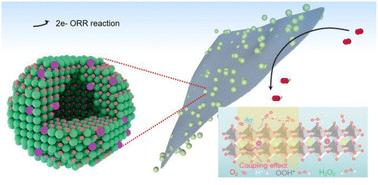
通过双电子氧还原反应(2e-ORR)电化学合成过氧化氢(H₂O₂)为传统的蒽醌工艺提供了一种有前途的替代方法。然而,这种方法往往存在动力学迟缓的问题。在这项研究中,我们引入了一种新的铋掺杂氧化铈(Bi- ceo2)复合材料,该复合材料具有中空纳米球和三角形纳米板结构,并在ceo2基体上高度分散地掺杂了Bi。值得注意的是,通过调整Bi掺杂量,可以在球和板之间动态调整Bi- ceo 2的形貌。这种创新的1%-Bi-CeO 2催化剂具有62.3%的H₂O₂选择性和显著提高的H₂O₂产率,在0.1 V下达到1.16 mol gcat -1 H -1,法拉第效率高达56.0%。密度泛函理论(DFT)计算表明,Bi掺杂剂有效地降低了*OOH中间体形成的自由能垒,从而加速了H₂O₂的生成。此外,当集成到双阴极系统中时,1%-Bi-CeO 2在去除罗丹明B (RhB)等有机染料方面表现出卓越的性能。这项工作为设计高效杂原子掺杂的2 - orr催化剂提供了突破性的方法,为更有效的电化学系统铺平了道路。
Homogeneous bismuth dopants regulate cerium oxide structure to boost hydrogen peroxide electrosynthesis via two-electron oxygen reduction†
The electrochemical synthesis of hydrogen peroxide (H2O2) through the two-electron oxygen reduction reaction (2e-ORR) offers a promising alternative to the traditional anthraquinone process. However, this method often suffers from sluggish kinetics. In this study, we introduce a novel bismuth-doped cerium oxide (Bi-CeO2) composite, featuring hollow nanospheres and triangular nanoplate structures with highly dispersed Bi dopants on the CeO2 matrix. Notably, the morphology of Bi-CeO2 can be dynamically tuned between spheres and plates by adjusting the amounts of Bi dopants. This innovative 1%-Bi-CeO2 catalyst exhibits an exceptional H2O2 selectivity of 62.3% and significantly enhanced H2O2 yield, reaching 1.16 mol gcat−1 h−1 at 0.1 V with a high faradaic efficiency of 56.0%. Density functional theory (DFT) calculations reveal that Bi dopants effectively lower the free energy barrier for *OOH intermediate formation, thereby accelerating H2O2 production. Additionally, when integrated into a dual-cathode system, 1%-Bi-CeO2 demonstrates superior performance in removing organic dyes such as rhodamine B (RhB). This work offers a groundbreaking approach for designing high-efficiency heteroatom-doped catalysts for the 2e-ORR, paving the way for more effective electrochemical systems.




 京公网安备 11010802042870号
京ICP备2023020795号-1
京公网安备 11010802042870号
京ICP备2023020795号-1

 分享
分享
 求助内容:
求助内容: 应助结果提醒方式:
 扫码关注我们
