Sangwoo Kim, Jeongah Lee, Yong Beom Kim, DongHwan Oh, Jun Kyu Kim, Bonjae Koo, Hyunseung Kim, Gi hong Jung, MinJoong Kim, Gisu Doo, Jongsu Seo, Tae Jin Lim, Kyeounghak Kim, Jeong Woo Han, WooChul Jung
{"title":"用原位生长的咖啡纳米层合理修饰牛乳增强碱性水电解","authors":"Sangwoo Kim, Jeongah Lee, Yong Beom Kim, DongHwan Oh, Jun Kyu Kim, Bonjae Koo, Hyunseung Kim, Gi hong Jung, MinJoong Kim, Gisu Doo, Jongsu Seo, Tae Jin Lim, Kyeounghak Kim, Jeong Woo Han, WooChul Jung","doi":"10.1021/acsnano.4c16691","DOIUrl":null,"url":null,"abstract":"Rational engineering of the surfaces of heterogeneous catalysts (especially the surfaces of supported metals) can endow intriguing catalytic functionalities for electrochemical reactions. However, it often requires complicated steps, and even if it does not, breaking the trade-off between activity and stability is quite challenging. Herein, we present a strategy for reconstructing supported catalysts via in situ growth of metallic nanolayers from the perovskite oxide support. When Ru-coated LaFe<sub>0.9</sub>Co<sub>0.1</sub>O<sub>3</sub> is thermally reduced, the CoFe nanoalloy spontaneously migrates onto the Ru and greatly increases the physicochemical stability of Ru in alkaline water electrolysis. Benefiting from an 81% reduction in Ru dissolution after decoration, it operates for over 200 h without noticeable degradation. Furthermore, the underlying Ru modifies the electronic structure and surface adsorption properties of the CoFe overlayer toward reaction intermediates, synergistically catalyzing both the oxygen evolution reaction and the hydrogen evolution reaction. Specifically, the mass activity of the oxygen evolution reaction is 64.1 times greater than that of commercial RuO<sub>2</sub>. Our work highlights a way to protect inherently unstable Ru from dissolution while allowing it to influence surface kinetics from the subsurface sites in heterogeneous catalysts.","PeriodicalId":21,"journal":{"name":"ACS Nano","volume":"85 2 1","pages":""},"PeriodicalIF":16.0000,"publicationDate":"2025-03-03","publicationTypes":"Journal Article","fieldsOfStudy":null,"isOpenAccess":false,"openAccessPdf":"","citationCount":"0","resultStr":"{\"title\":\"Enhanced Alkaline Water Electrolysis by the Rational Decoration of RuOx with the In Situ-Grown CoFe Nanolayer\",\"authors\":\"Sangwoo Kim, Jeongah Lee, Yong Beom Kim, DongHwan Oh, Jun Kyu Kim, Bonjae Koo, Hyunseung Kim, Gi hong Jung, MinJoong Kim, Gisu Doo, Jongsu Seo, Tae Jin Lim, Kyeounghak Kim, Jeong Woo Han, WooChul Jung\",\"doi\":\"10.1021/acsnano.4c16691\",\"DOIUrl\":null,\"url\":null,\"abstract\":\"Rational engineering of the surfaces of heterogeneous catalysts (especially the surfaces of supported metals) can endow intriguing catalytic functionalities for electrochemical reactions. However, it often requires complicated steps, and even if it does not, breaking the trade-off between activity and stability is quite challenging. Herein, we present a strategy for reconstructing supported catalysts via in situ growth of metallic nanolayers from the perovskite oxide support. When Ru-coated LaFe<sub>0.9</sub>Co<sub>0.1</sub>O<sub>3</sub> is thermally reduced, the CoFe nanoalloy spontaneously migrates onto the Ru and greatly increases the physicochemical stability of Ru in alkaline water electrolysis. Benefiting from an 81% reduction in Ru dissolution after decoration, it operates for over 200 h without noticeable degradation. Furthermore, the underlying Ru modifies the electronic structure and surface adsorption properties of the CoFe overlayer toward reaction intermediates, synergistically catalyzing both the oxygen evolution reaction and the hydrogen evolution reaction. Specifically, the mass activity of the oxygen evolution reaction is 64.1 times greater than that of commercial RuO<sub>2</sub>. Our work highlights a way to protect inherently unstable Ru from dissolution while allowing it to influence surface kinetics from the subsurface sites in heterogeneous catalysts.\",\"PeriodicalId\":21,\"journal\":{\"name\":\"ACS Nano\",\"volume\":\"85 2 1\",\"pages\":\"\"},\"PeriodicalIF\":16.0000,\"publicationDate\":\"2025-03-03\",\"publicationTypes\":\"Journal Article\",\"fieldsOfStudy\":null,\"isOpenAccess\":false,\"openAccessPdf\":\"\",\"citationCount\":\"0\",\"resultStr\":null,\"platform\":\"Semanticscholar\",\"paperid\":null,\"PeriodicalName\":\"ACS Nano\",\"FirstCategoryId\":\"88\",\"ListUrlMain\":\"https://doi.org/10.1021/acsnano.4c16691\",\"RegionNum\":1,\"RegionCategory\":\"材料科学\",\"ArticlePicture\":[],\"TitleCN\":null,\"AbstractTextCN\":null,\"PMCID\":null,\"EPubDate\":\"\",\"PubModel\":\"\",\"JCR\":\"Q1\",\"JCRName\":\"CHEMISTRY, MULTIDISCIPLINARY\",\"Score\":null,\"Total\":0}","platform":"Semanticscholar","paperid":null,"PeriodicalName":"ACS Nano","FirstCategoryId":"88","ListUrlMain":"https://doi.org/10.1021/acsnano.4c16691","RegionNum":1,"RegionCategory":"材料科学","ArticlePicture":[],"TitleCN":null,"AbstractTextCN":null,"PMCID":null,"EPubDate":"","PubModel":"","JCR":"Q1","JCRName":"CHEMISTRY, MULTIDISCIPLINARY","Score":null,"Total":0}
Enhanced Alkaline Water Electrolysis by the Rational Decoration of RuOx with the In Situ-Grown CoFe Nanolayer
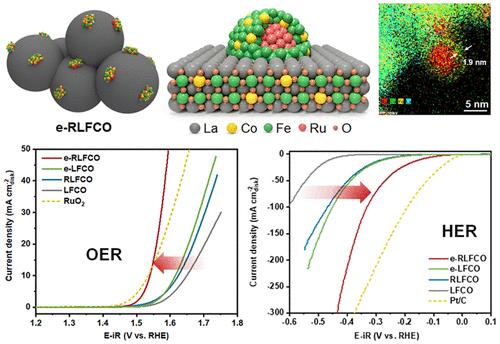
Rational engineering of the surfaces of heterogeneous catalysts (especially the surfaces of supported metals) can endow intriguing catalytic functionalities for electrochemical reactions. However, it often requires complicated steps, and even if it does not, breaking the trade-off between activity and stability is quite challenging. Herein, we present a strategy for reconstructing supported catalysts via in situ growth of metallic nanolayers from the perovskite oxide support. When Ru-coated LaFe0.9Co0.1O3 is thermally reduced, the CoFe nanoalloy spontaneously migrates onto the Ru and greatly increases the physicochemical stability of Ru in alkaline water electrolysis. Benefiting from an 81% reduction in Ru dissolution after decoration, it operates for over 200 h without noticeable degradation. Furthermore, the underlying Ru modifies the electronic structure and surface adsorption properties of the CoFe overlayer toward reaction intermediates, synergistically catalyzing both the oxygen evolution reaction and the hydrogen evolution reaction. Specifically, the mass activity of the oxygen evolution reaction is 64.1 times greater than that of commercial RuO2. Our work highlights a way to protect inherently unstable Ru from dissolution while allowing it to influence surface kinetics from the subsurface sites in heterogeneous catalysts.
期刊介绍:
ACS Nano, published monthly, serves as an international forum for comprehensive articles on nanoscience and nanotechnology research at the intersections of chemistry, biology, materials science, physics, and engineering. The journal fosters communication among scientists in these communities, facilitating collaboration, new research opportunities, and advancements through discoveries. ACS Nano covers synthesis, assembly, characterization, theory, and simulation of nanostructures, nanobiotechnology, nanofabrication, methods and tools for nanoscience and nanotechnology, and self- and directed-assembly. Alongside original research articles, it offers thorough reviews, perspectives on cutting-edge research, and discussions envisioning the future of nanoscience and nanotechnology.




 京公网安备 11010802042870号
京ICP备2023020795号-1
京公网安备 11010802042870号
京ICP备2023020795号-1

 分享
分享
 求助内容:
求助内容: 应助结果提醒方式:
 扫码关注我们
