{"title":"中性粒细胞降解六方氮化硼纳米材料的研究","authors":"Zhuomiao Liu, Jian Zhao, Liyun Yin, Kun Wang, Hao Feng, Lingzhi Li, Sicheng Xiong, Xinyue Li, Xia Liu, Yanhui Dai, Tongtao Yue, Zhenyu Wang, Baoshan Xing","doi":"10.1021/acs.est.4c13298","DOIUrl":null,"url":null,"abstract":"The biodegradation of hexagonal boron nitride (h-BN) nanomaterials by neutrophils was investigated. After incubation for 36 h, h-BN nanosheets are taken up by neutrophils, and their structure is highly disrupted, as observed via high-resolution transmission electron microscopy (HR-TEM) and confocal Raman imaging. Among the three degradation pathways, the release of neutrophil extracellular traps from neutrophils is the dominant, with myeloperoxidase (MPO) playing an important role. Molecular dynamics simulations show that MPO spontaneously attach onto h-BN surface, and leverage the active sites of MPO to form favorable contacts with h-BN to initiate the degradation. Hypochlorite produced by MPO is responsible for h-BN degradation. With the assistance of hypochlorite, B–O and N–O bonds are formed on h-BN, along with B–N bond breakage and the release of ionic boron and nitrogen based on byproduct identification and first-principle calculations. Additionally, h-BN nanosheets are significantly degraded into small pieces, and the particle concentration of h-BN with a size of 0–100 nm increases by 58.7% after degradation. Following degradation, h-BN nanosheets induce significant hemolysis of red blood cells, and exhibit higher cytotoxicity against epithelial cells. Our findings highlight the importance of considering h-BN degradation for its safe application, and demonstrate the actual risk of h-BN in biological and natural environments.","PeriodicalId":36,"journal":{"name":"环境科学与技术","volume":"1 1","pages":""},"PeriodicalIF":11.3000,"publicationDate":"2025-03-03","publicationTypes":"Journal Article","fieldsOfStudy":null,"isOpenAccess":false,"openAccessPdf":"","citationCount":"0","resultStr":"{\"title\":\"Biodegradation of Hexagonal Boron Nitride Nanomaterials by Neutrophils\",\"authors\":\"Zhuomiao Liu, Jian Zhao, Liyun Yin, Kun Wang, Hao Feng, Lingzhi Li, Sicheng Xiong, Xinyue Li, Xia Liu, Yanhui Dai, Tongtao Yue, Zhenyu Wang, Baoshan Xing\",\"doi\":\"10.1021/acs.est.4c13298\",\"DOIUrl\":null,\"url\":null,\"abstract\":\"The biodegradation of hexagonal boron nitride (h-BN) nanomaterials by neutrophils was investigated. After incubation for 36 h, h-BN nanosheets are taken up by neutrophils, and their structure is highly disrupted, as observed via high-resolution transmission electron microscopy (HR-TEM) and confocal Raman imaging. Among the three degradation pathways, the release of neutrophil extracellular traps from neutrophils is the dominant, with myeloperoxidase (MPO) playing an important role. Molecular dynamics simulations show that MPO spontaneously attach onto h-BN surface, and leverage the active sites of MPO to form favorable contacts with h-BN to initiate the degradation. Hypochlorite produced by MPO is responsible for h-BN degradation. With the assistance of hypochlorite, B–O and N–O bonds are formed on h-BN, along with B–N bond breakage and the release of ionic boron and nitrogen based on byproduct identification and first-principle calculations. Additionally, h-BN nanosheets are significantly degraded into small pieces, and the particle concentration of h-BN with a size of 0–100 nm increases by 58.7% after degradation. Following degradation, h-BN nanosheets induce significant hemolysis of red blood cells, and exhibit higher cytotoxicity against epithelial cells. Our findings highlight the importance of considering h-BN degradation for its safe application, and demonstrate the actual risk of h-BN in biological and natural environments.\",\"PeriodicalId\":36,\"journal\":{\"name\":\"环境科学与技术\",\"volume\":\"1 1\",\"pages\":\"\"},\"PeriodicalIF\":11.3000,\"publicationDate\":\"2025-03-03\",\"publicationTypes\":\"Journal Article\",\"fieldsOfStudy\":null,\"isOpenAccess\":false,\"openAccessPdf\":\"\",\"citationCount\":\"0\",\"resultStr\":null,\"platform\":\"Semanticscholar\",\"paperid\":null,\"PeriodicalName\":\"环境科学与技术\",\"FirstCategoryId\":\"1\",\"ListUrlMain\":\"https://doi.org/10.1021/acs.est.4c13298\",\"RegionNum\":1,\"RegionCategory\":\"环境科学与生态学\",\"ArticlePicture\":[],\"TitleCN\":null,\"AbstractTextCN\":null,\"PMCID\":null,\"EPubDate\":\"\",\"PubModel\":\"\",\"JCR\":\"Q1\",\"JCRName\":\"ENGINEERING, ENVIRONMENTAL\",\"Score\":null,\"Total\":0}","platform":"Semanticscholar","paperid":null,"PeriodicalName":"环境科学与技术","FirstCategoryId":"1","ListUrlMain":"https://doi.org/10.1021/acs.est.4c13298","RegionNum":1,"RegionCategory":"环境科学与生态学","ArticlePicture":[],"TitleCN":null,"AbstractTextCN":null,"PMCID":null,"EPubDate":"","PubModel":"","JCR":"Q1","JCRName":"ENGINEERING, ENVIRONMENTAL","Score":null,"Total":0}
Biodegradation of Hexagonal Boron Nitride Nanomaterials by Neutrophils
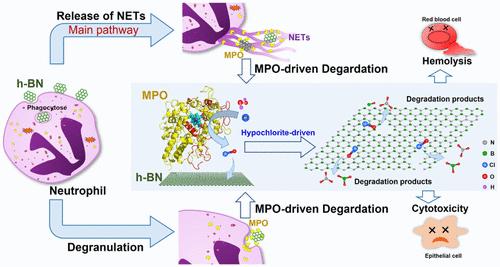
The biodegradation of hexagonal boron nitride (h-BN) nanomaterials by neutrophils was investigated. After incubation for 36 h, h-BN nanosheets are taken up by neutrophils, and their structure is highly disrupted, as observed via high-resolution transmission electron microscopy (HR-TEM) and confocal Raman imaging. Among the three degradation pathways, the release of neutrophil extracellular traps from neutrophils is the dominant, with myeloperoxidase (MPO) playing an important role. Molecular dynamics simulations show that MPO spontaneously attach onto h-BN surface, and leverage the active sites of MPO to form favorable contacts with h-BN to initiate the degradation. Hypochlorite produced by MPO is responsible for h-BN degradation. With the assistance of hypochlorite, B–O and N–O bonds are formed on h-BN, along with B–N bond breakage and the release of ionic boron and nitrogen based on byproduct identification and first-principle calculations. Additionally, h-BN nanosheets are significantly degraded into small pieces, and the particle concentration of h-BN with a size of 0–100 nm increases by 58.7% after degradation. Following degradation, h-BN nanosheets induce significant hemolysis of red blood cells, and exhibit higher cytotoxicity against epithelial cells. Our findings highlight the importance of considering h-BN degradation for its safe application, and demonstrate the actual risk of h-BN in biological and natural environments.
期刊介绍:
Environmental Science & Technology (ES&T) is a co-sponsored academic and technical magazine by the Hubei Provincial Environmental Protection Bureau and the Hubei Provincial Academy of Environmental Sciences.
Environmental Science & Technology (ES&T) holds the status of Chinese core journals, scientific papers source journals of China, Chinese Science Citation Database source journals, and Chinese Academic Journal Comprehensive Evaluation Database source journals. This publication focuses on the academic field of environmental protection, featuring articles related to environmental protection and technical advancements.




 京公网安备 11010802042870号
京ICP备2023020795号-1
京公网安备 11010802042870号
京ICP备2023020795号-1

 分享
分享
 求助内容:
求助内容: 应助结果提醒方式:
 扫码关注我们
