{"title":"Pt/α-MoC催化剂在高电流密度下促进ph -通用析氢反应","authors":"Wei Liu, Anyang Wang, Jihan Zhang, Shixiang Yu, Maolin Wang, Shuheng Tian, Haoyi Tang, Ziwen Zhao, Xiao Ren, Yuzheng Guo, Ding Ma","doi":"10.1021/acsnano.4c16678","DOIUrl":null,"url":null,"abstract":"Constructing subnanometric electrocatalysts is an efficient method to synergistically accelerate H<sub>2</sub>O dissociation and H<sup>+</sup> reduction for pH-universal hydrogen evolution reaction (HER) for industrial water electrolysis to produce green hydrogen. Here, we construct a subnanometric Pt/α-MoC catalyst, where the α-MoC component can dissociate water effectively, with the rapid proton release kinetics of Pt species on Pt/α-MoC to obtain a good HER performance at high current densities in all-pH electrolytes. Quasi-in situ X-ray photoelectron spectroscopy analyses and density functional theory calculations confirm the highly efficient water dissociation capability of α-MoC and the thermodynamically favorable desorption process of hydrolytically dissociated protons on Pt sites at the high current density. Consequently, Pt/α-MoC requires only a low overpotential of 125 mV to achieve a current density of 1000 mA cm<sup>–2</sup>. Moreover, a Pt/α-MoC-based proton exchange membrane water electrolysis device exhibits a low cell voltage (1.65 V) and promising stability over 300 h with no performance degradation at an industrial-level current density of 1 A cm<sup>–2</sup>. Notably, even at a current of 100 A, the cell voltage remains low at 2.15 V, demonstrating Pt/α-MoC’s promising potential as a scalable alternative for industrial hydrogen production. These findings elucidate the synergistic mechanism of α-MoC and atomically dispersed Pt in promoting efficient HER, offering valuable guidance for the design of electrocatalysts in high current density hydrogen.","PeriodicalId":21,"journal":{"name":"ACS Nano","volume":"190 1","pages":""},"PeriodicalIF":16.0000,"publicationDate":"2025-03-03","publicationTypes":"Journal Article","fieldsOfStudy":null,"isOpenAccess":false,"openAccessPdf":"","citationCount":"0","resultStr":"{\"title\":\"Pt/α-MoC Catalyst Boosting pH-Universal Hydrogen Evolution Reaction at High Current Densities\",\"authors\":\"Wei Liu, Anyang Wang, Jihan Zhang, Shixiang Yu, Maolin Wang, Shuheng Tian, Haoyi Tang, Ziwen Zhao, Xiao Ren, Yuzheng Guo, Ding Ma\",\"doi\":\"10.1021/acsnano.4c16678\",\"DOIUrl\":null,\"url\":null,\"abstract\":\"Constructing subnanometric electrocatalysts is an efficient method to synergistically accelerate H<sub>2</sub>O dissociation and H<sup>+</sup> reduction for pH-universal hydrogen evolution reaction (HER) for industrial water electrolysis to produce green hydrogen. Here, we construct a subnanometric Pt/α-MoC catalyst, where the α-MoC component can dissociate water effectively, with the rapid proton release kinetics of Pt species on Pt/α-MoC to obtain a good HER performance at high current densities in all-pH electrolytes. Quasi-in situ X-ray photoelectron spectroscopy analyses and density functional theory calculations confirm the highly efficient water dissociation capability of α-MoC and the thermodynamically favorable desorption process of hydrolytically dissociated protons on Pt sites at the high current density. Consequently, Pt/α-MoC requires only a low overpotential of 125 mV to achieve a current density of 1000 mA cm<sup>–2</sup>. Moreover, a Pt/α-MoC-based proton exchange membrane water electrolysis device exhibits a low cell voltage (1.65 V) and promising stability over 300 h with no performance degradation at an industrial-level current density of 1 A cm<sup>–2</sup>. Notably, even at a current of 100 A, the cell voltage remains low at 2.15 V, demonstrating Pt/α-MoC’s promising potential as a scalable alternative for industrial hydrogen production. These findings elucidate the synergistic mechanism of α-MoC and atomically dispersed Pt in promoting efficient HER, offering valuable guidance for the design of electrocatalysts in high current density hydrogen.\",\"PeriodicalId\":21,\"journal\":{\"name\":\"ACS Nano\",\"volume\":\"190 1\",\"pages\":\"\"},\"PeriodicalIF\":16.0000,\"publicationDate\":\"2025-03-03\",\"publicationTypes\":\"Journal Article\",\"fieldsOfStudy\":null,\"isOpenAccess\":false,\"openAccessPdf\":\"\",\"citationCount\":\"0\",\"resultStr\":null,\"platform\":\"Semanticscholar\",\"paperid\":null,\"PeriodicalName\":\"ACS Nano\",\"FirstCategoryId\":\"88\",\"ListUrlMain\":\"https://doi.org/10.1021/acsnano.4c16678\",\"RegionNum\":1,\"RegionCategory\":\"材料科学\",\"ArticlePicture\":[],\"TitleCN\":null,\"AbstractTextCN\":null,\"PMCID\":null,\"EPubDate\":\"\",\"PubModel\":\"\",\"JCR\":\"Q1\",\"JCRName\":\"CHEMISTRY, MULTIDISCIPLINARY\",\"Score\":null,\"Total\":0}","platform":"Semanticscholar","paperid":null,"PeriodicalName":"ACS Nano","FirstCategoryId":"88","ListUrlMain":"https://doi.org/10.1021/acsnano.4c16678","RegionNum":1,"RegionCategory":"材料科学","ArticlePicture":[],"TitleCN":null,"AbstractTextCN":null,"PMCID":null,"EPubDate":"","PubModel":"","JCR":"Q1","JCRName":"CHEMISTRY, MULTIDISCIPLINARY","Score":null,"Total":0}
引用次数: 0
摘要
构建亚纳米级电催化剂是协同加速工业水电解ph -通用析氢反应(HER)中H2O解离和H+还原的有效方法。本研究构建了一种亚纳米Pt/α-MoC催化剂,其中α-MoC组分可以有效解离水,并利用Pt/α-MoC在Pt/α-MoC上的快速质子释放动力学,在高电流密度下在所有ph电解质中获得良好的HER性能。准原位x射线光电子能谱分析和密度泛函理论计算证实了α-MoC具有高效的水解离能力,并且在高电流密度下水解解离的质子在Pt位上具有热力学上有利的解吸过程。因此,Pt/α-MoC只需要125 mV的低过电位就可以达到1000 mA cm-2的电流密度。此外,基于Pt/α- moc的质子交换膜电解装置具有较低的电池电压(1.65 V),并且在工业级电流密度为1 a cm-2的情况下,在300 h内具有良好的稳定性,性能不会下降。值得注意的是,即使在100 a的电流下,电池电压仍保持在2.15 V的低水平,这表明Pt/α-MoC作为工业制氢的可扩展替代品具有广阔的潜力。这些发现阐明了α-MoC和原子分散Pt在促进高效HER中的协同作用机制,为高电流密度氢电催化剂的设计提供了有价值的指导。
Pt/α-MoC Catalyst Boosting pH-Universal Hydrogen Evolution Reaction at High Current Densities
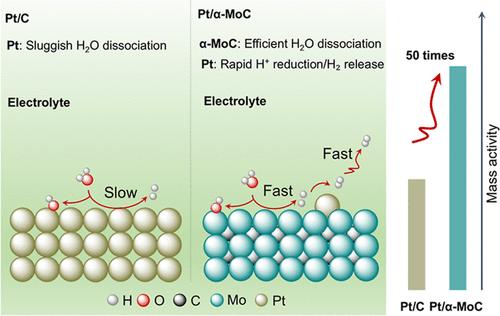
Constructing subnanometric electrocatalysts is an efficient method to synergistically accelerate H2O dissociation and H+ reduction for pH-universal hydrogen evolution reaction (HER) for industrial water electrolysis to produce green hydrogen. Here, we construct a subnanometric Pt/α-MoC catalyst, where the α-MoC component can dissociate water effectively, with the rapid proton release kinetics of Pt species on Pt/α-MoC to obtain a good HER performance at high current densities in all-pH electrolytes. Quasi-in situ X-ray photoelectron spectroscopy analyses and density functional theory calculations confirm the highly efficient water dissociation capability of α-MoC and the thermodynamically favorable desorption process of hydrolytically dissociated protons on Pt sites at the high current density. Consequently, Pt/α-MoC requires only a low overpotential of 125 mV to achieve a current density of 1000 mA cm–2. Moreover, a Pt/α-MoC-based proton exchange membrane water electrolysis device exhibits a low cell voltage (1.65 V) and promising stability over 300 h with no performance degradation at an industrial-level current density of 1 A cm–2. Notably, even at a current of 100 A, the cell voltage remains low at 2.15 V, demonstrating Pt/α-MoC’s promising potential as a scalable alternative for industrial hydrogen production. These findings elucidate the synergistic mechanism of α-MoC and atomically dispersed Pt in promoting efficient HER, offering valuable guidance for the design of electrocatalysts in high current density hydrogen.
期刊介绍:
ACS Nano, published monthly, serves as an international forum for comprehensive articles on nanoscience and nanotechnology research at the intersections of chemistry, biology, materials science, physics, and engineering. The journal fosters communication among scientists in these communities, facilitating collaboration, new research opportunities, and advancements through discoveries. ACS Nano covers synthesis, assembly, characterization, theory, and simulation of nanostructures, nanobiotechnology, nanofabrication, methods and tools for nanoscience and nanotechnology, and self- and directed-assembly. Alongside original research articles, it offers thorough reviews, perspectives on cutting-edge research, and discussions envisioning the future of nanoscience and nanotechnology.




 京公网安备 11010802042870号
京ICP备2023020795号-1
京公网安备 11010802042870号
京ICP备2023020795号-1

 分享
分享
 求助内容:
求助内容: 应助结果提醒方式:
 扫码关注我们
