{"title":"表面润湿性和微腔控制的多孔结构气泡输运机制研究","authors":"Qifan Li, Yi Zheng, Fangxiao Li","doi":"10.1021/acs.iecr.4c04612","DOIUrl":null,"url":null,"abstract":"Enhancing the heat transfer performance of porous structures through effective control of wettability and surface morphology has emerged as a critical factor in ensuring efficient equipment operation under high power conditions. This paper investigates the dynamic behavior of bubble growth on porous surfaces by establishing a transient fluid continuum surface force (VOF-CSF) model, emphasizing how wettability and surface microstructure influence bubble dynamics with specific wettability and microcavity configurations. The results indicate that the adhesion effect associated with hydrophobic surfaces leads to bubbles primarily expanding in the horizontal direction, thereby facilitating their merging with adjacent bubbles. As for smooth hydrophilic porous surfaces, there exists a clear microlayer liquid film between the bubbles and particles and replenishes the liquid supply. While, the microcavity structures generate numerous vortices at the bottom of the liquid film that significantly disturb the vapor–liquid interface and significantly enhance bubble departure; additionally, the liquid film within these microcavities provides an effective rehydration pathway. Furthermore, the microclusters induced by the fluid continuously interact with the bubble boundary, significantly enhancing the growth behavior of the bubbles. This interaction results in an increase in the bubble growth rate by 30–40% and improves heat transfer performance within porous structures by 23%.","PeriodicalId":39,"journal":{"name":"Industrial & Engineering Chemistry Research","volume":"99 1","pages":""},"PeriodicalIF":3.9000,"publicationDate":"2025-03-04","publicationTypes":"Journal Article","fieldsOfStudy":null,"isOpenAccess":false,"openAccessPdf":"","citationCount":"0","resultStr":"{\"title\":\"Study on the Mechanism of Bubble Transport on Porous Structure Controlled by Surface Wettability and Microcavity\",\"authors\":\"Qifan Li, Yi Zheng, Fangxiao Li\",\"doi\":\"10.1021/acs.iecr.4c04612\",\"DOIUrl\":null,\"url\":null,\"abstract\":\"Enhancing the heat transfer performance of porous structures through effective control of wettability and surface morphology has emerged as a critical factor in ensuring efficient equipment operation under high power conditions. This paper investigates the dynamic behavior of bubble growth on porous surfaces by establishing a transient fluid continuum surface force (VOF-CSF) model, emphasizing how wettability and surface microstructure influence bubble dynamics with specific wettability and microcavity configurations. The results indicate that the adhesion effect associated with hydrophobic surfaces leads to bubbles primarily expanding in the horizontal direction, thereby facilitating their merging with adjacent bubbles. As for smooth hydrophilic porous surfaces, there exists a clear microlayer liquid film between the bubbles and particles and replenishes the liquid supply. While, the microcavity structures generate numerous vortices at the bottom of the liquid film that significantly disturb the vapor–liquid interface and significantly enhance bubble departure; additionally, the liquid film within these microcavities provides an effective rehydration pathway. Furthermore, the microclusters induced by the fluid continuously interact with the bubble boundary, significantly enhancing the growth behavior of the bubbles. This interaction results in an increase in the bubble growth rate by 30–40% and improves heat transfer performance within porous structures by 23%.\",\"PeriodicalId\":39,\"journal\":{\"name\":\"Industrial & Engineering Chemistry Research\",\"volume\":\"99 1\",\"pages\":\"\"},\"PeriodicalIF\":3.9000,\"publicationDate\":\"2025-03-04\",\"publicationTypes\":\"Journal Article\",\"fieldsOfStudy\":null,\"isOpenAccess\":false,\"openAccessPdf\":\"\",\"citationCount\":\"0\",\"resultStr\":null,\"platform\":\"Semanticscholar\",\"paperid\":null,\"PeriodicalName\":\"Industrial & Engineering Chemistry Research\",\"FirstCategoryId\":\"5\",\"ListUrlMain\":\"https://doi.org/10.1021/acs.iecr.4c04612\",\"RegionNum\":3,\"RegionCategory\":\"工程技术\",\"ArticlePicture\":[],\"TitleCN\":null,\"AbstractTextCN\":null,\"PMCID\":null,\"EPubDate\":\"\",\"PubModel\":\"\",\"JCR\":\"Q2\",\"JCRName\":\"ENGINEERING, CHEMICAL\",\"Score\":null,\"Total\":0}","platform":"Semanticscholar","paperid":null,"PeriodicalName":"Industrial & Engineering Chemistry Research","FirstCategoryId":"5","ListUrlMain":"https://doi.org/10.1021/acs.iecr.4c04612","RegionNum":3,"RegionCategory":"工程技术","ArticlePicture":[],"TitleCN":null,"AbstractTextCN":null,"PMCID":null,"EPubDate":"","PubModel":"","JCR":"Q2","JCRName":"ENGINEERING, CHEMICAL","Score":null,"Total":0}
Study on the Mechanism of Bubble Transport on Porous Structure Controlled by Surface Wettability and Microcavity
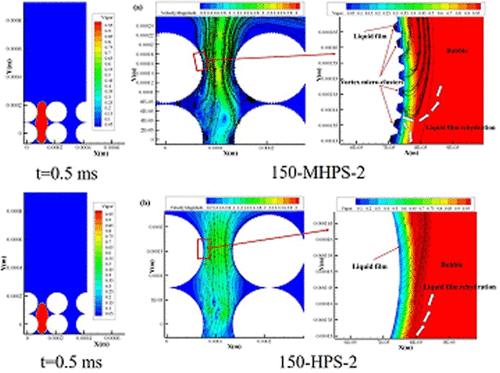
Enhancing the heat transfer performance of porous structures through effective control of wettability and surface morphology has emerged as a critical factor in ensuring efficient equipment operation under high power conditions. This paper investigates the dynamic behavior of bubble growth on porous surfaces by establishing a transient fluid continuum surface force (VOF-CSF) model, emphasizing how wettability and surface microstructure influence bubble dynamics with specific wettability and microcavity configurations. The results indicate that the adhesion effect associated with hydrophobic surfaces leads to bubbles primarily expanding in the horizontal direction, thereby facilitating their merging with adjacent bubbles. As for smooth hydrophilic porous surfaces, there exists a clear microlayer liquid film between the bubbles and particles and replenishes the liquid supply. While, the microcavity structures generate numerous vortices at the bottom of the liquid film that significantly disturb the vapor–liquid interface and significantly enhance bubble departure; additionally, the liquid film within these microcavities provides an effective rehydration pathway. Furthermore, the microclusters induced by the fluid continuously interact with the bubble boundary, significantly enhancing the growth behavior of the bubbles. This interaction results in an increase in the bubble growth rate by 30–40% and improves heat transfer performance within porous structures by 23%.
期刊介绍:
ndustrial & Engineering Chemistry, with variations in title and format, has been published since 1909 by the American Chemical Society. Industrial & Engineering Chemistry Research is a weekly publication that reports industrial and academic research in the broad fields of applied chemistry and chemical engineering with special focus on fundamentals, processes, and products.




 京公网安备 11010802042870号
京ICP备2023020795号-1
京公网安备 11010802042870号
京ICP备2023020795号-1

 分享
分享
 求助内容:
求助内容: 应助结果提醒方式:
 扫码关注我们
