Xiaotian Wang, Yaoyao Zhou, Xiufang Li, Mei Zou, Qiang Zhang, Weilin Xu, Yanfei Feng, Yingying Zhang, Renchuan You
{"title":"基于丝素蛋白的超低温传感抗冻高导电水凝胶","authors":"Xiaotian Wang, Yaoyao Zhou, Xiufang Li, Mei Zou, Qiang Zhang, Weilin Xu, Yanfei Feng, Yingying Zhang, Renchuan You","doi":"10.1021/acssensors.4c03642","DOIUrl":null,"url":null,"abstract":"Hydrogels with a combination of mechanical flexibility and good electrical conductivity hold significant potential for various applications. Nonetheless, it is inevitable that water-based conductive hydrogels lose their elasticity and conductivity at extremely low temperatures, severely limiting their utilization in ultralow temperature environments, such as those for Arctic/Antarctic exploration. In this study, we developed a conductive hydrogel based on a double network cross-linking strategy that incorporated silk fibroin (SF) and poly(3,4-ethylenedioxythiophene):poly(styrenesulfonate) (PEDOT:PSS) within a lithium bromide (LiBr) solution, which shows exceptional antifreezing (−108 °C freezing point) and excellent conductivity (16.33 S m<sup>–1</sup>). The obtained SF/PEDOT:PSS/LiBr (SPL) hydrogel shows a stable and reliable response to a wide range of deformations (compression: 0.5–60%; tensile: 1.0–100%), with a short response/recovery time of approximately 70 ms. More importantly, the hydrogel displays well-maintained conductivity, robust mechanical properties, and dependable sensing capabilities, even under temperatures as low as −80 °C. For proof of concept, we demonstrated the applications of the SPL hydrogel in detecting body movements, monitoring climate conditions, and ensuring information security in ultralow temperature environments. The results indicate that the antifreezing hydrogel is a promising candidate for fabricating flexible sensors, particularly well-suited for use in challenging ultralow temperature scenarios.","PeriodicalId":24,"journal":{"name":"ACS Sensors","volume":"2 1","pages":""},"PeriodicalIF":9.1000,"publicationDate":"2025-03-03","publicationTypes":"Journal Article","fieldsOfStudy":null,"isOpenAccess":false,"openAccessPdf":"","citationCount":"0","resultStr":"{\"title\":\"Silk Fibroin-Based Antifreezing and Highly Conductive Hydrogel for Sensing at Ultralow Temperature\",\"authors\":\"Xiaotian Wang, Yaoyao Zhou, Xiufang Li, Mei Zou, Qiang Zhang, Weilin Xu, Yanfei Feng, Yingying Zhang, Renchuan You\",\"doi\":\"10.1021/acssensors.4c03642\",\"DOIUrl\":null,\"url\":null,\"abstract\":\"Hydrogels with a combination of mechanical flexibility and good electrical conductivity hold significant potential for various applications. Nonetheless, it is inevitable that water-based conductive hydrogels lose their elasticity and conductivity at extremely low temperatures, severely limiting their utilization in ultralow temperature environments, such as those for Arctic/Antarctic exploration. In this study, we developed a conductive hydrogel based on a double network cross-linking strategy that incorporated silk fibroin (SF) and poly(3,4-ethylenedioxythiophene):poly(styrenesulfonate) (PEDOT:PSS) within a lithium bromide (LiBr) solution, which shows exceptional antifreezing (−108 °C freezing point) and excellent conductivity (16.33 S m<sup>–1</sup>). The obtained SF/PEDOT:PSS/LiBr (SPL) hydrogel shows a stable and reliable response to a wide range of deformations (compression: 0.5–60%; tensile: 1.0–100%), with a short response/recovery time of approximately 70 ms. More importantly, the hydrogel displays well-maintained conductivity, robust mechanical properties, and dependable sensing capabilities, even under temperatures as low as −80 °C. For proof of concept, we demonstrated the applications of the SPL hydrogel in detecting body movements, monitoring climate conditions, and ensuring information security in ultralow temperature environments. The results indicate that the antifreezing hydrogel is a promising candidate for fabricating flexible sensors, particularly well-suited for use in challenging ultralow temperature scenarios.\",\"PeriodicalId\":24,\"journal\":{\"name\":\"ACS Sensors\",\"volume\":\"2 1\",\"pages\":\"\"},\"PeriodicalIF\":9.1000,\"publicationDate\":\"2025-03-03\",\"publicationTypes\":\"Journal Article\",\"fieldsOfStudy\":null,\"isOpenAccess\":false,\"openAccessPdf\":\"\",\"citationCount\":\"0\",\"resultStr\":null,\"platform\":\"Semanticscholar\",\"paperid\":null,\"PeriodicalName\":\"ACS Sensors\",\"FirstCategoryId\":\"92\",\"ListUrlMain\":\"https://doi.org/10.1021/acssensors.4c03642\",\"RegionNum\":1,\"RegionCategory\":\"化学\",\"ArticlePicture\":[],\"TitleCN\":null,\"AbstractTextCN\":null,\"PMCID\":null,\"EPubDate\":\"\",\"PubModel\":\"\",\"JCR\":\"Q1\",\"JCRName\":\"CHEMISTRY, ANALYTICAL\",\"Score\":null,\"Total\":0}","platform":"Semanticscholar","paperid":null,"PeriodicalName":"ACS Sensors","FirstCategoryId":"92","ListUrlMain":"https://doi.org/10.1021/acssensors.4c03642","RegionNum":1,"RegionCategory":"化学","ArticlePicture":[],"TitleCN":null,"AbstractTextCN":null,"PMCID":null,"EPubDate":"","PubModel":"","JCR":"Q1","JCRName":"CHEMISTRY, ANALYTICAL","Score":null,"Total":0}
引用次数: 0
摘要
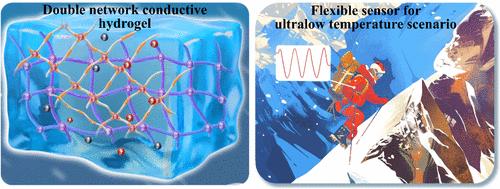
具有机械灵活性和良好导电性的水凝胶在各种应用中具有巨大的潜力。然而,水基导电水凝胶在极低温度下不可避免地会失去弹性和导电性,这严重限制了其在超低温环境中的应用,例如北极/南极勘探。在这项研究中,我们开发了一种基于双网络交联策略的导电水凝胶,该水凝胶将丝素(SF)和聚(3,4-乙烯二氧噻吩):聚苯乙烯磺酸盐(PEDOT:PSS)加入溴化锂(LiBr)溶液中,具有优异的抗冻性(- 108°C冰点)和优异的导电性(16.33 S m-1)。所得的SF/PEDOT:PSS/LiBr (SPL)水凝胶对大范围的变形(压缩:0.5-60%;拉伸:1.0-100%),响应/恢复时间短,约为70毫秒。更重要的是,即使在低至- 80°C的温度下,水凝胶也具有良好的导电性,坚固的机械性能和可靠的传感能力。为了验证概念,我们展示了SPL水凝胶在检测身体运动、监测气候条件和确保超低温环境下信息安全方面的应用。结果表明,抗冻水凝胶是制造柔性传感器的有希望的候选者,特别适合在具有挑战性的超低温环境中使用。
Silk Fibroin-Based Antifreezing and Highly Conductive Hydrogel for Sensing at Ultralow Temperature
Hydrogels with a combination of mechanical flexibility and good electrical conductivity hold significant potential for various applications. Nonetheless, it is inevitable that water-based conductive hydrogels lose their elasticity and conductivity at extremely low temperatures, severely limiting their utilization in ultralow temperature environments, such as those for Arctic/Antarctic exploration. In this study, we developed a conductive hydrogel based on a double network cross-linking strategy that incorporated silk fibroin (SF) and poly(3,4-ethylenedioxythiophene):poly(styrenesulfonate) (PEDOT:PSS) within a lithium bromide (LiBr) solution, which shows exceptional antifreezing (−108 °C freezing point) and excellent conductivity (16.33 S m–1). The obtained SF/PEDOT:PSS/LiBr (SPL) hydrogel shows a stable and reliable response to a wide range of deformations (compression: 0.5–60%; tensile: 1.0–100%), with a short response/recovery time of approximately 70 ms. More importantly, the hydrogel displays well-maintained conductivity, robust mechanical properties, and dependable sensing capabilities, even under temperatures as low as −80 °C. For proof of concept, we demonstrated the applications of the SPL hydrogel in detecting body movements, monitoring climate conditions, and ensuring information security in ultralow temperature environments. The results indicate that the antifreezing hydrogel is a promising candidate for fabricating flexible sensors, particularly well-suited for use in challenging ultralow temperature scenarios.
期刊介绍:
ACS Sensors is a peer-reviewed research journal that focuses on the dissemination of new and original knowledge in the field of sensor science, particularly those that selectively sense chemical or biological species or processes. The journal covers a broad range of topics, including but not limited to biosensors, chemical sensors, gas sensors, intracellular sensors, single molecule sensors, cell chips, and microfluidic devices. It aims to publish articles that address conceptual advances in sensing technology applicable to various types of analytes or application papers that report on the use of existing sensing concepts in new ways or for new analytes.



 京公网安备 11010802042870号
京ICP备2023020795号-1
京公网安备 11010802042870号
京ICP备2023020795号-1

 分享
分享
 求助内容:
求助内容: 应助结果提醒方式:
 扫码关注我们
