Basanta Lamichhane, Sarah-Eve Gélinas, Natacha Merindol, Manoj Koirala, Karen Cristine Gonçalves dos Santos, Hugo Germain, Isabel Desgagné-Penix
{"title":"白芨中amarillidaceae生物碱合成酶网络的研究","authors":"Basanta Lamichhane, Sarah-Eve Gélinas, Natacha Merindol, Manoj Koirala, Karen Cristine Gonçalves dos Santos, Hugo Germain, Isabel Desgagné-Penix","doi":"10.1111/pbi.70026","DOIUrl":null,"url":null,"abstract":"<p><i>Amaryllidaceae</i> alkaloids (AAs) are diverse bioactive metabolites with significant pharmaceutical potential, derived from 4′-O-methylnorbelladine (4′<i>O</i>M). The biosynthesis of these compounds involves the condensation of tyramine and 3,4-dihydroxybenzaldehyde by norbelladine synthase (NBS) and/or noroxomaritidine/norcraugsodine reductase (NR), followed by <i>O</i>-methylation. Cytochrome P450 enzymes, particularly the CYP96T family, introduce further structural diversity through C–C couplings, resulting in lycorine, galanthamine and crinine cores. Despite their importance, the exact biosynthetic pathways remain poorly defined. In this study, we describe key enzymes from <i>Leucojum aestivum</i> (<i>La</i>), providing crucial insight into AA biosynthesis. Transient expression in <i>Nicotiana benthamiana</i> demonstrated that <i>La</i>NBS and <i>La</i>NRII catalyse the conversion of tyramine and 3,4-dihydroxybenzaldehyde to norbelladine, which is subsequently <i>O</i>-methylated by a norbelladine-4′-<i>O</i>-methyltransferase (<i>La</i>N4′<i>O</i>MT) <i>in planta</i>. Co-agroinfiltration of <i>La</i>NBS, <i>La</i>NRII, <i>La</i>N4′<i>O</i>MT and <i>La</i>CYP96T1 resulted in the production of various phenol-coupled products, with lycorine as the predominant compound, alongside haemanthamine, crinine/vittatine and norgalanthamine. This study identifies <i>La</i>CYP96T1 and <i>La</i>CYP96T2 as the first monocot enzymes capable of catalysing all three regioselective C-C phenol couplings and also highlights the substrate promiscuity of <i>La</i>NRII. The findings not only elucidate critical steps in AA biosynthesis but also open new avenues for biotechnological application in producing valuable alkaloids, offering potential for novel drug development.</p>","PeriodicalId":221,"journal":{"name":"Plant Biotechnology Journal","volume":"23 6","pages":"1988-2005"},"PeriodicalIF":10.5000,"publicationDate":"2025-03-04","publicationTypes":"Journal Article","fieldsOfStudy":null,"isOpenAccess":false,"openAccessPdf":"https://onlinelibrary.wiley.com/doi/epdf/10.1111/pbi.70026","citationCount":"0","resultStr":"{\"title\":\"Elucidating the enzyme network driving Amaryllidaceae alkaloids biosynthesis in Leucojum aestivum\",\"authors\":\"Basanta Lamichhane, Sarah-Eve Gélinas, Natacha Merindol, Manoj Koirala, Karen Cristine Gonçalves dos Santos, Hugo Germain, Isabel Desgagné-Penix\",\"doi\":\"10.1111/pbi.70026\",\"DOIUrl\":null,\"url\":null,\"abstract\":\"<p><i>Amaryllidaceae</i> alkaloids (AAs) are diverse bioactive metabolites with significant pharmaceutical potential, derived from 4′-O-methylnorbelladine (4′<i>O</i>M). The biosynthesis of these compounds involves the condensation of tyramine and 3,4-dihydroxybenzaldehyde by norbelladine synthase (NBS) and/or noroxomaritidine/norcraugsodine reductase (NR), followed by <i>O</i>-methylation. Cytochrome P450 enzymes, particularly the CYP96T family, introduce further structural diversity through C–C couplings, resulting in lycorine, galanthamine and crinine cores. Despite their importance, the exact biosynthetic pathways remain poorly defined. In this study, we describe key enzymes from <i>Leucojum aestivum</i> (<i>La</i>), providing crucial insight into AA biosynthesis. Transient expression in <i>Nicotiana benthamiana</i> demonstrated that <i>La</i>NBS and <i>La</i>NRII catalyse the conversion of tyramine and 3,4-dihydroxybenzaldehyde to norbelladine, which is subsequently <i>O</i>-methylated by a norbelladine-4′-<i>O</i>-methyltransferase (<i>La</i>N4′<i>O</i>MT) <i>in planta</i>. Co-agroinfiltration of <i>La</i>NBS, <i>La</i>NRII, <i>La</i>N4′<i>O</i>MT and <i>La</i>CYP96T1 resulted in the production of various phenol-coupled products, with lycorine as the predominant compound, alongside haemanthamine, crinine/vittatine and norgalanthamine. This study identifies <i>La</i>CYP96T1 and <i>La</i>CYP96T2 as the first monocot enzymes capable of catalysing all three regioselective C-C phenol couplings and also highlights the substrate promiscuity of <i>La</i>NRII. The findings not only elucidate critical steps in AA biosynthesis but also open new avenues for biotechnological application in producing valuable alkaloids, offering potential for novel drug development.</p>\",\"PeriodicalId\":221,\"journal\":{\"name\":\"Plant Biotechnology Journal\",\"volume\":\"23 6\",\"pages\":\"1988-2005\"},\"PeriodicalIF\":10.5000,\"publicationDate\":\"2025-03-04\",\"publicationTypes\":\"Journal Article\",\"fieldsOfStudy\":null,\"isOpenAccess\":false,\"openAccessPdf\":\"https://onlinelibrary.wiley.com/doi/epdf/10.1111/pbi.70026\",\"citationCount\":\"0\",\"resultStr\":null,\"platform\":\"Semanticscholar\",\"paperid\":null,\"PeriodicalName\":\"Plant Biotechnology Journal\",\"FirstCategoryId\":\"5\",\"ListUrlMain\":\"https://onlinelibrary.wiley.com/doi/10.1111/pbi.70026\",\"RegionNum\":1,\"RegionCategory\":\"生物学\",\"ArticlePicture\":[],\"TitleCN\":null,\"AbstractTextCN\":null,\"PMCID\":null,\"EPubDate\":\"\",\"PubModel\":\"\",\"JCR\":\"Q1\",\"JCRName\":\"BIOTECHNOLOGY & APPLIED MICROBIOLOGY\",\"Score\":null,\"Total\":0}","platform":"Semanticscholar","paperid":null,"PeriodicalName":"Plant Biotechnology Journal","FirstCategoryId":"5","ListUrlMain":"https://onlinelibrary.wiley.com/doi/10.1111/pbi.70026","RegionNum":1,"RegionCategory":"生物学","ArticlePicture":[],"TitleCN":null,"AbstractTextCN":null,"PMCID":null,"EPubDate":"","PubModel":"","JCR":"Q1","JCRName":"BIOTECHNOLOGY & APPLIED MICROBIOLOGY","Score":null,"Total":0}
引用次数: 0
摘要
Amaryllidaceae生物碱(AAs)是由4′-O-methylnorbelladine(4′om)衍生而来的具有多种生物活性的代谢物,具有重要的药用潜力。这些化合物的生物合成包括酪胺和3,4-二羟基苯甲醛的缩合,由去甲苯拉定合成酶(NBS)和/或去甲咯马替丁/去甲咯索丁还原酶(NR),然后进行o -甲基化。细胞色素P450酶,特别是CYP96T家族,通过C-C偶联进一步引入结构多样性,产生石蒜碱、加兰他敏和铁碱核心。尽管它们很重要,但确切的生物合成途径仍然不明确。在这项研究中,我们描述了从Leucojum aestivum (La)的关键酶,为AA的生物合成提供了重要的见解。在benthamiana中的瞬时表达表明,LaNBS和LaNRII催化酪胺和3,4-二羟基苯甲醛转化为去贝拉定,然后在植物中被去贝拉定-4 ' - o -甲基转移酶(LaN4'OMT) o -甲基化。LaNBS、LaNRII、LaN4'OMT和LaCYP96T1的共渗导致多种酚偶联产物的产生,以石芋碱为主要化合物,还有海毒胺、克立宁/维他汀和去甲加兰他敏。本研究确定了LaCYP96T1和LaCYP96T2是第一个能够催化所有三种区域选择性C-C -酚偶联的单株酶,并强调了LaNRII的底物混杂性。这一发现不仅阐明了AA生物合成的关键步骤,而且为生物技术在生产有价值生物碱方面的应用开辟了新的途径,为新药开发提供了潜力。
Elucidating the enzyme network driving Amaryllidaceae alkaloids biosynthesis in Leucojum aestivum
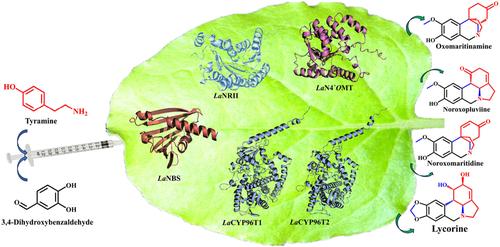
Amaryllidaceae alkaloids (AAs) are diverse bioactive metabolites with significant pharmaceutical potential, derived from 4′-O-methylnorbelladine (4′OM). The biosynthesis of these compounds involves the condensation of tyramine and 3,4-dihydroxybenzaldehyde by norbelladine synthase (NBS) and/or noroxomaritidine/norcraugsodine reductase (NR), followed by O-methylation. Cytochrome P450 enzymes, particularly the CYP96T family, introduce further structural diversity through C–C couplings, resulting in lycorine, galanthamine and crinine cores. Despite their importance, the exact biosynthetic pathways remain poorly defined. In this study, we describe key enzymes from Leucojum aestivum (La), providing crucial insight into AA biosynthesis. Transient expression in Nicotiana benthamiana demonstrated that LaNBS and LaNRII catalyse the conversion of tyramine and 3,4-dihydroxybenzaldehyde to norbelladine, which is subsequently O-methylated by a norbelladine-4′-O-methyltransferase (LaN4′OMT) in planta. Co-agroinfiltration of LaNBS, LaNRII, LaN4′OMT and LaCYP96T1 resulted in the production of various phenol-coupled products, with lycorine as the predominant compound, alongside haemanthamine, crinine/vittatine and norgalanthamine. This study identifies LaCYP96T1 and LaCYP96T2 as the first monocot enzymes capable of catalysing all three regioselective C-C phenol couplings and also highlights the substrate promiscuity of LaNRII. The findings not only elucidate critical steps in AA biosynthesis but also open new avenues for biotechnological application in producing valuable alkaloids, offering potential for novel drug development.
期刊介绍:
Plant Biotechnology Journal aspires to publish original research and insightful reviews of high impact, authored by prominent researchers in applied plant science. The journal places a special emphasis on molecular plant sciences and their practical applications through plant biotechnology. Our goal is to establish a platform for showcasing significant advances in the field, encompassing curiosity-driven studies with potential applications, strategic research in plant biotechnology, scientific analysis of crucial issues for the beneficial utilization of plant sciences, and assessments of the performance of plant biotechnology products in practical applications.





 京公网安备 11010802042870号
京ICP备2023020795号-1
京公网安备 11010802042870号
京ICP备2023020795号-1

 分享
分享
 求助内容:
求助内容: 应助结果提醒方式:
 扫码关注我们
