Sabrina Ormston, Tianhai Yan, Xianjiang Chen, Alan W Gordon, Katerina Theodoridou, Sharon Huws, Sokratis Stergiadis
{"title":"饲粮粗料比例和杂交对泌乳奶牛饲料效率和甲烷排放的影响。","authors":"Sabrina Ormston, Tianhai Yan, Xianjiang Chen, Alan W Gordon, Katerina Theodoridou, Sharon Huws, Sokratis Stergiadis","doi":"10.1016/j.aninu.2024.08.011","DOIUrl":null,"url":null,"abstract":"<p><p>Increasing forage proportion (FP) in the diets of dairy cows would reduce competition for human edible foods and reduce feed costs, particularly in low-input systems. However, increasing FP reduces productivity and may increases methane (CH<sub>4</sub>) emission parameters. This work aimed to investigate the impact of FP and breed on feed efficiency and CH<sub>4</sub> emission parameters. Data from 32 individual experiments conducted at the Agri-Food and Biosciences Institute between 1992 and 2010 were utilised in this study resulting in data from 796 Holstein-Friesian (HF), 50 Norwegian Red (NR), 46 Jersey × HF (J × HF) and 16 NR × HF cows. Diets consisted of varying proportions of forage and concentrate dependent on the experimental protocols of each experiment. A linear mixed model was used to investigate the effect of low (LFP; 10% to 30%), medium (MFP; 30% to 59%), high (HFP; 60% to 87%) and pure (FOR; 100%) FP (dry matter [DM] basis) and breed on feed efficiency, and CH<sub>4</sub> emission parameters and multivariate redundancy analysis identified associations between animal and dietary drivers on the same variables. Total dry matter intake (DMI) was higher for cows offered LFP (17.3 kg/d) and MFP (17.9 kg/d) compared to HFP (15.3 kg/d) and FOR (13.8 kg/d) (<i>P</i> < 0.001). Milk yield (<i>P</i> < 0.001), milk yield/DMI (<i>P</i> < 0.001), energy corrected milk (ECM)/DMI (<i>P</i> < 0.001) and milk energy/DMI (<i>P</i> < 0.001) were higher for LFP and MFP compared to HFP and FOR. Methane/DMI was higher for HFP (24.3 g/kg) compared to MFP (22.4 g/kg) (<i>P</i> < 0.001). Methane/milk yield (<i>P</i> < 0.001) or CH<sub>4</sub>/ECM (<i>P</i> < 0.001) was higher for HFP (22.5 or 21.6 g/kg) and FOR (27.0 or 25.8 g/kg) compared to MFP (19.1 or 17.9 g/kg). There were no differences between LFP and MFP or between HFP and FOR for milk yield, milk yield/DMI, ECM/DMI, milk energy/DMI, CH<sub>4</sub>/milk yield and CH<sub>4</sub>/ECM (<i>P</i> > 0.05). Differences existed between breeds for residual feed intake (<i>P</i> = 0.040), milk yield/DMI (<i>P</i> = 0.041) and CH<sub>4</sub>/DMI (<i>P</i> = 0.048) with multivariate redundancy analysis demonstrating negative correlations with efficiency and positive correlations with CH<sub>4</sub>/DMI and CH<sub>4</sub>/milk yield. Feeding concentrates at 70% to 90% of DMI (LFP group) would not result in any further benefits for productivity, feed efficiency or CH<sub>4</sub> yield and intensity when compared to feeding 41% to 70% concentrates of DMI (MFP group). There may be opportunity to improve profitability for lower intensity farms with less concentrate input.</p>","PeriodicalId":8184,"journal":{"name":"Animal Nutrition","volume":"20 ","pages":"419-429"},"PeriodicalIF":8.3000,"publicationDate":"2024-12-28","publicationTypes":"Journal Article","fieldsOfStudy":null,"isOpenAccess":false,"openAccessPdf":"https://www.ncbi.nlm.nih.gov/pmc/articles/PMC11875188/pdf/","citationCount":"0","resultStr":"{\"title\":\"Impact of dietary forage proportion and crossbreeding on feed efficiency and methane emissions in lactating dairy cows.\",\"authors\":\"Sabrina Ormston, Tianhai Yan, Xianjiang Chen, Alan W Gordon, Katerina Theodoridou, Sharon Huws, Sokratis Stergiadis\",\"doi\":\"10.1016/j.aninu.2024.08.011\",\"DOIUrl\":null,\"url\":null,\"abstract\":\"<p><p>Increasing forage proportion (FP) in the diets of dairy cows would reduce competition for human edible foods and reduce feed costs, particularly in low-input systems. However, increasing FP reduces productivity and may increases methane (CH<sub>4</sub>) emission parameters. This work aimed to investigate the impact of FP and breed on feed efficiency and CH<sub>4</sub> emission parameters. Data from 32 individual experiments conducted at the Agri-Food and Biosciences Institute between 1992 and 2010 were utilised in this study resulting in data from 796 Holstein-Friesian (HF), 50 Norwegian Red (NR), 46 Jersey × HF (J × HF) and 16 NR × HF cows. Diets consisted of varying proportions of forage and concentrate dependent on the experimental protocols of each experiment. A linear mixed model was used to investigate the effect of low (LFP; 10% to 30%), medium (MFP; 30% to 59%), high (HFP; 60% to 87%) and pure (FOR; 100%) FP (dry matter [DM] basis) and breed on feed efficiency, and CH<sub>4</sub> emission parameters and multivariate redundancy analysis identified associations between animal and dietary drivers on the same variables. Total dry matter intake (DMI) was higher for cows offered LFP (17.3 kg/d) and MFP (17.9 kg/d) compared to HFP (15.3 kg/d) and FOR (13.8 kg/d) (<i>P</i> < 0.001). Milk yield (<i>P</i> < 0.001), milk yield/DMI (<i>P</i> < 0.001), energy corrected milk (ECM)/DMI (<i>P</i> < 0.001) and milk energy/DMI (<i>P</i> < 0.001) were higher for LFP and MFP compared to HFP and FOR. Methane/DMI was higher for HFP (24.3 g/kg) compared to MFP (22.4 g/kg) (<i>P</i> < 0.001). Methane/milk yield (<i>P</i> < 0.001) or CH<sub>4</sub>/ECM (<i>P</i> < 0.001) was higher for HFP (22.5 or 21.6 g/kg) and FOR (27.0 or 25.8 g/kg) compared to MFP (19.1 or 17.9 g/kg). There were no differences between LFP and MFP or between HFP and FOR for milk yield, milk yield/DMI, ECM/DMI, milk energy/DMI, CH<sub>4</sub>/milk yield and CH<sub>4</sub>/ECM (<i>P</i> > 0.05). Differences existed between breeds for residual feed intake (<i>P</i> = 0.040), milk yield/DMI (<i>P</i> = 0.041) and CH<sub>4</sub>/DMI (<i>P</i> = 0.048) with multivariate redundancy analysis demonstrating negative correlations with efficiency and positive correlations with CH<sub>4</sub>/DMI and CH<sub>4</sub>/milk yield. Feeding concentrates at 70% to 90% of DMI (LFP group) would not result in any further benefits for productivity, feed efficiency or CH<sub>4</sub> yield and intensity when compared to feeding 41% to 70% concentrates of DMI (MFP group). There may be opportunity to improve profitability for lower intensity farms with less concentrate input.</p>\",\"PeriodicalId\":8184,\"journal\":{\"name\":\"Animal Nutrition\",\"volume\":\"20 \",\"pages\":\"419-429\"},\"PeriodicalIF\":8.3000,\"publicationDate\":\"2024-12-28\",\"publicationTypes\":\"Journal Article\",\"fieldsOfStudy\":null,\"isOpenAccess\":false,\"openAccessPdf\":\"https://www.ncbi.nlm.nih.gov/pmc/articles/PMC11875188/pdf/\",\"citationCount\":\"0\",\"resultStr\":null,\"platform\":\"Semanticscholar\",\"paperid\":null,\"PeriodicalName\":\"Animal Nutrition\",\"FirstCategoryId\":\"97\",\"ListUrlMain\":\"https://doi.org/10.1016/j.aninu.2024.08.011\",\"RegionNum\":1,\"RegionCategory\":\"农林科学\",\"ArticlePicture\":[],\"TitleCN\":null,\"AbstractTextCN\":null,\"PMCID\":null,\"EPubDate\":\"2025/3/1 0:00:00\",\"PubModel\":\"eCollection\",\"JCR\":\"Q1\",\"JCRName\":\"AGRICULTURE, DAIRY & ANIMAL SCIENCE\",\"Score\":null,\"Total\":0}","platform":"Semanticscholar","paperid":null,"PeriodicalName":"Animal Nutrition","FirstCategoryId":"97","ListUrlMain":"https://doi.org/10.1016/j.aninu.2024.08.011","RegionNum":1,"RegionCategory":"农林科学","ArticlePicture":[],"TitleCN":null,"AbstractTextCN":null,"PMCID":null,"EPubDate":"2025/3/1 0:00:00","PubModel":"eCollection","JCR":"Q1","JCRName":"AGRICULTURE, DAIRY & ANIMAL SCIENCE","Score":null,"Total":0}
引用次数: 0
摘要
提高奶牛日粮中的饲料比例(FP)将减少对人类食用食品的竞争,降低饲料成本,特别是在低投入系统中。然而,增加FP会降低生产力,并可能增加甲烷(CH4)排放参数。本研究旨在探讨FP和品种对饲料效率和CH4排放参数的影响。本研究利用了1992年至2010年期间农业食品和生物科学研究所进行的32项单独实验的数据,其中包括796头荷尔斯坦-弗里西亚奶牛(HF)、50头挪威红奶牛(NR)、46头泽西× HF奶牛(J × HF)和16头NR × HF奶牛的数据。饲粮由不同比例的草料和精料组成,这取决于每个试验的试验方案。采用线性混合模型研究低LFP的影响;10% ~ 30%),中(MFP;30% ~ 59%),高(HFP;60%至87%)和纯(FOR;100%) FP(干物质[DM]基础)和品种对饲料效率的影响,CH4排放参数和多变量冗余分析在相同的变量上确定了动物和饲粮驱动因素之间的相关性。饲粮低磷(17.3 kg/d)和高磷(17.9 kg/d)的奶牛总干物质采食量(DMI)高于饲粮高磷(15.3 kg/d)和饲粮低磷(13.8 kg/d) (P P P P P P P P 4/ECM (P 4/产奶量和CH4/ECM (P 0.05))。不同品种的剩余采食量(P = 0.040)、产奶量/DMI (P = 0.041)和CH4/DMI (P = 0.048)存在差异,多因素冗余分析显示,产奶效率与产奶效率呈负相关,与CH4/DMI和CH4/产奶量呈正相关。与饲喂DMI含量为41% ~ 70%的精料(MFP组)相比,饲喂DMI含量为70% ~ 90%的精料(LFP组)在生产力、饲料效率或CH4产量和强度方面没有任何进一步的好处。对于精料投入较少的低集约农场,可能有机会提高盈利能力。
Impact of dietary forage proportion and crossbreeding on feed efficiency and methane emissions in lactating dairy cows.
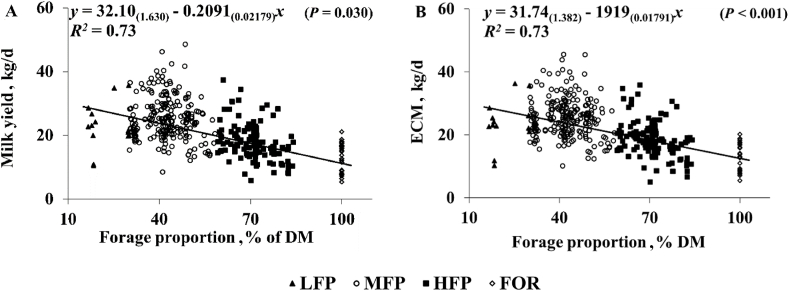
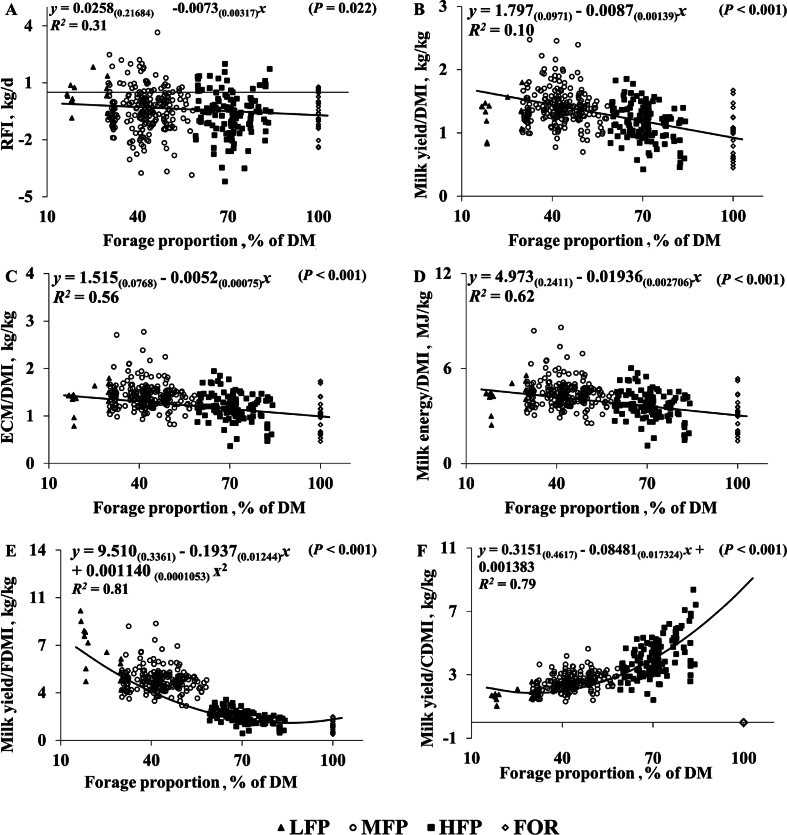
Increasing forage proportion (FP) in the diets of dairy cows would reduce competition for human edible foods and reduce feed costs, particularly in low-input systems. However, increasing FP reduces productivity and may increases methane (CH4) emission parameters. This work aimed to investigate the impact of FP and breed on feed efficiency and CH4 emission parameters. Data from 32 individual experiments conducted at the Agri-Food and Biosciences Institute between 1992 and 2010 were utilised in this study resulting in data from 796 Holstein-Friesian (HF), 50 Norwegian Red (NR), 46 Jersey × HF (J × HF) and 16 NR × HF cows. Diets consisted of varying proportions of forage and concentrate dependent on the experimental protocols of each experiment. A linear mixed model was used to investigate the effect of low (LFP; 10% to 30%), medium (MFP; 30% to 59%), high (HFP; 60% to 87%) and pure (FOR; 100%) FP (dry matter [DM] basis) and breed on feed efficiency, and CH4 emission parameters and multivariate redundancy analysis identified associations between animal and dietary drivers on the same variables. Total dry matter intake (DMI) was higher for cows offered LFP (17.3 kg/d) and MFP (17.9 kg/d) compared to HFP (15.3 kg/d) and FOR (13.8 kg/d) (P < 0.001). Milk yield (P < 0.001), milk yield/DMI (P < 0.001), energy corrected milk (ECM)/DMI (P < 0.001) and milk energy/DMI (P < 0.001) were higher for LFP and MFP compared to HFP and FOR. Methane/DMI was higher for HFP (24.3 g/kg) compared to MFP (22.4 g/kg) (P < 0.001). Methane/milk yield (P < 0.001) or CH4/ECM (P < 0.001) was higher for HFP (22.5 or 21.6 g/kg) and FOR (27.0 or 25.8 g/kg) compared to MFP (19.1 or 17.9 g/kg). There were no differences between LFP and MFP or between HFP and FOR for milk yield, milk yield/DMI, ECM/DMI, milk energy/DMI, CH4/milk yield and CH4/ECM (P > 0.05). Differences existed between breeds for residual feed intake (P = 0.040), milk yield/DMI (P = 0.041) and CH4/DMI (P = 0.048) with multivariate redundancy analysis demonstrating negative correlations with efficiency and positive correlations with CH4/DMI and CH4/milk yield. Feeding concentrates at 70% to 90% of DMI (LFP group) would not result in any further benefits for productivity, feed efficiency or CH4 yield and intensity when compared to feeding 41% to 70% concentrates of DMI (MFP group). There may be opportunity to improve profitability for lower intensity farms with less concentrate input.
Animal NutritionAgricultural and Biological Sciences-Animal Science and Zoology
CiteScore
7.40
自引率
3.20%
发文量
172
审稿时长
12 weeks
期刊介绍:
Animal Nutrition encompasses the full gamut of animal nutritional sciences and reviews including, but not limited to, fundamental aspects of animal nutrition such as nutritional requirements, metabolic studies, body composition, energetics, immunology, neuroscience, microbiology, genetics and molecular and cell biology related to nutrition, and more applied aspects of animal nutrition, such as raw material evaluation, feed additives, nutritive value of novel ingredients and feed safety.





 京公网安备 11010802042870号
京ICP备2023020795号-1
京公网安备 11010802042870号
京ICP备2023020795号-1

 分享
分享
 求助内容:
求助内容: 应助结果提醒方式:
 扫码关注我们
