{"title":"双酚A和滴滴涕破坏乳腺脂肪细胞功能:对乳腺癌风险和进展的影响。","authors":"Sarah M Bernhardt, Carrie D House","doi":"10.3389/fonc.2025.1490898","DOIUrl":null,"url":null,"abstract":"<p><p>As breast cancer incidence continues to rise worldwide, there is a pressing need to understand the environmental factors that contribute to its development. Obesogens, including Bisphenol A (BPA) and Dichlorodiphenyltrichloroethane (DDT), are highly prevalent in the environment, and have been associated with obesity and metabolic dysregulation. BPA and DDT, known to disrupt hormone signaling in breast epithelial cells, also promote adipogenesis, lipogenesis, and adipokine secretion in adipose tissue, directly contributing to the pathogenesis of obesity. While the adipose-rich mammary gland may be particularly vulnerable to environmental obesogens, there is a scarcity of research investigating obesogen-mediated changes in adipocytes that drive oncogenic transformation of breast epithelial cells. Here, we review the preclinical and clinical evidence linking BPA and DDT to impaired mammary gland development and breast cancer risk. We discuss how the obesogen-driven mechanisms that contribute to obesity, including changes in adipogenesis, lipogenesis, and adipokine secretion, could provide a pro-inflammatory, nutrient-rich environment that promotes activation of oncogenic pathways in breast epithelial cells. Understanding the role of obesogens in breast cancer risk and progression is essential for informing public health guidelines aimed at minimizing obesogen exposure, to ultimately reduce breast cancer incidence and improve outcomes for women.</p>","PeriodicalId":12482,"journal":{"name":"Frontiers in Oncology","volume":"15 ","pages":"1490898"},"PeriodicalIF":3.5000,"publicationDate":"2025-02-17","publicationTypes":"Journal Article","fieldsOfStudy":null,"isOpenAccess":false,"openAccessPdf":"https://www.ncbi.nlm.nih.gov/pmc/articles/PMC11873108/pdf/","citationCount":"0","resultStr":"{\"title\":\"Bisphenol A and DDT disrupt adipocyte function in the mammary gland: implications for breast cancer risk and progression.\",\"authors\":\"Sarah M Bernhardt, Carrie D House\",\"doi\":\"10.3389/fonc.2025.1490898\",\"DOIUrl\":null,\"url\":null,\"abstract\":\"<p><p>As breast cancer incidence continues to rise worldwide, there is a pressing need to understand the environmental factors that contribute to its development. Obesogens, including Bisphenol A (BPA) and Dichlorodiphenyltrichloroethane (DDT), are highly prevalent in the environment, and have been associated with obesity and metabolic dysregulation. BPA and DDT, known to disrupt hormone signaling in breast epithelial cells, also promote adipogenesis, lipogenesis, and adipokine secretion in adipose tissue, directly contributing to the pathogenesis of obesity. While the adipose-rich mammary gland may be particularly vulnerable to environmental obesogens, there is a scarcity of research investigating obesogen-mediated changes in adipocytes that drive oncogenic transformation of breast epithelial cells. Here, we review the preclinical and clinical evidence linking BPA and DDT to impaired mammary gland development and breast cancer risk. We discuss how the obesogen-driven mechanisms that contribute to obesity, including changes in adipogenesis, lipogenesis, and adipokine secretion, could provide a pro-inflammatory, nutrient-rich environment that promotes activation of oncogenic pathways in breast epithelial cells. Understanding the role of obesogens in breast cancer risk and progression is essential for informing public health guidelines aimed at minimizing obesogen exposure, to ultimately reduce breast cancer incidence and improve outcomes for women.</p>\",\"PeriodicalId\":12482,\"journal\":{\"name\":\"Frontiers in Oncology\",\"volume\":\"15 \",\"pages\":\"1490898\"},\"PeriodicalIF\":3.5000,\"publicationDate\":\"2025-02-17\",\"publicationTypes\":\"Journal Article\",\"fieldsOfStudy\":null,\"isOpenAccess\":false,\"openAccessPdf\":\"https://www.ncbi.nlm.nih.gov/pmc/articles/PMC11873108/pdf/\",\"citationCount\":\"0\",\"resultStr\":null,\"platform\":\"Semanticscholar\",\"paperid\":null,\"PeriodicalName\":\"Frontiers in Oncology\",\"FirstCategoryId\":\"3\",\"ListUrlMain\":\"https://doi.org/10.3389/fonc.2025.1490898\",\"RegionNum\":3,\"RegionCategory\":\"医学\",\"ArticlePicture\":[],\"TitleCN\":null,\"AbstractTextCN\":null,\"PMCID\":null,\"EPubDate\":\"2025/1/1 0:00:00\",\"PubModel\":\"eCollection\",\"JCR\":\"Q2\",\"JCRName\":\"ONCOLOGY\",\"Score\":null,\"Total\":0}","platform":"Semanticscholar","paperid":null,"PeriodicalName":"Frontiers in Oncology","FirstCategoryId":"3","ListUrlMain":"https://doi.org/10.3389/fonc.2025.1490898","RegionNum":3,"RegionCategory":"医学","ArticlePicture":[],"TitleCN":null,"AbstractTextCN":null,"PMCID":null,"EPubDate":"2025/1/1 0:00:00","PubModel":"eCollection","JCR":"Q2","JCRName":"ONCOLOGY","Score":null,"Total":0}
Bisphenol A and DDT disrupt adipocyte function in the mammary gland: implications for breast cancer risk and progression.
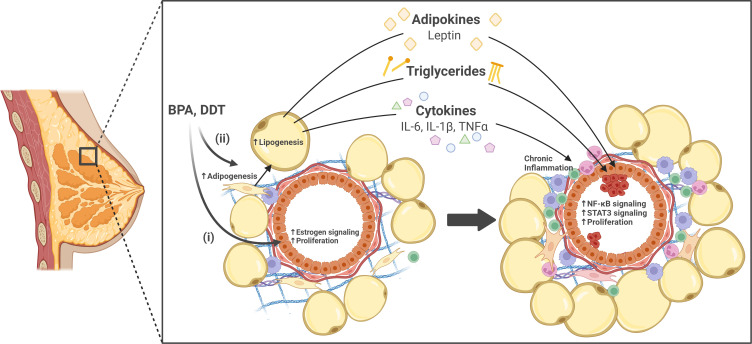
As breast cancer incidence continues to rise worldwide, there is a pressing need to understand the environmental factors that contribute to its development. Obesogens, including Bisphenol A (BPA) and Dichlorodiphenyltrichloroethane (DDT), are highly prevalent in the environment, and have been associated with obesity and metabolic dysregulation. BPA and DDT, known to disrupt hormone signaling in breast epithelial cells, also promote adipogenesis, lipogenesis, and adipokine secretion in adipose tissue, directly contributing to the pathogenesis of obesity. While the adipose-rich mammary gland may be particularly vulnerable to environmental obesogens, there is a scarcity of research investigating obesogen-mediated changes in adipocytes that drive oncogenic transformation of breast epithelial cells. Here, we review the preclinical and clinical evidence linking BPA and DDT to impaired mammary gland development and breast cancer risk. We discuss how the obesogen-driven mechanisms that contribute to obesity, including changes in adipogenesis, lipogenesis, and adipokine secretion, could provide a pro-inflammatory, nutrient-rich environment that promotes activation of oncogenic pathways in breast epithelial cells. Understanding the role of obesogens in breast cancer risk and progression is essential for informing public health guidelines aimed at minimizing obesogen exposure, to ultimately reduce breast cancer incidence and improve outcomes for women.
期刊介绍:
Cancer Imaging and Diagnosis is dedicated to the publication of results from clinical and research studies applied to cancer diagnosis and treatment. The section aims to publish studies from the entire field of cancer imaging: results from routine use of clinical imaging in both radiology and nuclear medicine, results from clinical trials, experimental molecular imaging in humans and small animals, research on new contrast agents in CT, MRI, ultrasound, publication of new technical applications and processing algorithms to improve the standardization of quantitative imaging and image guided interventions for the diagnosis and treatment of cancer.




 京公网安备 11010802042870号
京ICP备2023020795号-1
京公网安备 11010802042870号
京ICP备2023020795号-1

 分享
分享
 求助内容:
求助内容: 应助结果提醒方式:
 扫码关注我们
