{"title":"关于单侧离心主观视觉垂直测试最佳旋转刺激的临床研究。","authors":"Xueqing Zhang, Qiaomei Deng, Xiaobang Huang, Chao Wen, Wei Wang, Taisheng Chen","doi":"10.3389/fnins.2025.1529572","DOIUrl":null,"url":null,"abstract":"<p><strong>Objective: </strong>To investigate the optimal stimulation intensity and reference range of the unilateral centrifugation subjective visual vertical (UC-SVV) test and to fill the technical gap in otolithic function evaluation in patients with peripheral vestibular diseases.</p><p><strong>Method: </strong>Forty healthy subjects (median age 28 years) underwent a UC-SVV test at rotation speeds of 60, 120, 180, and 240 deg./s using the Neuro Kinetics Inc. (NKI) I-Portal 6.0 NOTC rotating chair system. The deviation angles of the UC-SVV line in the centre and left/right positions at each rotation speed were recorded and analysed.</p><p><strong>Results: </strong>Forty healthy subjects completed the test. The deviation angle of the UC-SVV line differed according to the rotation speed (60, 120, 180, and 240 deg./s). At each rotation speed, the position of the rotation axis (left/centre/right position) affected the deviation angle and direction of the UC-SVV line. At each position of the rotation axis, the rotation speed also affected the deviation angle. When the rotation chair was translated to the left and right positions, the UC-SVV line deviated to the right and left sides, respectively, and the deviation angle increased with increasing rotation speed. The deviation angle at 60 deg./s was significantly less than that at 180 and 240 deg./s (<i>p</i> < 0.001). When the rotation axis was in the centre position, the absolute value of the SVV deviation was less than 0.3, and there was no statistically significant difference at any rotation speed.</p><p><strong>Conclusion: </strong>This study preliminarily discussed the deviation direction and angle of the UC-SVV line under different stimulation intensities in a range of healthy middle-aged subjects. The optimal stimulation intensity for the UC-SVV test is suggested to be 180 or 240 deg./s. Specifically, the peak rotation speed could be 180 deg./s if the subject is unable to tolerate high-speed rotation. This study provides support for improving this technology for evaluation of otolith function and its diagnostic significance in peripheral vestibular diseases.</p>","PeriodicalId":12639,"journal":{"name":"Frontiers in Neuroscience","volume":"19 ","pages":"1529572"},"PeriodicalIF":4.0000,"publicationDate":"2025-02-17","publicationTypes":"Journal Article","fieldsOfStudy":null,"isOpenAccess":false,"openAccessPdf":"https://www.ncbi.nlm.nih.gov/pmc/articles/PMC11872882/pdf/","citationCount":"0","resultStr":"{\"title\":\"Clinical study on the optimal rotational stimulation for the unilateral centrifugation subjective visual vertical test.\",\"authors\":\"Xueqing Zhang, Qiaomei Deng, Xiaobang Huang, Chao Wen, Wei Wang, Taisheng Chen\",\"doi\":\"10.3389/fnins.2025.1529572\",\"DOIUrl\":null,\"url\":null,\"abstract\":\"<p><strong>Objective: </strong>To investigate the optimal stimulation intensity and reference range of the unilateral centrifugation subjective visual vertical (UC-SVV) test and to fill the technical gap in otolithic function evaluation in patients with peripheral vestibular diseases.</p><p><strong>Method: </strong>Forty healthy subjects (median age 28 years) underwent a UC-SVV test at rotation speeds of 60, 120, 180, and 240 deg./s using the Neuro Kinetics Inc. (NKI) I-Portal 6.0 NOTC rotating chair system. The deviation angles of the UC-SVV line in the centre and left/right positions at each rotation speed were recorded and analysed.</p><p><strong>Results: </strong>Forty healthy subjects completed the test. The deviation angle of the UC-SVV line differed according to the rotation speed (60, 120, 180, and 240 deg./s). At each rotation speed, the position of the rotation axis (left/centre/right position) affected the deviation angle and direction of the UC-SVV line. At each position of the rotation axis, the rotation speed also affected the deviation angle. When the rotation chair was translated to the left and right positions, the UC-SVV line deviated to the right and left sides, respectively, and the deviation angle increased with increasing rotation speed. The deviation angle at 60 deg./s was significantly less than that at 180 and 240 deg./s (<i>p</i> < 0.001). When the rotation axis was in the centre position, the absolute value of the SVV deviation was less than 0.3, and there was no statistically significant difference at any rotation speed.</p><p><strong>Conclusion: </strong>This study preliminarily discussed the deviation direction and angle of the UC-SVV line under different stimulation intensities in a range of healthy middle-aged subjects. The optimal stimulation intensity for the UC-SVV test is suggested to be 180 or 240 deg./s. Specifically, the peak rotation speed could be 180 deg./s if the subject is unable to tolerate high-speed rotation. This study provides support for improving this technology for evaluation of otolith function and its diagnostic significance in peripheral vestibular diseases.</p>\",\"PeriodicalId\":12639,\"journal\":{\"name\":\"Frontiers in Neuroscience\",\"volume\":\"19 \",\"pages\":\"1529572\"},\"PeriodicalIF\":4.0000,\"publicationDate\":\"2025-02-17\",\"publicationTypes\":\"Journal Article\",\"fieldsOfStudy\":null,\"isOpenAccess\":false,\"openAccessPdf\":\"https://www.ncbi.nlm.nih.gov/pmc/articles/PMC11872882/pdf/\",\"citationCount\":\"0\",\"resultStr\":null,\"platform\":\"Semanticscholar\",\"paperid\":null,\"PeriodicalName\":\"Frontiers in Neuroscience\",\"FirstCategoryId\":\"3\",\"ListUrlMain\":\"https://doi.org/10.3389/fnins.2025.1529572\",\"RegionNum\":3,\"RegionCategory\":\"医学\",\"ArticlePicture\":[],\"TitleCN\":null,\"AbstractTextCN\":null,\"PMCID\":null,\"EPubDate\":\"2025/1/1 0:00:00\",\"PubModel\":\"eCollection\",\"JCR\":\"Q2\",\"JCRName\":\"NEUROSCIENCES\",\"Score\":null,\"Total\":0}","platform":"Semanticscholar","paperid":null,"PeriodicalName":"Frontiers in Neuroscience","FirstCategoryId":"3","ListUrlMain":"https://doi.org/10.3389/fnins.2025.1529572","RegionNum":3,"RegionCategory":"医学","ArticlePicture":[],"TitleCN":null,"AbstractTextCN":null,"PMCID":null,"EPubDate":"2025/1/1 0:00:00","PubModel":"eCollection","JCR":"Q2","JCRName":"NEUROSCIENCES","Score":null,"Total":0}
Clinical study on the optimal rotational stimulation for the unilateral centrifugation subjective visual vertical test.
Objective: To investigate the optimal stimulation intensity and reference range of the unilateral centrifugation subjective visual vertical (UC-SVV) test and to fill the technical gap in otolithic function evaluation in patients with peripheral vestibular diseases.
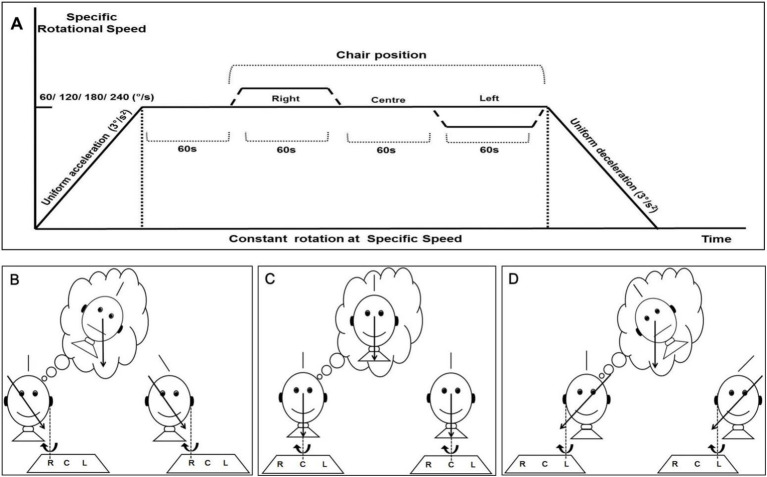
Method: Forty healthy subjects (median age 28 years) underwent a UC-SVV test at rotation speeds of 60, 120, 180, and 240 deg./s using the Neuro Kinetics Inc. (NKI) I-Portal 6.0 NOTC rotating chair system. The deviation angles of the UC-SVV line in the centre and left/right positions at each rotation speed were recorded and analysed.
Results: Forty healthy subjects completed the test. The deviation angle of the UC-SVV line differed according to the rotation speed (60, 120, 180, and 240 deg./s). At each rotation speed, the position of the rotation axis (left/centre/right position) affected the deviation angle and direction of the UC-SVV line. At each position of the rotation axis, the rotation speed also affected the deviation angle. When the rotation chair was translated to the left and right positions, the UC-SVV line deviated to the right and left sides, respectively, and the deviation angle increased with increasing rotation speed. The deviation angle at 60 deg./s was significantly less than that at 180 and 240 deg./s (p < 0.001). When the rotation axis was in the centre position, the absolute value of the SVV deviation was less than 0.3, and there was no statistically significant difference at any rotation speed.
Conclusion: This study preliminarily discussed the deviation direction and angle of the UC-SVV line under different stimulation intensities in a range of healthy middle-aged subjects. The optimal stimulation intensity for the UC-SVV test is suggested to be 180 or 240 deg./s. Specifically, the peak rotation speed could be 180 deg./s if the subject is unable to tolerate high-speed rotation. This study provides support for improving this technology for evaluation of otolith function and its diagnostic significance in peripheral vestibular diseases.
期刊介绍:
Neural Technology is devoted to the convergence between neurobiology and quantum-, nano- and micro-sciences. In our vision, this interdisciplinary approach should go beyond the technological development of sophisticated methods and should contribute in generating a genuine change in our discipline.






 京公网安备 11010802042870号
京ICP备2023020795号-1
京公网安备 11010802042870号
京ICP备2023020795号-1

 分享
分享
 求助内容:
求助内容: 应助结果提醒方式:
 扫码关注我们
