{"title":"用OCT和OCTA特征细粒度分类揭示葡萄酒斑血管病理异质性。","authors":"Xiaofeng Deng;Defu Chen;Bowen Liu;Xiwan Zhang;Haixia Qiu;Wu Yuan;Hongliang Ren","doi":"10.1109/JBHI.2025.3545931","DOIUrl":null,"url":null,"abstract":"Accurate classification of port wine stains (PWS, vascular malformations present at birth), is critical for subsequent treatment planning. However, the current method of classifying PWS based on the external skin appearance rarely reflects the underlying angiopathological heterogeneity of PWS lesions, resulting in inconsistent outcomes with the common vascular-targeted photodynamic therapy (V-PDT) treatments. Conversely, optical coherence tomography angiography (OCTA) is an ideal tool for visualizing the vascular malformations of PWS. Previous studies have shown no significant correlation between OCTA quantitative metrics and the PWS subtypes determined by the current classification approach. In this study, we propose a novel fine-grained classification method for PWS that integrates OCT and OCTA imaging. Utilizing a machine learning-based approach, we subdivided PWS into five distinct subtypes by unearthing the heterogeneity of hypodermic histopathology and vessel structures. Six quantitative metrics, encompassing vascular morphology and depth information of PWS lesions, were designed and statistically analyzed to evaluate angiopathological differences among the subtypes. Our classification reveals significant distinctions across all metrics compared to conventional skin appearance-based subtypes, demonstrating its ability to accurately capture angiopathological heterogeneity. This research marks the first attempt to classify PWS based on angiopathology, potentially guiding more effective subtyping and treatment strategies for PWS.","PeriodicalId":13073,"journal":{"name":"IEEE Journal of Biomedical and Health Informatics","volume":"29 7","pages":"4991-5002"},"PeriodicalIF":7.7000,"publicationDate":"2025-02-26","publicationTypes":"Journal Article","fieldsOfStudy":null,"isOpenAccess":false,"openAccessPdf":"","citationCount":"0","resultStr":"{\"title\":\"Fine-Grained Classification Reveals Angiopathological Heterogeneity of Port Wine Stains Using OCT and OCTA Features\",\"authors\":\"Xiaofeng Deng;Defu Chen;Bowen Liu;Xiwan Zhang;Haixia Qiu;Wu Yuan;Hongliang Ren\",\"doi\":\"10.1109/JBHI.2025.3545931\",\"DOIUrl\":null,\"url\":null,\"abstract\":\"Accurate classification of port wine stains (PWS, vascular malformations present at birth), is critical for subsequent treatment planning. However, the current method of classifying PWS based on the external skin appearance rarely reflects the underlying angiopathological heterogeneity of PWS lesions, resulting in inconsistent outcomes with the common vascular-targeted photodynamic therapy (V-PDT) treatments. Conversely, optical coherence tomography angiography (OCTA) is an ideal tool for visualizing the vascular malformations of PWS. Previous studies have shown no significant correlation between OCTA quantitative metrics and the PWS subtypes determined by the current classification approach. In this study, we propose a novel fine-grained classification method for PWS that integrates OCT and OCTA imaging. Utilizing a machine learning-based approach, we subdivided PWS into five distinct subtypes by unearthing the heterogeneity of hypodermic histopathology and vessel structures. Six quantitative metrics, encompassing vascular morphology and depth information of PWS lesions, were designed and statistically analyzed to evaluate angiopathological differences among the subtypes. Our classification reveals significant distinctions across all metrics compared to conventional skin appearance-based subtypes, demonstrating its ability to accurately capture angiopathological heterogeneity. This research marks the first attempt to classify PWS based on angiopathology, potentially guiding more effective subtyping and treatment strategies for PWS.\",\"PeriodicalId\":13073,\"journal\":{\"name\":\"IEEE Journal of Biomedical and Health Informatics\",\"volume\":\"29 7\",\"pages\":\"4991-5002\"},\"PeriodicalIF\":7.7000,\"publicationDate\":\"2025-02-26\",\"publicationTypes\":\"Journal Article\",\"fieldsOfStudy\":null,\"isOpenAccess\":false,\"openAccessPdf\":\"\",\"citationCount\":\"0\",\"resultStr\":null,\"platform\":\"Semanticscholar\",\"paperid\":null,\"PeriodicalName\":\"IEEE Journal of Biomedical and Health Informatics\",\"FirstCategoryId\":\"5\",\"ListUrlMain\":\"https://ieeexplore.ieee.org/document/10904246/\",\"RegionNum\":2,\"RegionCategory\":\"医学\",\"ArticlePicture\":[],\"TitleCN\":null,\"AbstractTextCN\":null,\"PMCID\":null,\"EPubDate\":\"\",\"PubModel\":\"\",\"JCR\":\"Q1\",\"JCRName\":\"COMPUTER SCIENCE, INFORMATION SYSTEMS\",\"Score\":null,\"Total\":0}","platform":"Semanticscholar","paperid":null,"PeriodicalName":"IEEE Journal of Biomedical and Health Informatics","FirstCategoryId":"5","ListUrlMain":"https://ieeexplore.ieee.org/document/10904246/","RegionNum":2,"RegionCategory":"医学","ArticlePicture":[],"TitleCN":null,"AbstractTextCN":null,"PMCID":null,"EPubDate":"","PubModel":"","JCR":"Q1","JCRName":"COMPUTER SCIENCE, INFORMATION SYSTEMS","Score":null,"Total":0}
Fine-Grained Classification Reveals Angiopathological Heterogeneity of Port Wine Stains Using OCT and OCTA Features
Accurate classification of port wine stains (PWS, vascular malformations present at birth), is critical for subsequent treatment planning. However, the current method of classifying PWS based on the external skin appearance rarely reflects the underlying angiopathological heterogeneity of PWS lesions, resulting in inconsistent outcomes with the common vascular-targeted photodynamic therapy (V-PDT) treatments. Conversely, optical coherence tomography angiography (OCTA) is an ideal tool for visualizing the vascular malformations of PWS. Previous studies have shown no significant correlation between OCTA quantitative metrics and the PWS subtypes determined by the current classification approach. In this study, we propose a novel fine-grained classification method for PWS that integrates OCT and OCTA imaging. Utilizing a machine learning-based approach, we subdivided PWS into five distinct subtypes by unearthing the heterogeneity of hypodermic histopathology and vessel structures. Six quantitative metrics, encompassing vascular morphology and depth information of PWS lesions, were designed and statistically analyzed to evaluate angiopathological differences among the subtypes. Our classification reveals significant distinctions across all metrics compared to conventional skin appearance-based subtypes, demonstrating its ability to accurately capture angiopathological heterogeneity. This research marks the first attempt to classify PWS based on angiopathology, potentially guiding more effective subtyping and treatment strategies for PWS.
期刊介绍:
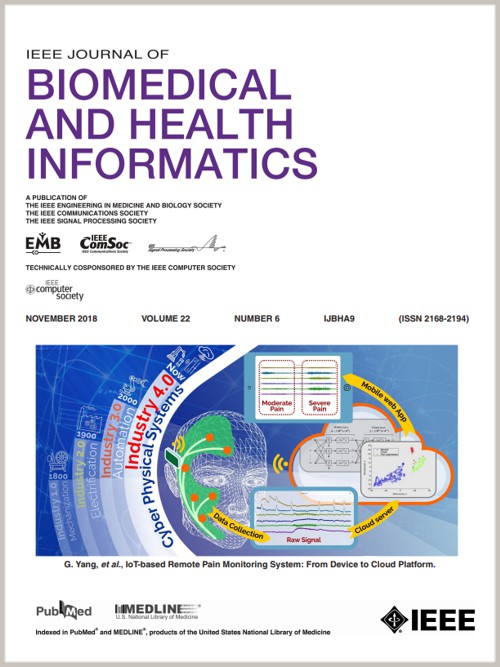
IEEE Journal of Biomedical and Health Informatics publishes original papers presenting recent advances where information and communication technologies intersect with health, healthcare, life sciences, and biomedicine. Topics include acquisition, transmission, storage, retrieval, management, and analysis of biomedical and health information. The journal covers applications of information technologies in healthcare, patient monitoring, preventive care, early disease diagnosis, therapy discovery, and personalized treatment protocols. It explores electronic medical and health records, clinical information systems, decision support systems, medical and biological imaging informatics, wearable systems, body area/sensor networks, and more. Integration-related topics like interoperability, evidence-based medicine, and secure patient data are also addressed.




 京公网安备 11010802042870号
京ICP备2023020795号-1
京公网安备 11010802042870号
京ICP备2023020795号-1

 分享
分享
 求助内容:
求助内容: 应助结果提醒方式:
 扫码关注我们
