Erik Serrano, Srinivas Niranj Chandrasekaran, Dave Bunten, Kenneth I. Brewer, Jenna Tomkinson, Roshan Kern, Michael Bornholdt, Stephen J. Fleming, Ruifan Pei, John Arevalo, Hillary Tsang, Vincent Rubinetti, Callum Tromans-Coia, Tim Becker, Erin Weisbart, Charlotte Bunne, Alexandr A. Kalinin, Rebecca Senft, Stephen J. Taylor, Nasim Jamali, Adeniyi Adeboye, Hamdah Shafqat Abbasi, Allen Goodman, Juan C. Caicedo, Anne E. Carpenter, Beth A. Cimini, Shantanu Singh, Gregory P. Way
{"title":"利用Pycytominer进行可重复的基于图像的分析。","authors":"Erik Serrano, Srinivas Niranj Chandrasekaran, Dave Bunten, Kenneth I. Brewer, Jenna Tomkinson, Roshan Kern, Michael Bornholdt, Stephen J. Fleming, Ruifan Pei, John Arevalo, Hillary Tsang, Vincent Rubinetti, Callum Tromans-Coia, Tim Becker, Erin Weisbart, Charlotte Bunne, Alexandr A. Kalinin, Rebecca Senft, Stephen J. Taylor, Nasim Jamali, Adeniyi Adeboye, Hamdah Shafqat Abbasi, Allen Goodman, Juan C. Caicedo, Anne E. Carpenter, Beth A. Cimini, Shantanu Singh, Gregory P. Way","doi":"10.1038/s41592-025-02611-8","DOIUrl":null,"url":null,"abstract":"Advances in high-throughput microscopy have enabled the rapid acquisition of large numbers of high-content microscopy images. Next, whether by deep learning or classical algorithms, image analysis pipelines commonly produce single-cell features. To process these single cells for downstream applications, we present Pycytominer, a user-friendly, open-source Python package that implements the bioinformatics steps key to image-based profiling. We demonstrate Pycytominer’s usefulness in a machine-learning project to predict nuisance compounds that cause undesirable cell injuries. Pycytominer is a user-friendly, open-source Python package that carries out key bioinformatics steps in image-based profiling.","PeriodicalId":18981,"journal":{"name":"Nature Methods","volume":"22 4","pages":"677-680"},"PeriodicalIF":32.1000,"publicationDate":"2025-03-03","publicationTypes":"Journal Article","fieldsOfStudy":null,"isOpenAccess":false,"openAccessPdf":"","citationCount":"0","resultStr":"{\"title\":\"Reproducible image-based profiling with Pycytominer\",\"authors\":\"Erik Serrano, Srinivas Niranj Chandrasekaran, Dave Bunten, Kenneth I. Brewer, Jenna Tomkinson, Roshan Kern, Michael Bornholdt, Stephen J. Fleming, Ruifan Pei, John Arevalo, Hillary Tsang, Vincent Rubinetti, Callum Tromans-Coia, Tim Becker, Erin Weisbart, Charlotte Bunne, Alexandr A. Kalinin, Rebecca Senft, Stephen J. Taylor, Nasim Jamali, Adeniyi Adeboye, Hamdah Shafqat Abbasi, Allen Goodman, Juan C. Caicedo, Anne E. Carpenter, Beth A. Cimini, Shantanu Singh, Gregory P. Way\",\"doi\":\"10.1038/s41592-025-02611-8\",\"DOIUrl\":null,\"url\":null,\"abstract\":\"Advances in high-throughput microscopy have enabled the rapid acquisition of large numbers of high-content microscopy images. Next, whether by deep learning or classical algorithms, image analysis pipelines commonly produce single-cell features. To process these single cells for downstream applications, we present Pycytominer, a user-friendly, open-source Python package that implements the bioinformatics steps key to image-based profiling. We demonstrate Pycytominer’s usefulness in a machine-learning project to predict nuisance compounds that cause undesirable cell injuries. Pycytominer is a user-friendly, open-source Python package that carries out key bioinformatics steps in image-based profiling.\",\"PeriodicalId\":18981,\"journal\":{\"name\":\"Nature Methods\",\"volume\":\"22 4\",\"pages\":\"677-680\"},\"PeriodicalIF\":32.1000,\"publicationDate\":\"2025-03-03\",\"publicationTypes\":\"Journal Article\",\"fieldsOfStudy\":null,\"isOpenAccess\":false,\"openAccessPdf\":\"\",\"citationCount\":\"0\",\"resultStr\":null,\"platform\":\"Semanticscholar\",\"paperid\":null,\"PeriodicalName\":\"Nature Methods\",\"FirstCategoryId\":\"99\",\"ListUrlMain\":\"https://www.nature.com/articles/s41592-025-02611-8\",\"RegionNum\":1,\"RegionCategory\":\"生物学\",\"ArticlePicture\":[],\"TitleCN\":null,\"AbstractTextCN\":null,\"PMCID\":null,\"EPubDate\":\"\",\"PubModel\":\"\",\"JCR\":\"Q1\",\"JCRName\":\"BIOCHEMICAL RESEARCH METHODS\",\"Score\":null,\"Total\":0}","platform":"Semanticscholar","paperid":null,"PeriodicalName":"Nature Methods","FirstCategoryId":"99","ListUrlMain":"https://www.nature.com/articles/s41592-025-02611-8","RegionNum":1,"RegionCategory":"生物学","ArticlePicture":[],"TitleCN":null,"AbstractTextCN":null,"PMCID":null,"EPubDate":"","PubModel":"","JCR":"Q1","JCRName":"BIOCHEMICAL RESEARCH METHODS","Score":null,"Total":0}
Reproducible image-based profiling with Pycytominer
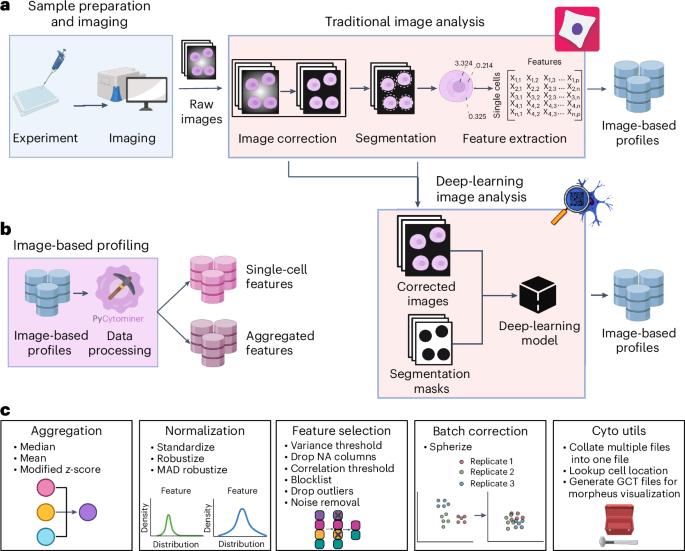
Advances in high-throughput microscopy have enabled the rapid acquisition of large numbers of high-content microscopy images. Next, whether by deep learning or classical algorithms, image analysis pipelines commonly produce single-cell features. To process these single cells for downstream applications, we present Pycytominer, a user-friendly, open-source Python package that implements the bioinformatics steps key to image-based profiling. We demonstrate Pycytominer’s usefulness in a machine-learning project to predict nuisance compounds that cause undesirable cell injuries. Pycytominer is a user-friendly, open-source Python package that carries out key bioinformatics steps in image-based profiling.
期刊介绍:
Nature Methods is a monthly journal that focuses on publishing innovative methods and substantial enhancements to fundamental life sciences research techniques. Geared towards a diverse, interdisciplinary readership of researchers in academia and industry engaged in laboratory work, the journal offers new tools for research and emphasizes the immediate practical significance of the featured work. It publishes primary research papers and reviews recent technical and methodological advancements, with a particular interest in primary methods papers relevant to the biological and biomedical sciences. This includes methods rooted in chemistry with practical applications for studying biological problems.




 京公网安备 11010802042870号
京ICP备2023020795号-1
京公网安备 11010802042870号
京ICP备2023020795号-1

 分享
分享
 求助内容:
求助内容: 应助结果提醒方式:
 扫码关注我们
