IF 2.9 3区 生物学Q2 MULTIDISCIPLINARY SCIENCESPeerJPub Date : 2025-02-28eCollection Date: 2025-01-01DOI:10.7717/peerj.19027
Mingwei Li, Wei Liu, Xizhenzi Fan, Wenhui Song, Achou Su, Xue Zhang, Thomas Zheng, Tianxiao Yu
{"title":"妊娠后三个月肾功能指标与子痫前期的关系:一项回顾性研究。","authors":"Mingwei Li, Wei Liu, Xizhenzi Fan, Wenhui Song, Achou Su, Xue Zhang, Thomas Zheng, Tianxiao Yu","doi":"10.7717/peerj.19027","DOIUrl":null,"url":null,"abstract":"<p><strong>Background: </strong>To investigate the relationship between serum renal function indicators and preeclampsia (PE) in pregnant women at second trimester of pregnancy, determine the optimal critical values of the above indicators, and further identify the independent risk factors of PE.</p><p><strong>Methods: </strong>We assessed the renal function indicators in second trimesters of 137 pregnant women with PE and 137 normal pregnant women who delivered at Shijiazhuang Fourth Hospital between January 2020 to December 2022. Paired <i>t</i>-tests, paired Mann-Whitney U tests, and Chi-square tests were used to evaluate differences of clinical data between the two groups. Receiver operating characteristic (ROC) curves was employed to establish the optimal critical values of the above indicators. A 1:1 matched case-control logistic regression analysis was conducted to identify the independent risk factors for PE.</p><p><strong>Results: </strong>The levels of serum uric acid and the ratio of serum uric acid to serum creatinine were significantly higher in the PE group compared to the control (<i>P</i> < 0.001), while the serum creatinine levels were higher in control group (<i>P</i> = 0.002). The incidence of adverse maternal (<i>P</i> < 0.001) and neonatal outcomes (<i>P</i> < 0.001) in the PE group were higher than those in the control group. A ROC analysis based on the occurrence of PE showed that the levels of serum uric acid (<i>P</i> < 0.001), serum creatinine (<i>P</i> = 0.006) and the ratio of serum uric acid to serum creatinine (<i>P</i> < 0.001) were statistically significant. After adjusting for confounding factors, elevated serum uric acid (a <i>OR</i> = 1.012, 95% CI [1.005-1.019], <i>P</i> < 0.001) and an increased serum uric acid to serum creatinine ratio (a <i>OR</i> = 1.190, 95% CI [1.053-1.346], <i>P</i> = 0.005) were identified as independent risk factors for PE. There was no significant difference in renal function between maternal and newborn group in relation to the occurrence of adverse outcomes (<i>P</i> > 0.05 <i>vs</i>. all groups).</p><p><strong>Conclusions: </strong>Through the analysis of renal function indicators in patients with PE in the second trimester of pregnancy and those in a normal control group, it is found that elevated serum uric acid and serum uric acid to serum creatinine ratio in PE individual may serve as indicative markers for the onset of PE. Targeting this subset of the population for monitoring and management during the second trimester could enhance the efficacy of medical interventions.</p>","PeriodicalId":19799,"journal":{"name":"PeerJ","volume":"13 ","pages":"e19027"},"PeriodicalIF":2.9000,"publicationDate":"2025-02-28","publicationTypes":"Journal Article","fieldsOfStudy":null,"isOpenAccess":false,"openAccessPdf":"https://www.ncbi.nlm.nih.gov/pmc/articles/PMC11874948/pdf/","citationCount":"0","resultStr":"{\"title\":\"The relationship between renal function indicators and preeclampsia in the second trimester of pregnancy: a retrospective study.\",\"authors\":\"Mingwei Li, Wei Liu, Xizhenzi Fan, Wenhui Song, Achou Su, Xue Zhang, Thomas Zheng, Tianxiao Yu\",\"doi\":\"10.7717/peerj.19027\",\"DOIUrl\":null,\"url\":null,\"abstract\":\"<p><strong>Background: </strong>To investigate the relationship between serum renal function indicators and preeclampsia (PE) in pregnant women at second trimester of pregnancy, determine the optimal critical values of the above indicators, and further identify the independent risk factors of PE.</p><p><strong>Methods: </strong>We assessed the renal function indicators in second trimesters of 137 pregnant women with PE and 137 normal pregnant women who delivered at Shijiazhuang Fourth Hospital between January 2020 to December 2022. Paired <i>t</i>-tests, paired Mann-Whitney U tests, and Chi-square tests were used to evaluate differences of clinical data between the two groups. Receiver operating characteristic (ROC) curves was employed to establish the optimal critical values of the above indicators. A 1:1 matched case-control logistic regression analysis was conducted to identify the independent risk factors for PE.</p><p><strong>Results: </strong>The levels of serum uric acid and the ratio of serum uric acid to serum creatinine were significantly higher in the PE group compared to the control (<i>P</i> < 0.001), while the serum creatinine levels were higher in control group (<i>P</i> = 0.002). The incidence of adverse maternal (<i>P</i> < 0.001) and neonatal outcomes (<i>P</i> < 0.001) in the PE group were higher than those in the control group. A ROC analysis based on the occurrence of PE showed that the levels of serum uric acid (<i>P</i> < 0.001), serum creatinine (<i>P</i> = 0.006) and the ratio of serum uric acid to serum creatinine (<i>P</i> < 0.001) were statistically significant. After adjusting for confounding factors, elevated serum uric acid (a <i>OR</i> = 1.012, 95% CI [1.005-1.019], <i>P</i> < 0.001) and an increased serum uric acid to serum creatinine ratio (a <i>OR</i> = 1.190, 95% CI [1.053-1.346], <i>P</i> = 0.005) were identified as independent risk factors for PE. There was no significant difference in renal function between maternal and newborn group in relation to the occurrence of adverse outcomes (<i>P</i> > 0.05 <i>vs</i>. all groups).</p><p><strong>Conclusions: </strong>Through the analysis of renal function indicators in patients with PE in the second trimester of pregnancy and those in a normal control group, it is found that elevated serum uric acid and serum uric acid to serum creatinine ratio in PE individual may serve as indicative markers for the onset of PE. Targeting this subset of the population for monitoring and management during the second trimester could enhance the efficacy of medical interventions.</p>\",\"PeriodicalId\":19799,\"journal\":{\"name\":\"PeerJ\",\"volume\":\"13 \",\"pages\":\"e19027\"},\"PeriodicalIF\":2.9000,\"publicationDate\":\"2025-02-28\",\"publicationTypes\":\"Journal Article\",\"fieldsOfStudy\":null,\"isOpenAccess\":false,\"openAccessPdf\":\"https://www.ncbi.nlm.nih.gov/pmc/articles/PMC11874948/pdf/\",\"citationCount\":\"0\",\"resultStr\":null,\"platform\":\"Semanticscholar\",\"paperid\":null,\"PeriodicalName\":\"PeerJ\",\"FirstCategoryId\":\"99\",\"ListUrlMain\":\"https://doi.org/10.7717/peerj.19027\",\"RegionNum\":3,\"RegionCategory\":\"生物学\",\"ArticlePicture\":[],\"TitleCN\":null,\"AbstractTextCN\":null,\"PMCID\":null,\"EPubDate\":\"2025/1/1 0:00:00\",\"PubModel\":\"eCollection\",\"JCR\":\"Q2\",\"JCRName\":\"MULTIDISCIPLINARY SCIENCES\",\"Score\":null,\"Total\":0}","platform":"Semanticscholar","paperid":null,"PeriodicalName":"PeerJ","FirstCategoryId":"99","ListUrlMain":"https://doi.org/10.7717/peerj.19027","RegionNum":3,"RegionCategory":"生物学","ArticlePicture":[],"TitleCN":null,"AbstractTextCN":null,"PMCID":null,"EPubDate":"2025/1/1 0:00:00","PubModel":"eCollection","JCR":"Q2","JCRName":"MULTIDISCIPLINARY SCIENCES","Score":null,"Total":0}
引用次数: 0
摘要
背景:探讨妊娠中期孕妇血清肾功能指标与子痫前期(PE)的关系,确定上述指标的最佳临界值,进一步确定PE的独立危险因素。方法:对2020年1月至2022年12月在石家庄市第四医院分娩的137例PE孕妇和137例正常孕妇的妊娠中期肾功能指标进行评估。采用配对t检验、配对Mann-Whitney U检验和卡方检验评价两组临床资料的差异。采用受试者工作特征(ROC)曲线确定上述指标的最佳临界值。采用1:1匹配的病例-对照logistic回归分析,确定PE的独立危险因素。结果:PE组血清尿酸水平及尿酸/肌酐比值显著高于对照组(P < 0.001),而PE组血清肌酐水平显著高于对照组(P = 0.002)。PE组孕产妇不良事件发生率(P < 0.001)和新生儿不良事件发生率(P < 0.001)均高于对照组。根据PE发生情况进行ROC分析,血清尿酸(P < 0.001)、血清肌酐(P = 0.006)、血清尿酸/血清肌酐比值(P < 0.001)差异均有统计学意义。在校正混杂因素后,血清尿酸升高(OR = 1.012, 95% CI [1.005-1.019], P < 0.001)和血清尿酸与血清肌酐比值升高(OR = 1.190, 95% CI [1.053-1.346], P = 0.005)被确定为PE的独立危险因素。在不良结局发生方面,产妇组与新生儿组肾功能差异无统计学意义(P < 0.05)。结论:通过对妊娠中期PE患者与正常对照组的肾功能指标分析,发现PE个体血清尿酸及血清尿酸/肌酐比值升高可作为PE发病的指示性指标。针对这部分人群在妊娠中期进行监测和管理,可以提高医疗干预的效果。
The relationship between renal function indicators and preeclampsia in the second trimester of pregnancy: a retrospective study.
Background: To investigate the relationship between serum renal function indicators and preeclampsia (PE) in pregnant women at second trimester of pregnancy, determine the optimal critical values of the above indicators, and further identify the independent risk factors of PE.
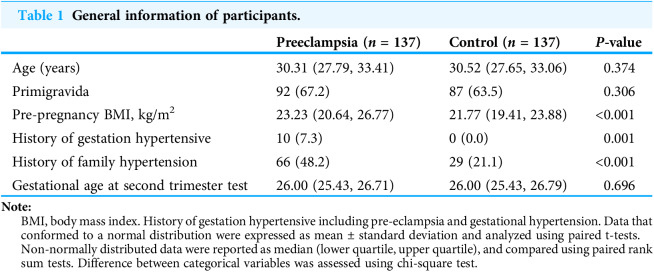
Methods: We assessed the renal function indicators in second trimesters of 137 pregnant women with PE and 137 normal pregnant women who delivered at Shijiazhuang Fourth Hospital between January 2020 to December 2022. Paired t-tests, paired Mann-Whitney U tests, and Chi-square tests were used to evaluate differences of clinical data between the two groups. Receiver operating characteristic (ROC) curves was employed to establish the optimal critical values of the above indicators. A 1:1 matched case-control logistic regression analysis was conducted to identify the independent risk factors for PE.
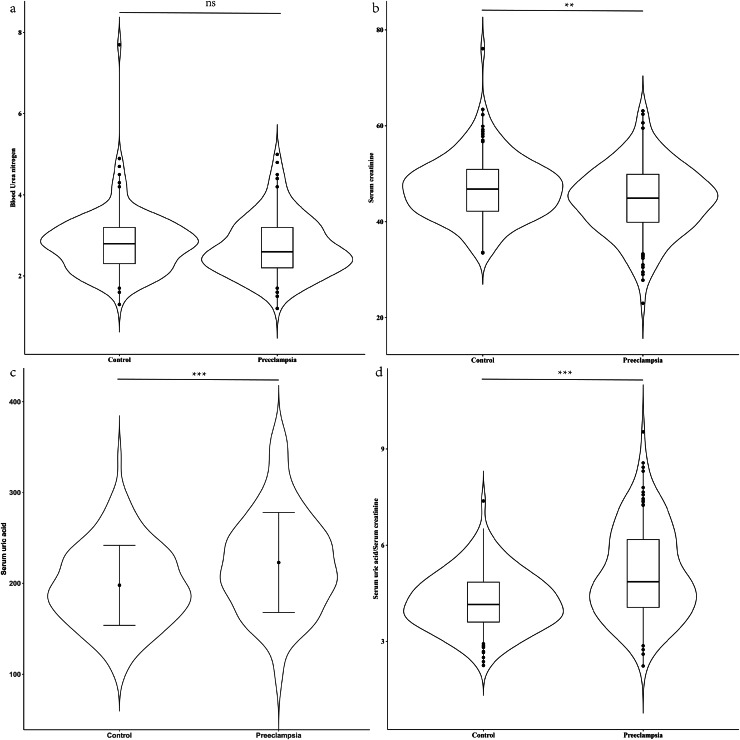
Results: The levels of serum uric acid and the ratio of serum uric acid to serum creatinine were significantly higher in the PE group compared to the control (P < 0.001), while the serum creatinine levels were higher in control group (P = 0.002). The incidence of adverse maternal (P < 0.001) and neonatal outcomes (P < 0.001) in the PE group were higher than those in the control group. A ROC analysis based on the occurrence of PE showed that the levels of serum uric acid (P < 0.001), serum creatinine (P = 0.006) and the ratio of serum uric acid to serum creatinine (P < 0.001) were statistically significant. After adjusting for confounding factors, elevated serum uric acid (a OR = 1.012, 95% CI [1.005-1.019], P < 0.001) and an increased serum uric acid to serum creatinine ratio (a OR = 1.190, 95% CI [1.053-1.346], P = 0.005) were identified as independent risk factors for PE. There was no significant difference in renal function between maternal and newborn group in relation to the occurrence of adverse outcomes (P > 0.05 vs. all groups).
Conclusions: Through the analysis of renal function indicators in patients with PE in the second trimester of pregnancy and those in a normal control group, it is found that elevated serum uric acid and serum uric acid to serum creatinine ratio in PE individual may serve as indicative markers for the onset of PE. Targeting this subset of the population for monitoring and management during the second trimester could enhance the efficacy of medical interventions.
期刊介绍:
PeerJ is an open access peer-reviewed scientific journal covering research in the biological and medical sciences. At PeerJ, authors take out a lifetime publication plan (for as little as $99) which allows them to publish articles in the journal for free, forever. PeerJ has 5 Nobel Prize Winners on the Board; they have won several industry and media awards; and they are widely recognized as being one of the most interesting recent developments in academic publishing.





 京公网安备 11010802042870号
京ICP备2023020795号-1
京公网安备 11010802042870号
京ICP备2023020795号-1

 分享
分享
 求助内容:
求助内容: 应助结果提醒方式:
 扫码关注我们
