IF 2.4 3区 生物学Q2 MULTIDISCIPLINARY SCIENCESPeerJPub Date : 2025-02-26eCollection Date: 2025-01-01DOI:10.7717/peerj.19028
Ke Xie, Chuan Zhang, Shiyu Nie, Shengnan Kang, Zhong Wang, Xuehe Zhang
{"title":"预后营养指数(PNI)作为脑卒中相关性肺炎患者住院死亡率的影响因素:一项回顾性研究","authors":"Ke Xie, Chuan Zhang, Shiyu Nie, Shengnan Kang, Zhong Wang, Xuehe Zhang","doi":"10.7717/peerj.19028","DOIUrl":null,"url":null,"abstract":"<p><strong>Background: </strong>Stroke-associated pneumonia (SAP) significantly increases patients' risk of death after stroke. The identification of patients at high risk for SAP remains difficult. Nutritional assessment is valuable for risk identification in stroke patients. The aim of this study was to evaluate the relationship between prognostic nutritional index (PNI) levels and in-hospital mortality in SAP patients.</p><p><strong>Methods: </strong>A total of 336 SAP patients who visited the Third People's Hospital of Chengdu from January 2019 to December 2023 were included in this study, and PNI were calculated based on the results of admission examinations. Linear regression was used to analyze the influencing factors of baseline PNI in SAP patients. Logistic regression as well as restricted cubic splines (RCS) were used to analyze the relationship between baseline PNI levels and hospital mortality events in SAP patients. Receiver operating characteristic (ROC) curves were plotted to assess the predictive value of PNI for in-hospital mortality by area under the curve (AUC).</p><p><strong>Results: </strong>Thirty out of 336 SAP patients presented with in-hospital mortality and these patients had significantly lower PNI levels. In our study, PNI levels were influenced by age, body mass index, and total cholesterol. Increased PNI levels are an independent protective factor for the risk of in-hospital mortality in SAP patients (OR: 0.232, 95% CI [0.096-0.561], <i>P</i> = 0.001). There was a nonlinear correlation between PNI and in-hospital mortality events (<i>P</i> for nonlinear <0.001). In terms of predictive effect, PNI levels were more efficacious in predicting in-hospital mortality in SAP patients with higher sensitivity and/or specificity compared to individual indicators (AUC = 0.750, 95% CI [0.641-0.860], <i>P</i> < 0.001).</p><p><strong>Conclusion: </strong>PNI levels in SAP patients were associated with the short-term prognosis of patients, and SAP patients with elevated PNI levels had a reduced risk of in-hospital mortality.</p>","PeriodicalId":19799,"journal":{"name":"PeerJ","volume":"13 ","pages":"e19028"},"PeriodicalIF":2.4000,"publicationDate":"2025-02-26","publicationTypes":"Journal Article","fieldsOfStudy":null,"isOpenAccess":false,"openAccessPdf":"https://www.ncbi.nlm.nih.gov/pmc/articles/PMC11871890/pdf/","citationCount":"0","resultStr":"{\"title\":\"Prognostic nutritional index (PNI) as an influencing factor for in-hospital mortality in patients with stroke-associated pneumonia: a retrospective study.\",\"authors\":\"Ke Xie, Chuan Zhang, Shiyu Nie, Shengnan Kang, Zhong Wang, Xuehe Zhang\",\"doi\":\"10.7717/peerj.19028\",\"DOIUrl\":null,\"url\":null,\"abstract\":\"<p><strong>Background: </strong>Stroke-associated pneumonia (SAP) significantly increases patients' risk of death after stroke. The identification of patients at high risk for SAP remains difficult. Nutritional assessment is valuable for risk identification in stroke patients. The aim of this study was to evaluate the relationship between prognostic nutritional index (PNI) levels and in-hospital mortality in SAP patients.</p><p><strong>Methods: </strong>A total of 336 SAP patients who visited the Third People's Hospital of Chengdu from January 2019 to December 2023 were included in this study, and PNI were calculated based on the results of admission examinations. Linear regression was used to analyze the influencing factors of baseline PNI in SAP patients. Logistic regression as well as restricted cubic splines (RCS) were used to analyze the relationship between baseline PNI levels and hospital mortality events in SAP patients. Receiver operating characteristic (ROC) curves were plotted to assess the predictive value of PNI for in-hospital mortality by area under the curve (AUC).</p><p><strong>Results: </strong>Thirty out of 336 SAP patients presented with in-hospital mortality and these patients had significantly lower PNI levels. In our study, PNI levels were influenced by age, body mass index, and total cholesterol. Increased PNI levels are an independent protective factor for the risk of in-hospital mortality in SAP patients (OR: 0.232, 95% CI [0.096-0.561], <i>P</i> = 0.001). There was a nonlinear correlation between PNI and in-hospital mortality events (<i>P</i> for nonlinear <0.001). In terms of predictive effect, PNI levels were more efficacious in predicting in-hospital mortality in SAP patients with higher sensitivity and/or specificity compared to individual indicators (AUC = 0.750, 95% CI [0.641-0.860], <i>P</i> < 0.001).</p><p><strong>Conclusion: </strong>PNI levels in SAP patients were associated with the short-term prognosis of patients, and SAP patients with elevated PNI levels had a reduced risk of in-hospital mortality.</p>\",\"PeriodicalId\":19799,\"journal\":{\"name\":\"PeerJ\",\"volume\":\"13 \",\"pages\":\"e19028\"},\"PeriodicalIF\":2.4000,\"publicationDate\":\"2025-02-26\",\"publicationTypes\":\"Journal Article\",\"fieldsOfStudy\":null,\"isOpenAccess\":false,\"openAccessPdf\":\"https://www.ncbi.nlm.nih.gov/pmc/articles/PMC11871890/pdf/\",\"citationCount\":\"0\",\"resultStr\":null,\"platform\":\"Semanticscholar\",\"paperid\":null,\"PeriodicalName\":\"PeerJ\",\"FirstCategoryId\":\"99\",\"ListUrlMain\":\"https://doi.org/10.7717/peerj.19028\",\"RegionNum\":3,\"RegionCategory\":\"生物学\",\"ArticlePicture\":[],\"TitleCN\":null,\"AbstractTextCN\":null,\"PMCID\":null,\"EPubDate\":\"2025/1/1 0:00:00\",\"PubModel\":\"eCollection\",\"JCR\":\"Q2\",\"JCRName\":\"MULTIDISCIPLINARY SCIENCES\",\"Score\":null,\"Total\":0}","platform":"Semanticscholar","paperid":null,"PeriodicalName":"PeerJ","FirstCategoryId":"99","ListUrlMain":"https://doi.org/10.7717/peerj.19028","RegionNum":3,"RegionCategory":"生物学","ArticlePicture":[],"TitleCN":null,"AbstractTextCN":null,"PMCID":null,"EPubDate":"2025/1/1 0:00:00","PubModel":"eCollection","JCR":"Q2","JCRName":"MULTIDISCIPLINARY SCIENCES","Score":null,"Total":0}
引用次数: 0
摘要
背景:卒中相关性肺炎(SAP)显著增加患者卒中后死亡的风险。识别SAP高危患者仍然很困难。营养评估对卒中患者的风险识别是有价值的。本研究的目的是评估SAP患者预后营养指数(PNI)水平与住院死亡率之间的关系。方法:选取2019年1月至2023年12月在成都市第三人民医院就诊的SAP患者336例,根据入院检查结果计算PNI。采用线性回归分析SAP患者基线PNI的影响因素。采用Logistic回归和限制性三次样条(RCS)分析SAP患者基线PNI水平与医院死亡事件之间的关系。绘制受试者工作特征(ROC)曲线,通过曲线下面积(AUC)评估PNI对住院死亡率的预测价值。结果:336例SAP患者中有30例出现院内死亡,这些患者的PNI水平显著降低。在我们的研究中,PNI水平受年龄、体重指数和总胆固醇的影响。PNI水平升高是SAP患者住院死亡风险的独立保护因素(OR: 0.232, 95% CI [0.096-0.561], P = 0.001)。PNI与院内死亡事件之间存在非线性相关(P为非线性P < 0.001)。结论:SAP患者的PNI水平与患者的短期预后相关,PNI水平升高的SAP患者住院死亡风险降低。
Prognostic nutritional index (PNI) as an influencing factor for in-hospital mortality in patients with stroke-associated pneumonia: a retrospective study.
Background: Stroke-associated pneumonia (SAP) significantly increases patients' risk of death after stroke. The identification of patients at high risk for SAP remains difficult. Nutritional assessment is valuable for risk identification in stroke patients. The aim of this study was to evaluate the relationship between prognostic nutritional index (PNI) levels and in-hospital mortality in SAP patients.
Methods: A total of 336 SAP patients who visited the Third People's Hospital of Chengdu from January 2019 to December 2023 were included in this study, and PNI were calculated based on the results of admission examinations. Linear regression was used to analyze the influencing factors of baseline PNI in SAP patients. Logistic regression as well as restricted cubic splines (RCS) were used to analyze the relationship between baseline PNI levels and hospital mortality events in SAP patients. Receiver operating characteristic (ROC) curves were plotted to assess the predictive value of PNI for in-hospital mortality by area under the curve (AUC).
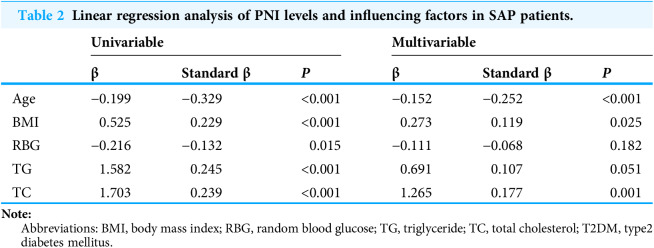
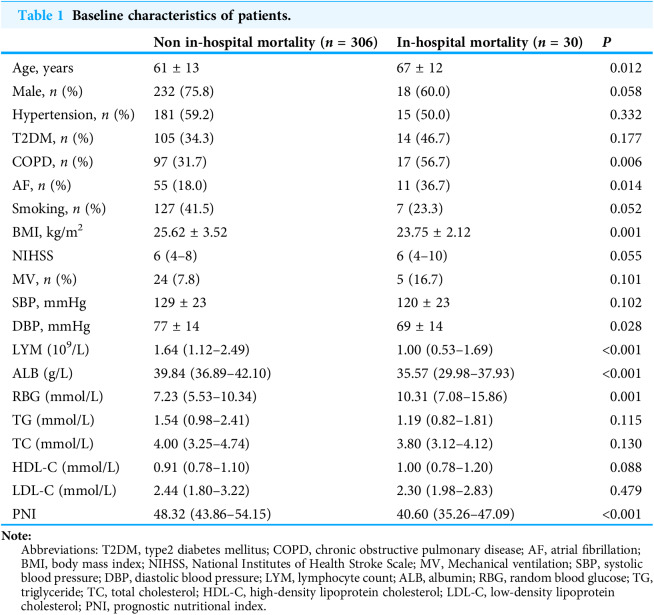
Results: Thirty out of 336 SAP patients presented with in-hospital mortality and these patients had significantly lower PNI levels. In our study, PNI levels were influenced by age, body mass index, and total cholesterol. Increased PNI levels are an independent protective factor for the risk of in-hospital mortality in SAP patients (OR: 0.232, 95% CI [0.096-0.561], P = 0.001). There was a nonlinear correlation between PNI and in-hospital mortality events (P for nonlinear <0.001). In terms of predictive effect, PNI levels were more efficacious in predicting in-hospital mortality in SAP patients with higher sensitivity and/or specificity compared to individual indicators (AUC = 0.750, 95% CI [0.641-0.860], P < 0.001).
Conclusion: PNI levels in SAP patients were associated with the short-term prognosis of patients, and SAP patients with elevated PNI levels had a reduced risk of in-hospital mortality.
期刊介绍:
PeerJ is an open access peer-reviewed scientific journal covering research in the biological and medical sciences. At PeerJ, authors take out a lifetime publication plan (for as little as $99) which allows them to publish articles in the journal for free, forever. PeerJ has 5 Nobel Prize Winners on the Board; they have won several industry and media awards; and they are widely recognized as being one of the most interesting recent developments in academic publishing.






 京公网安备 11010802042870号
京ICP备2023020795号-1
京公网安备 11010802042870号
京ICP备2023020795号-1

 分享
分享
 求助内容:
求助内容: 应助结果提醒方式:
 扫码关注我们
