IF 2.4 3区 生物学Q2 MULTIDISCIPLINARY SCIENCESPeerJPub Date : 2025-02-25eCollection Date: 2025-01-01DOI:10.7717/peerj.18928
Violeta Larios-Serrato, Hilda A Valdez-Salazar, Javier Torres, Margarita Camorlinga, Patricia Piña-Sánchez, Fernando Minauro, Martha-Eugenia Ruiz-Tachiquín
{"title":"胃癌、肠、弥漫性和非萎缩性胃炎的活检分析:墨西哥患者杂合性缺失的概述。","authors":"Violeta Larios-Serrato, Hilda A Valdez-Salazar, Javier Torres, Margarita Camorlinga, Patricia Piña-Sánchez, Fernando Minauro, Martha-Eugenia Ruiz-Tachiquín","doi":"10.7717/peerj.18928","DOIUrl":null,"url":null,"abstract":"<p><p>This study analyzed the loss of heterozygosity (LOH) effect on gastric cancer (GC) tumor samples from 21 Mexican patients, including diffuse (DGC) and intestinal (IGC) subtypes, as well as non-atrophic gastritis (NAG, control). Whole-genome high-density arrays were performed, and LOH regions were identified among the tissue samples. The differences in affected chromosomes were established among groups, with chromosomes 6 and 8 primarily affected in DGC and chromosomes 3, 16, and 17 in IGC. Functional pathway analysis revealed involvement in cancer-associated processes, such as signal transduction, immune response, and cellular metabolism. Five LOH-genes (IRAK1, IKBKG, PAK3, TKTL1, PRPS1) shared between GC and NAG suggest an early role in carcinogenesis. Specific genes were highlighted for Hallmarks of Cancer NAG-related genes (PTPRJ and NDUFS) were linked to cell proliferation and growth; IGC genes (GNAI2, RHOA, MAPKAPK3, MST1R) to genomic instability, metastasis, and arrest of cell death; and DGC genes to energy metabolism and immune evasion. These findings emphasize the role of LOH in GC pathogenesis and underscore the need for further research to understand LOH-affected genes and their diagnostic or evolution potential in cancer management. Portions of this text were previously published as part of a preprint (https://www.medrxiv.org/content/10.1101/2024.07.29.24311063v1).</p>","PeriodicalId":19799,"journal":{"name":"PeerJ","volume":"13 ","pages":"e18928"},"PeriodicalIF":2.4000,"publicationDate":"2025-02-25","publicationTypes":"Journal Article","fieldsOfStudy":null,"isOpenAccess":false,"openAccessPdf":"https://www.ncbi.nlm.nih.gov/pmc/articles/PMC11869887/pdf/","citationCount":"0","resultStr":"{\"title\":\"Analysis of biopsies of gastric cancer, intestinal and diffuse, and non-atrophic gastritis: an overview of loss of heterozygosity in Mexican patients.\",\"authors\":\"Violeta Larios-Serrato, Hilda A Valdez-Salazar, Javier Torres, Margarita Camorlinga, Patricia Piña-Sánchez, Fernando Minauro, Martha-Eugenia Ruiz-Tachiquín\",\"doi\":\"10.7717/peerj.18928\",\"DOIUrl\":null,\"url\":null,\"abstract\":\"<p><p>This study analyzed the loss of heterozygosity (LOH) effect on gastric cancer (GC) tumor samples from 21 Mexican patients, including diffuse (DGC) and intestinal (IGC) subtypes, as well as non-atrophic gastritis (NAG, control). Whole-genome high-density arrays were performed, and LOH regions were identified among the tissue samples. The differences in affected chromosomes were established among groups, with chromosomes 6 and 8 primarily affected in DGC and chromosomes 3, 16, and 17 in IGC. Functional pathway analysis revealed involvement in cancer-associated processes, such as signal transduction, immune response, and cellular metabolism. Five LOH-genes (IRAK1, IKBKG, PAK3, TKTL1, PRPS1) shared between GC and NAG suggest an early role in carcinogenesis. Specific genes were highlighted for Hallmarks of Cancer NAG-related genes (PTPRJ and NDUFS) were linked to cell proliferation and growth; IGC genes (GNAI2, RHOA, MAPKAPK3, MST1R) to genomic instability, metastasis, and arrest of cell death; and DGC genes to energy metabolism and immune evasion. These findings emphasize the role of LOH in GC pathogenesis and underscore the need for further research to understand LOH-affected genes and their diagnostic or evolution potential in cancer management. Portions of this text were previously published as part of a preprint (https://www.medrxiv.org/content/10.1101/2024.07.29.24311063v1).</p>\",\"PeriodicalId\":19799,\"journal\":{\"name\":\"PeerJ\",\"volume\":\"13 \",\"pages\":\"e18928\"},\"PeriodicalIF\":2.4000,\"publicationDate\":\"2025-02-25\",\"publicationTypes\":\"Journal Article\",\"fieldsOfStudy\":null,\"isOpenAccess\":false,\"openAccessPdf\":\"https://www.ncbi.nlm.nih.gov/pmc/articles/PMC11869887/pdf/\",\"citationCount\":\"0\",\"resultStr\":null,\"platform\":\"Semanticscholar\",\"paperid\":null,\"PeriodicalName\":\"PeerJ\",\"FirstCategoryId\":\"99\",\"ListUrlMain\":\"https://doi.org/10.7717/peerj.18928\",\"RegionNum\":3,\"RegionCategory\":\"生物学\",\"ArticlePicture\":[],\"TitleCN\":null,\"AbstractTextCN\":null,\"PMCID\":null,\"EPubDate\":\"2025/1/1 0:00:00\",\"PubModel\":\"eCollection\",\"JCR\":\"Q2\",\"JCRName\":\"MULTIDISCIPLINARY SCIENCES\",\"Score\":null,\"Total\":0}","platform":"Semanticscholar","paperid":null,"PeriodicalName":"PeerJ","FirstCategoryId":"99","ListUrlMain":"https://doi.org/10.7717/peerj.18928","RegionNum":3,"RegionCategory":"生物学","ArticlePicture":[],"TitleCN":null,"AbstractTextCN":null,"PMCID":null,"EPubDate":"2025/1/1 0:00:00","PubModel":"eCollection","JCR":"Q2","JCRName":"MULTIDISCIPLINARY SCIENCES","Score":null,"Total":0}
Analysis of biopsies of gastric cancer, intestinal and diffuse, and non-atrophic gastritis: an overview of loss of heterozygosity in Mexican patients.
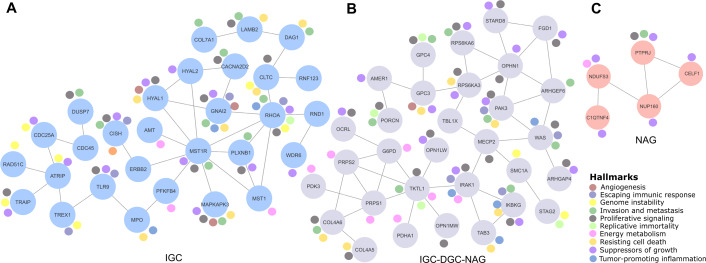
This study analyzed the loss of heterozygosity (LOH) effect on gastric cancer (GC) tumor samples from 21 Mexican patients, including diffuse (DGC) and intestinal (IGC) subtypes, as well as non-atrophic gastritis (NAG, control). Whole-genome high-density arrays were performed, and LOH regions were identified among the tissue samples. The differences in affected chromosomes were established among groups, with chromosomes 6 and 8 primarily affected in DGC and chromosomes 3, 16, and 17 in IGC. Functional pathway analysis revealed involvement in cancer-associated processes, such as signal transduction, immune response, and cellular metabolism. Five LOH-genes (IRAK1, IKBKG, PAK3, TKTL1, PRPS1) shared between GC and NAG suggest an early role in carcinogenesis. Specific genes were highlighted for Hallmarks of Cancer NAG-related genes (PTPRJ and NDUFS) were linked to cell proliferation and growth; IGC genes (GNAI2, RHOA, MAPKAPK3, MST1R) to genomic instability, metastasis, and arrest of cell death; and DGC genes to energy metabolism and immune evasion. These findings emphasize the role of LOH in GC pathogenesis and underscore the need for further research to understand LOH-affected genes and their diagnostic or evolution potential in cancer management. Portions of this text were previously published as part of a preprint (https://www.medrxiv.org/content/10.1101/2024.07.29.24311063v1).
期刊介绍:
PeerJ is an open access peer-reviewed scientific journal covering research in the biological and medical sciences. At PeerJ, authors take out a lifetime publication plan (for as little as $99) which allows them to publish articles in the journal for free, forever. PeerJ has 5 Nobel Prize Winners on the Board; they have won several industry and media awards; and they are widely recognized as being one of the most interesting recent developments in academic publishing.






 京公网安备 11010802042870号
京ICP备2023020795号-1
京公网安备 11010802042870号
京ICP备2023020795号-1

 分享
分享
 求助内容:
求助内容: 应助结果提醒方式:
 扫码关注我们
