Chen Wang, Roderick C. I. MacKenzie, Uli Würfel, Dieter Neher, Thomas Kirchartz, Carsten Deibel, Maria Saladina
{"title":"有机太阳能电池中输运阻力占主导地位的填充因子损失","authors":"Chen Wang, Roderick C. I. MacKenzie, Uli Würfel, Dieter Neher, Thomas Kirchartz, Carsten Deibel, Maria Saladina","doi":"10.1002/aenm.202405889","DOIUrl":null,"url":null,"abstract":"<p>Organic photovoltaics (OPV) are a promising solar cell technology well-suited to mass production using roll-to-roll processes. The efficiency of lab-scale solar cells has exceeded 20% and considerable attention is currently being given to understanding and minimizing the remaining loss mechanisms preventing higher efficiencies. While recent efficiency improvements are partly owed to reducing non-radiative recombination losses at open circuit, the low fill factor (<i>FF</i>) due to a significant transport resistance is becoming the Achilles heel of OPV. The term transport resistance refers to a voltage and light intensity-dependent charge collection loss in low-mobility materials. In this perspective, it is demonstrated that even the highest efficiency organic solar cells (OSCs) reported to-date have significant performance losses that can be attributed to transport resistance and that lead to high <i>FF</i> losses. A closer look at the transport resistance and the material properties influencing it is provided. How to experimentally characterize and quantify the transport resistance is described by providing easy to follow instructions. Furthermore, the causes and theory behind transport resistance are detailed. In particular, the relevant figures of merit (FoMs) and different viewpoints on the transport resistance are integrated. Finally, we outline strategies that can be followed to minimize these charge collection losses in future solar cells.</p>","PeriodicalId":111,"journal":{"name":"Advanced Energy Materials","volume":"16 3","pages":""},"PeriodicalIF":25.5000,"publicationDate":"2026-01-21","publicationTypes":"Journal Article","fieldsOfStudy":null,"isOpenAccess":false,"openAccessPdf":"https://advanced.onlinelibrary.wiley.com/doi/epdf/10.1002/aenm.202405889","citationCount":"0","resultStr":"{\"title\":\"Transport Resistance Dominates the Fill Factor Losses in Record Organic Solar Cells\",\"authors\":\"Chen Wang, Roderick C. I. MacKenzie, Uli Würfel, Dieter Neher, Thomas Kirchartz, Carsten Deibel, Maria Saladina\",\"doi\":\"10.1002/aenm.202405889\",\"DOIUrl\":null,\"url\":null,\"abstract\":\"<p>Organic photovoltaics (OPV) are a promising solar cell technology well-suited to mass production using roll-to-roll processes. The efficiency of lab-scale solar cells has exceeded 20% and considerable attention is currently being given to understanding and minimizing the remaining loss mechanisms preventing higher efficiencies. While recent efficiency improvements are partly owed to reducing non-radiative recombination losses at open circuit, the low fill factor (<i>FF</i>) due to a significant transport resistance is becoming the Achilles heel of OPV. The term transport resistance refers to a voltage and light intensity-dependent charge collection loss in low-mobility materials. In this perspective, it is demonstrated that even the highest efficiency organic solar cells (OSCs) reported to-date have significant performance losses that can be attributed to transport resistance and that lead to high <i>FF</i> losses. A closer look at the transport resistance and the material properties influencing it is provided. How to experimentally characterize and quantify the transport resistance is described by providing easy to follow instructions. Furthermore, the causes and theory behind transport resistance are detailed. In particular, the relevant figures of merit (FoMs) and different viewpoints on the transport resistance are integrated. Finally, we outline strategies that can be followed to minimize these charge collection losses in future solar cells.</p>\",\"PeriodicalId\":111,\"journal\":{\"name\":\"Advanced Energy Materials\",\"volume\":\"16 3\",\"pages\":\"\"},\"PeriodicalIF\":25.5000,\"publicationDate\":\"2026-01-21\",\"publicationTypes\":\"Journal Article\",\"fieldsOfStudy\":null,\"isOpenAccess\":false,\"openAccessPdf\":\"https://advanced.onlinelibrary.wiley.com/doi/epdf/10.1002/aenm.202405889\",\"citationCount\":\"0\",\"resultStr\":null,\"platform\":\"Semanticscholar\",\"paperid\":null,\"PeriodicalName\":\"Advanced Energy Materials\",\"FirstCategoryId\":\"88\",\"ListUrlMain\":\"https://onlinelibrary.wiley.com/doi/10.1002/aenm.202405889\",\"RegionNum\":1,\"RegionCategory\":\"材料科学\",\"ArticlePicture\":[],\"TitleCN\":null,\"AbstractTextCN\":null,\"PMCID\":null,\"EPubDate\":\"2025/3/5 0:00:00\",\"PubModel\":\"Epub\",\"JCR\":\"Q1\",\"JCRName\":\"CHEMISTRY, PHYSICAL\",\"Score\":null,\"Total\":0}","platform":"Semanticscholar","paperid":null,"PeriodicalName":"Advanced Energy Materials","FirstCategoryId":"88","ListUrlMain":"https://onlinelibrary.wiley.com/doi/10.1002/aenm.202405889","RegionNum":1,"RegionCategory":"材料科学","ArticlePicture":[],"TitleCN":null,"AbstractTextCN":null,"PMCID":null,"EPubDate":"2025/3/5 0:00:00","PubModel":"Epub","JCR":"Q1","JCRName":"CHEMISTRY, PHYSICAL","Score":null,"Total":0}
Transport Resistance Dominates the Fill Factor Losses in Record Organic Solar Cells
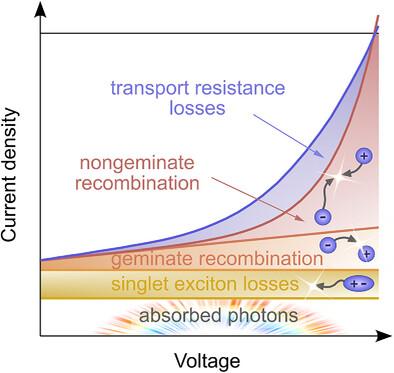
Organic photovoltaics (OPV) are a promising solar cell technology well-suited to mass production using roll-to-roll processes. The efficiency of lab-scale solar cells has exceeded 20% and considerable attention is currently being given to understanding and minimizing the remaining loss mechanisms preventing higher efficiencies. While recent efficiency improvements are partly owed to reducing non-radiative recombination losses at open circuit, the low fill factor (FF) due to a significant transport resistance is becoming the Achilles heel of OPV. The term transport resistance refers to a voltage and light intensity-dependent charge collection loss in low-mobility materials. In this perspective, it is demonstrated that even the highest efficiency organic solar cells (OSCs) reported to-date have significant performance losses that can be attributed to transport resistance and that lead to high FF losses. A closer look at the transport resistance and the material properties influencing it is provided. How to experimentally characterize and quantify the transport resistance is described by providing easy to follow instructions. Furthermore, the causes and theory behind transport resistance are detailed. In particular, the relevant figures of merit (FoMs) and different viewpoints on the transport resistance are integrated. Finally, we outline strategies that can be followed to minimize these charge collection losses in future solar cells.
期刊介绍:
Established in 2011, Advanced Energy Materials is an international, interdisciplinary, English-language journal that focuses on materials used in energy harvesting, conversion, and storage. It is regarded as a top-quality journal alongside Advanced Materials, Advanced Functional Materials, and Small.
With a 2022 Impact Factor of 27.8, Advanced Energy Materials is considered a prime source for the best energy-related research. The journal covers a wide range of topics in energy-related research, including organic and inorganic photovoltaics, batteries and supercapacitors, fuel cells, hydrogen generation and storage, thermoelectrics, water splitting and photocatalysis, solar fuels and thermosolar power, magnetocalorics, and piezoelectronics.
The readership of Advanced Energy Materials includes materials scientists, chemists, physicists, and engineers in both academia and industry. The journal is indexed in various databases and collections, such as Advanced Technologies & Aerospace Database, FIZ Karlsruhe, INSPEC (IET), Science Citation Index Expanded, Technology Collection, and Web of Science, among others.







 京公网安备 11010802042870号
京ICP备2023020795号-1
京公网安备 11010802042870号
京ICP备2023020795号-1

 分享
分享
 求助内容:
求助内容: 应助结果提醒方式:
 扫码关注我们
