Danilo A. Nagaoka , Leandro Hostert , Rogério V. Gelamo , Camila M. Maroneze , Denise Maria de Andrade , Alisson R. Cadore , Christiano J.S. de Matos
{"title":"厘米级非晶氧化铌薄膜转化为结晶二硫化铌(NbS2):合成及稳定性","authors":"Danilo A. Nagaoka , Leandro Hostert , Rogério V. Gelamo , Camila M. Maroneze , Denise Maria de Andrade , Alisson R. Cadore , Christiano J.S. de Matos","doi":"10.1016/j.apsusc.2025.162864","DOIUrl":null,"url":null,"abstract":"<div><div>Niobium disulfide (NbS<sub>2</sub>) is a layered transition metal dichalcogenide (TMD) with metallic characteristics. While mono- and few-layer NbS<sub>2</sub> <!-->have been explored by various research groups, significant challenges remain in achieving continuous films. In this study, we present a procedure for converting centimeter-scale thin films of niobium oxide (Nb<sub>x</sub>O<sub>y</sub>), deposited using physical vapor deposition (PVD), into a continuous, crystalline, mixed-phase (2H/3R) NbS<sub>2</sub> <!-->film through sulfurization. We examine the influence of the initial Nb<sub>x</sub>O<sub>y</sub> <!-->film thickness on the NbS<sub>2</sub> <!-->conversion and stability. Adjusting the initial Nb<sub>x</sub>O<sub>y</sub> <!-->thickness results in distinct roughness profiles, electrical resistivities and stabilities against re-oxidation. The NbS<sub>2</sub> <!-->films demonstrate intrinsically low resistivity, measuring at 190 ± 23 Ω/sqr (80 ± 5 Ω/sqr) for the thinner (thicker) film. However, over a 21-day exposure to air, the long-term stability of these films varies with thickness. Thinner films show a significant increase in resistivity, rising by 367 %–699 ± 97 Ω/sqr. In contrast, the thicker film exhibits a modest increase of only 22 %, reaching 97 ± 5 Ω/sqr. Even after one year of air exposure, the thicker film remains conductive, and the initial characteristics of the converted films can be restored through the resulfurization process. This process enables the scalable production of large-area NbS<sub>2</sub> <!-->films, suitable for nanotechnological applications.</div></div>","PeriodicalId":247,"journal":{"name":"Applied Surface Science","volume":"695 ","pages":"Article 162864"},"PeriodicalIF":6.6000,"publicationDate":"2025-06-30","publicationTypes":"Journal Article","fieldsOfStudy":null,"isOpenAccess":false,"openAccessPdf":"","citationCount":"0","resultStr":"{\"title\":\"Conversion of centimeter-scale amorphous niobium oxide thin films into crystalline niobium disulfide (NbS2): Synthesis and stability\",\"authors\":\"Danilo A. Nagaoka , Leandro Hostert , Rogério V. Gelamo , Camila M. Maroneze , Denise Maria de Andrade , Alisson R. Cadore , Christiano J.S. de Matos\",\"doi\":\"10.1016/j.apsusc.2025.162864\",\"DOIUrl\":null,\"url\":null,\"abstract\":\"<div><div>Niobium disulfide (NbS<sub>2</sub>) is a layered transition metal dichalcogenide (TMD) with metallic characteristics. While mono- and few-layer NbS<sub>2</sub> <!-->have been explored by various research groups, significant challenges remain in achieving continuous films. In this study, we present a procedure for converting centimeter-scale thin films of niobium oxide (Nb<sub>x</sub>O<sub>y</sub>), deposited using physical vapor deposition (PVD), into a continuous, crystalline, mixed-phase (2H/3R) NbS<sub>2</sub> <!-->film through sulfurization. We examine the influence of the initial Nb<sub>x</sub>O<sub>y</sub> <!-->film thickness on the NbS<sub>2</sub> <!-->conversion and stability. Adjusting the initial Nb<sub>x</sub>O<sub>y</sub> <!-->thickness results in distinct roughness profiles, electrical resistivities and stabilities against re-oxidation. The NbS<sub>2</sub> <!-->films demonstrate intrinsically low resistivity, measuring at 190 ± 23 Ω/sqr (80 ± 5 Ω/sqr) for the thinner (thicker) film. However, over a 21-day exposure to air, the long-term stability of these films varies with thickness. Thinner films show a significant increase in resistivity, rising by 367 %–699 ± 97 Ω/sqr. In contrast, the thicker film exhibits a modest increase of only 22 %, reaching 97 ± 5 Ω/sqr. Even after one year of air exposure, the thicker film remains conductive, and the initial characteristics of the converted films can be restored through the resulfurization process. This process enables the scalable production of large-area NbS<sub>2</sub> <!-->films, suitable for nanotechnological applications.</div></div>\",\"PeriodicalId\":247,\"journal\":{\"name\":\"Applied Surface Science\",\"volume\":\"695 \",\"pages\":\"Article 162864\"},\"PeriodicalIF\":6.6000,\"publicationDate\":\"2025-06-30\",\"publicationTypes\":\"Journal Article\",\"fieldsOfStudy\":null,\"isOpenAccess\":false,\"openAccessPdf\":\"\",\"citationCount\":\"0\",\"resultStr\":null,\"platform\":\"Semanticscholar\",\"paperid\":null,\"PeriodicalName\":\"Applied Surface Science\",\"FirstCategoryId\":\"88\",\"ListUrlMain\":\"https://www.sciencedirect.com/science/article/pii/S0169433225005781\",\"RegionNum\":2,\"RegionCategory\":\"材料科学\",\"ArticlePicture\":[],\"TitleCN\":null,\"AbstractTextCN\":null,\"PMCID\":null,\"EPubDate\":\"2025/3/4 0:00:00\",\"PubModel\":\"Epub\",\"JCR\":\"Q2\",\"JCRName\":\"CHEMISTRY, PHYSICAL\",\"Score\":null,\"Total\":0}","platform":"Semanticscholar","paperid":null,"PeriodicalName":"Applied Surface Science","FirstCategoryId":"88","ListUrlMain":"https://www.sciencedirect.com/science/article/pii/S0169433225005781","RegionNum":2,"RegionCategory":"材料科学","ArticlePicture":[],"TitleCN":null,"AbstractTextCN":null,"PMCID":null,"EPubDate":"2025/3/4 0:00:00","PubModel":"Epub","JCR":"Q2","JCRName":"CHEMISTRY, PHYSICAL","Score":null,"Total":0}
Conversion of centimeter-scale amorphous niobium oxide thin films into crystalline niobium disulfide (NbS2): Synthesis and stability
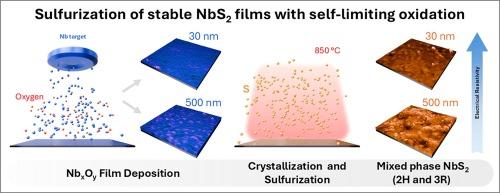
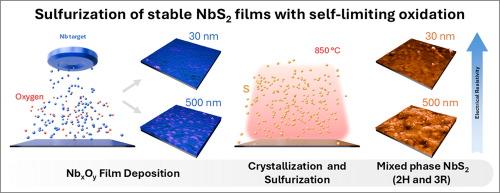
Niobium disulfide (NbS2) is a layered transition metal dichalcogenide (TMD) with metallic characteristics. While mono- and few-layer NbS2 have been explored by various research groups, significant challenges remain in achieving continuous films. In this study, we present a procedure for converting centimeter-scale thin films of niobium oxide (NbxOy), deposited using physical vapor deposition (PVD), into a continuous, crystalline, mixed-phase (2H/3R) NbS2 film through sulfurization. We examine the influence of the initial NbxOy film thickness on the NbS2 conversion and stability. Adjusting the initial NbxOy thickness results in distinct roughness profiles, electrical resistivities and stabilities against re-oxidation. The NbS2 films demonstrate intrinsically low resistivity, measuring at 190 ± 23 Ω/sqr (80 ± 5 Ω/sqr) for the thinner (thicker) film. However, over a 21-day exposure to air, the long-term stability of these films varies with thickness. Thinner films show a significant increase in resistivity, rising by 367 %–699 ± 97 Ω/sqr. In contrast, the thicker film exhibits a modest increase of only 22 %, reaching 97 ± 5 Ω/sqr. Even after one year of air exposure, the thicker film remains conductive, and the initial characteristics of the converted films can be restored through the resulfurization process. This process enables the scalable production of large-area NbS2 films, suitable for nanotechnological applications.
期刊介绍:
Applied Surface Science covers topics contributing to a better understanding of surfaces, interfaces, nanostructures and their applications. The journal is concerned with scientific research on the atomic and molecular level of material properties determined with specific surface analytical techniques and/or computational methods, as well as the processing of such structures.




 京公网安备 11010802042870号
京ICP备2023020795号-1
京公网安备 11010802042870号
京ICP备2023020795号-1

 分享
分享
 求助内容:
求助内容: 应助结果提醒方式:
 扫码关注我们
