Pei Song , Zhikai Gao , Tiren Peng , Zhiguo Wang , Sen Lu , Zepeng Jia , Zishan Luo , Hong Cui , Weizhi Tian , Rong Feng , Lingxia Jin , Hongkuan Yuan
{"title":"MN4/MXene界面上的单原子溶解和电场驱动的吸附机制:利用机器学习解开催化描述符","authors":"Pei Song , Zhikai Gao , Tiren Peng , Zhiguo Wang , Sen Lu , Zepeng Jia , Zishan Luo , Hong Cui , Weizhi Tian , Rong Feng , Lingxia Jin , Hongkuan Yuan","doi":"10.1016/j.apsusc.2025.162886","DOIUrl":null,"url":null,"abstract":"<div><div>Single-atom catalysts (SACs) have attracted much attention in the field of energy and environment due to their tunable activity. Here, we present a study of MXene(M<sub>2</sub>NO) carriers to modulate the catalytic activity and reactive metal dissolution of SAC at the M−N−C(MN<sub>4</sub>) interface. The density functional theory (DFT) results indicated that M<sub>2</sub>NO provides axial traction for MN<sub>4</sub>, weakening the interaction of M−3<em>d</em> orbitals with *O/*OH/*OOH-<em>p</em> orbitals in MN<sub>4</sub>, forming higher π* and π orbitals, and lowering the ORR or OER overpotential of FeN<sub>4</sub>/M<sub>2</sub>NO and CoN<sub>4</sub>/M<sub>2</sub>NO (Ti, V, Cr, Nb and Ta). Pourbaix diagrams were constructed based on thermodynamic cycling and DFT, and the results showed that FeN<sub>4</sub>/M<sub>2</sub>NO (M = Ti, V, Cr, Nb and Ta) had lower metal dissolution. And with the addition of 0.2 V/Ang interfacial electric field, FeN<sub>4</sub>/Ti<sub>2</sub>NO exhibits excellent OER (0.28 V) overpotential. The accuracy of the constructed simple descriptors of ORR and OER catalytic performance: <em>EA</em><sub>1</sub> × <em>EA</em><sub>2</sub> - <em>M</em><sub>1</sub> and <em>M</em><sub>1</sub> - <em>a</em> - <em>b</em> was demonstrated by four machine learning methods and symbolic regression algorithms. This study reveals the law of the influence of M<sub>2</sub>NO on the catalytic performance of the MN<sub>4</sub> interface and improves new ideas for the design of high-performance SACs.</div></div>","PeriodicalId":247,"journal":{"name":"Applied Surface Science","volume":"695 ","pages":"Article 162886"},"PeriodicalIF":6.9000,"publicationDate":"2025-06-30","publicationTypes":"Journal Article","fieldsOfStudy":null,"isOpenAccess":false,"openAccessPdf":"","citationCount":"0","resultStr":"{\"title\":\"Single-atom dissolution at the MN4/MXene interface and electric field-driven adsorption mechanisms: Unraveling catalytic descriptors using machine learning\",\"authors\":\"Pei Song , Zhikai Gao , Tiren Peng , Zhiguo Wang , Sen Lu , Zepeng Jia , Zishan Luo , Hong Cui , Weizhi Tian , Rong Feng , Lingxia Jin , Hongkuan Yuan\",\"doi\":\"10.1016/j.apsusc.2025.162886\",\"DOIUrl\":null,\"url\":null,\"abstract\":\"<div><div>Single-atom catalysts (SACs) have attracted much attention in the field of energy and environment due to their tunable activity. Here, we present a study of MXene(M<sub>2</sub>NO) carriers to modulate the catalytic activity and reactive metal dissolution of SAC at the M−N−C(MN<sub>4</sub>) interface. The density functional theory (DFT) results indicated that M<sub>2</sub>NO provides axial traction for MN<sub>4</sub>, weakening the interaction of M−3<em>d</em> orbitals with *O/*OH/*OOH-<em>p</em> orbitals in MN<sub>4</sub>, forming higher π* and π orbitals, and lowering the ORR or OER overpotential of FeN<sub>4</sub>/M<sub>2</sub>NO and CoN<sub>4</sub>/M<sub>2</sub>NO (Ti, V, Cr, Nb and Ta). Pourbaix diagrams were constructed based on thermodynamic cycling and DFT, and the results showed that FeN<sub>4</sub>/M<sub>2</sub>NO (M = Ti, V, Cr, Nb and Ta) had lower metal dissolution. And with the addition of 0.2 V/Ang interfacial electric field, FeN<sub>4</sub>/Ti<sub>2</sub>NO exhibits excellent OER (0.28 V) overpotential. The accuracy of the constructed simple descriptors of ORR and OER catalytic performance: <em>EA</em><sub>1</sub> × <em>EA</em><sub>2</sub> - <em>M</em><sub>1</sub> and <em>M</em><sub>1</sub> - <em>a</em> - <em>b</em> was demonstrated by four machine learning methods and symbolic regression algorithms. This study reveals the law of the influence of M<sub>2</sub>NO on the catalytic performance of the MN<sub>4</sub> interface and improves new ideas for the design of high-performance SACs.</div></div>\",\"PeriodicalId\":247,\"journal\":{\"name\":\"Applied Surface Science\",\"volume\":\"695 \",\"pages\":\"Article 162886\"},\"PeriodicalIF\":6.9000,\"publicationDate\":\"2025-06-30\",\"publicationTypes\":\"Journal Article\",\"fieldsOfStudy\":null,\"isOpenAccess\":false,\"openAccessPdf\":\"\",\"citationCount\":\"0\",\"resultStr\":null,\"platform\":\"Semanticscholar\",\"paperid\":null,\"PeriodicalName\":\"Applied Surface Science\",\"FirstCategoryId\":\"88\",\"ListUrlMain\":\"https://www.sciencedirect.com/science/article/pii/S0169433225006002\",\"RegionNum\":2,\"RegionCategory\":\"材料科学\",\"ArticlePicture\":[],\"TitleCN\":null,\"AbstractTextCN\":null,\"PMCID\":null,\"EPubDate\":\"2025/3/4 0:00:00\",\"PubModel\":\"Epub\",\"JCR\":\"Q2\",\"JCRName\":\"CHEMISTRY, PHYSICAL\",\"Score\":null,\"Total\":0}","platform":"Semanticscholar","paperid":null,"PeriodicalName":"Applied Surface Science","FirstCategoryId":"88","ListUrlMain":"https://www.sciencedirect.com/science/article/pii/S0169433225006002","RegionNum":2,"RegionCategory":"材料科学","ArticlePicture":[],"TitleCN":null,"AbstractTextCN":null,"PMCID":null,"EPubDate":"2025/3/4 0:00:00","PubModel":"Epub","JCR":"Q2","JCRName":"CHEMISTRY, PHYSICAL","Score":null,"Total":0}
Single-atom dissolution at the MN4/MXene interface and electric field-driven adsorption mechanisms: Unraveling catalytic descriptors using machine learning
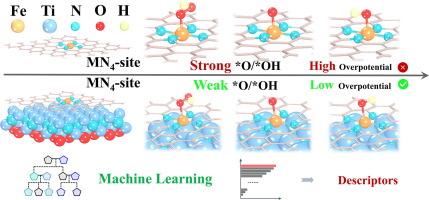
Single-atom catalysts (SACs) have attracted much attention in the field of energy and environment due to their tunable activity. Here, we present a study of MXene(M2NO) carriers to modulate the catalytic activity and reactive metal dissolution of SAC at the M−N−C(MN4) interface. The density functional theory (DFT) results indicated that M2NO provides axial traction for MN4, weakening the interaction of M−3d orbitals with *O/*OH/*OOH-p orbitals in MN4, forming higher π* and π orbitals, and lowering the ORR or OER overpotential of FeN4/M2NO and CoN4/M2NO (Ti, V, Cr, Nb and Ta). Pourbaix diagrams were constructed based on thermodynamic cycling and DFT, and the results showed that FeN4/M2NO (M = Ti, V, Cr, Nb and Ta) had lower metal dissolution. And with the addition of 0.2 V/Ang interfacial electric field, FeN4/Ti2NO exhibits excellent OER (0.28 V) overpotential. The accuracy of the constructed simple descriptors of ORR and OER catalytic performance: EA1 × EA2 - M1 and M1 - a - b was demonstrated by four machine learning methods and symbolic regression algorithms. This study reveals the law of the influence of M2NO on the catalytic performance of the MN4 interface and improves new ideas for the design of high-performance SACs.
期刊介绍:
Applied Surface Science covers topics contributing to a better understanding of surfaces, interfaces, nanostructures and their applications. The journal is concerned with scientific research on the atomic and molecular level of material properties determined with specific surface analytical techniques and/or computational methods, as well as the processing of such structures.





 京公网安备 11010802042870号
京ICP备2023020795号-1
京公网安备 11010802042870号
京ICP备2023020795号-1

 分享
分享
 求助内容:
求助内容: 应助结果提醒方式:
 扫码关注我们
