Zhi Yuan Lee , Sirin Kamarulzaman , Rizqullah Rasyiddin , Sheila Y.X. Sim , Georgina E.K.K. Seah , Ai Wei Gan , Zibiao Li , Zhuang Mao Png , Shermin S. Goh
{"title":"热塑性塑料通过全氟苯基硝基C-H插入形成可回收热固性塑料的动态交联","authors":"Zhi Yuan Lee , Sirin Kamarulzaman , Rizqullah Rasyiddin , Sheila Y.X. Sim , Georgina E.K.K. Seah , Ai Wei Gan , Zibiao Li , Zhuang Mao Png , Shermin S. Goh","doi":"10.1016/j.chempr.2025.102479","DOIUrl":null,"url":null,"abstract":"<div><div>Covalent adaptable networks (CANs) are polymers crosslinked via dynamic covalent bonds<span><span> (DCBs), endowing the networks with both thermoset-like stability and thermoplastic-like recyclability. Although post-polymerization crosslinking of thermoplastics is an efficient strategy to form CANs, the process is non-trivial, especially for poly(olefins) that have low functionality and a fully hydrocarbon backbone. Herein, we introduce perflurophenyl azide-based nitrene crosslinkers to install disulfide<span><span>, imine, and </span>acetal DCBs into poly(olefins) and other thermoplastics, thereby converting them into CANs. Crosslinking was effective for a wide range of thermoplastics, imparting both dimensional and solvent stability. The resultant CANs could also exhibit enhanced mechanical performance, such as doubling of tensile toughness and self-healing ability. Unlike traditional thermosets, the DCBs enabled these CANs to be chemically and/or mechanically recycled multiple times. This methodology has the advantage of utilizing existing and even post-consumer </span></span>plastic blends as starting materials, improving their thermo-mechanical properties while maintaining recyclability of the synthesized CANs.</span></div></div>","PeriodicalId":268,"journal":{"name":"Chem","volume":"11 8","pages":"Article 102479"},"PeriodicalIF":19.1000,"publicationDate":"2025-08-14","publicationTypes":"Journal Article","fieldsOfStudy":null,"isOpenAccess":false,"openAccessPdf":"","citationCount":"0","resultStr":"{\"title\":\"Dynamic crosslinking of thermoplastics via perfluorophenyl nitrene C–H insertion to form recyclable thermosets\",\"authors\":\"Zhi Yuan Lee , Sirin Kamarulzaman , Rizqullah Rasyiddin , Sheila Y.X. Sim , Georgina E.K.K. Seah , Ai Wei Gan , Zibiao Li , Zhuang Mao Png , Shermin S. Goh\",\"doi\":\"10.1016/j.chempr.2025.102479\",\"DOIUrl\":null,\"url\":null,\"abstract\":\"<div><div>Covalent adaptable networks (CANs) are polymers crosslinked via dynamic covalent bonds<span><span> (DCBs), endowing the networks with both thermoset-like stability and thermoplastic-like recyclability. Although post-polymerization crosslinking of thermoplastics is an efficient strategy to form CANs, the process is non-trivial, especially for poly(olefins) that have low functionality and a fully hydrocarbon backbone. Herein, we introduce perflurophenyl azide-based nitrene crosslinkers to install disulfide<span><span>, imine, and </span>acetal DCBs into poly(olefins) and other thermoplastics, thereby converting them into CANs. Crosslinking was effective for a wide range of thermoplastics, imparting both dimensional and solvent stability. The resultant CANs could also exhibit enhanced mechanical performance, such as doubling of tensile toughness and self-healing ability. Unlike traditional thermosets, the DCBs enabled these CANs to be chemically and/or mechanically recycled multiple times. This methodology has the advantage of utilizing existing and even post-consumer </span></span>plastic blends as starting materials, improving their thermo-mechanical properties while maintaining recyclability of the synthesized CANs.</span></div></div>\",\"PeriodicalId\":268,\"journal\":{\"name\":\"Chem\",\"volume\":\"11 8\",\"pages\":\"Article 102479\"},\"PeriodicalIF\":19.1000,\"publicationDate\":\"2025-08-14\",\"publicationTypes\":\"Journal Article\",\"fieldsOfStudy\":null,\"isOpenAccess\":false,\"openAccessPdf\":\"\",\"citationCount\":\"0\",\"resultStr\":null,\"platform\":\"Semanticscholar\",\"paperid\":null,\"PeriodicalName\":\"Chem\",\"FirstCategoryId\":\"92\",\"ListUrlMain\":\"https://www.sciencedirect.com/science/article/pii/S2451929425000695\",\"RegionNum\":1,\"RegionCategory\":\"化学\",\"ArticlePicture\":[],\"TitleCN\":null,\"AbstractTextCN\":null,\"PMCID\":null,\"EPubDate\":\"2025/3/5 0:00:00\",\"PubModel\":\"Epub\",\"JCR\":\"Q1\",\"JCRName\":\"CHEMISTRY, MULTIDISCIPLINARY\",\"Score\":null,\"Total\":0}","platform":"Semanticscholar","paperid":null,"PeriodicalName":"Chem","FirstCategoryId":"92","ListUrlMain":"https://www.sciencedirect.com/science/article/pii/S2451929425000695","RegionNum":1,"RegionCategory":"化学","ArticlePicture":[],"TitleCN":null,"AbstractTextCN":null,"PMCID":null,"EPubDate":"2025/3/5 0:00:00","PubModel":"Epub","JCR":"Q1","JCRName":"CHEMISTRY, MULTIDISCIPLINARY","Score":null,"Total":0}
Dynamic crosslinking of thermoplastics via perfluorophenyl nitrene C–H insertion to form recyclable thermosets
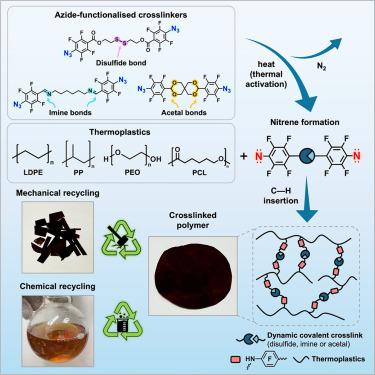
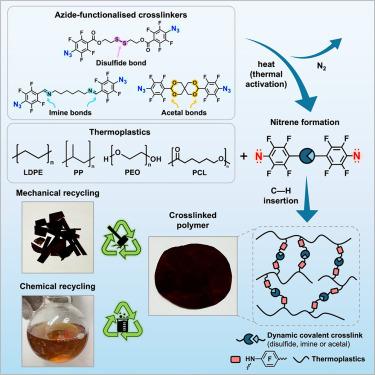
Covalent adaptable networks (CANs) are polymers crosslinked via dynamic covalent bonds (DCBs), endowing the networks with both thermoset-like stability and thermoplastic-like recyclability. Although post-polymerization crosslinking of thermoplastics is an efficient strategy to form CANs, the process is non-trivial, especially for poly(olefins) that have low functionality and a fully hydrocarbon backbone. Herein, we introduce perflurophenyl azide-based nitrene crosslinkers to install disulfide, imine, and acetal DCBs into poly(olefins) and other thermoplastics, thereby converting them into CANs. Crosslinking was effective for a wide range of thermoplastics, imparting both dimensional and solvent stability. The resultant CANs could also exhibit enhanced mechanical performance, such as doubling of tensile toughness and self-healing ability. Unlike traditional thermosets, the DCBs enabled these CANs to be chemically and/or mechanically recycled multiple times. This methodology has the advantage of utilizing existing and even post-consumer plastic blends as starting materials, improving their thermo-mechanical properties while maintaining recyclability of the synthesized CANs.
期刊介绍:
Chem, affiliated with Cell as its sister journal, serves as a platform for groundbreaking research and illustrates how fundamental inquiries in chemistry and its related fields can contribute to addressing future global challenges. It was established in 2016, and is currently edited by Robert Eagling.




 京公网安备 11010802042870号
京ICP备2023020795号-1
京公网安备 11010802042870号
京ICP备2023020795号-1

 分享
分享
 求助内容:
求助内容: 应助结果提醒方式:
 扫码关注我们
