{"title":"新型双发射上转换荧光探针成像糖尿病异位脂质堆积","authors":"Zheming Zhang, Zhiyuan Wang, Mengfan Kan, Minggang Tian, Zhongwen Zhang","doi":"10.1021/acssensors.4c03149","DOIUrl":null,"url":null,"abstract":"Diabetic kidney disease (DKD) is a leading cause of death among diabetic patients, primarily due to ectopic lipid accumulation in nonadipose tissues. The lack of molecular tools for quantitatively visualizing this lipid accumulation has hindered in-depth studies. This study aims to develop a dual-emissive up-conversion fluorescent probe, DSDM, for precise in vivo and ex vivo analyses of lipid accumulation. DSDM exhibits up-conversion green emission and down-conversion near-infrared (NIR) fluorescence when excited at 561 nm. This allows for the simultaneous imaging of lipid droplets (LDs) and the endoplasmic reticulum (ER), the primary sites for lipid synthesis and storage. With intracellular lipid consumption and accumulation, the green emission in LDs decreased or increased, while the NIR fluorescence in the ER remained constant. Using the NIR emission as an internal control, the green-to-NIR emission intensity ratio can quantify the LD amount accurately, overcoming the possible interferences from inhomogeneous staining, variation in cell population, and other factors. With the probe, we quantitatively analyzed LD accumulation in human kidney cells with either overexpressed or silenced aquaporin 7 (AQP7), induced by palmitic acid. Herein, AQP7 is specifically expressed in kidney tubules and is the only channel that regulates adipose glycerol transport. In DKD mice with kidney-specific AQP7 knockout, the probe successfully detected up-regulated lipid accumulation and ER stress. Tissue imaging revealed that the inhibited close contact between LDs and ER might facilitate the assessment of lipid accumulation in DKD. This approach effectively addresses the limitations of precise tissue biopsy in DKD, thereby improving DKD management.","PeriodicalId":24,"journal":{"name":"ACS Sensors","volume":"28 1","pages":""},"PeriodicalIF":10.9000,"publicationDate":"2025-03-04","publicationTypes":"Journal Article","fieldsOfStudy":null,"isOpenAccess":false,"openAccessPdf":"","citationCount":"0","resultStr":"{\"title\":\"Novel Dual-Emissive Up-conversion Fluorescent Probe for Imaging Ectopic Lipid Accumulation in Diabetes Mellitus\",\"authors\":\"Zheming Zhang, Zhiyuan Wang, Mengfan Kan, Minggang Tian, Zhongwen Zhang\",\"doi\":\"10.1021/acssensors.4c03149\",\"DOIUrl\":null,\"url\":null,\"abstract\":\"Diabetic kidney disease (DKD) is a leading cause of death among diabetic patients, primarily due to ectopic lipid accumulation in nonadipose tissues. The lack of molecular tools for quantitatively visualizing this lipid accumulation has hindered in-depth studies. This study aims to develop a dual-emissive up-conversion fluorescent probe, DSDM, for precise in vivo and ex vivo analyses of lipid accumulation. DSDM exhibits up-conversion green emission and down-conversion near-infrared (NIR) fluorescence when excited at 561 nm. This allows for the simultaneous imaging of lipid droplets (LDs) and the endoplasmic reticulum (ER), the primary sites for lipid synthesis and storage. With intracellular lipid consumption and accumulation, the green emission in LDs decreased or increased, while the NIR fluorescence in the ER remained constant. Using the NIR emission as an internal control, the green-to-NIR emission intensity ratio can quantify the LD amount accurately, overcoming the possible interferences from inhomogeneous staining, variation in cell population, and other factors. With the probe, we quantitatively analyzed LD accumulation in human kidney cells with either overexpressed or silenced aquaporin 7 (AQP7), induced by palmitic acid. Herein, AQP7 is specifically expressed in kidney tubules and is the only channel that regulates adipose glycerol transport. In DKD mice with kidney-specific AQP7 knockout, the probe successfully detected up-regulated lipid accumulation and ER stress. Tissue imaging revealed that the inhibited close contact between LDs and ER might facilitate the assessment of lipid accumulation in DKD. This approach effectively addresses the limitations of precise tissue biopsy in DKD, thereby improving DKD management.\",\"PeriodicalId\":24,\"journal\":{\"name\":\"ACS Sensors\",\"volume\":\"28 1\",\"pages\":\"\"},\"PeriodicalIF\":10.9000,\"publicationDate\":\"2025-03-04\",\"publicationTypes\":\"Journal Article\",\"fieldsOfStudy\":null,\"isOpenAccess\":false,\"openAccessPdf\":\"\",\"citationCount\":\"0\",\"resultStr\":null,\"platform\":\"Semanticscholar\",\"paperid\":null,\"PeriodicalName\":\"ACS Sensors\",\"FirstCategoryId\":\"92\",\"ListUrlMain\":\"https://doi.org/10.1021/acssensors.4c03149\",\"RegionNum\":1,\"RegionCategory\":\"化学\",\"ArticlePicture\":[],\"TitleCN\":null,\"AbstractTextCN\":null,\"PMCID\":null,\"EPubDate\":\"\",\"PubModel\":\"\",\"JCR\":\"Q1\",\"JCRName\":\"CHEMISTRY, ANALYTICAL\",\"Score\":null,\"Total\":0}","platform":"Semanticscholar","paperid":null,"PeriodicalName":"ACS Sensors","FirstCategoryId":"92","ListUrlMain":"https://doi.org/10.1021/acssensors.4c03149","RegionNum":1,"RegionCategory":"化学","ArticlePicture":[],"TitleCN":null,"AbstractTextCN":null,"PMCID":null,"EPubDate":"","PubModel":"","JCR":"Q1","JCRName":"CHEMISTRY, ANALYTICAL","Score":null,"Total":0}
Novel Dual-Emissive Up-conversion Fluorescent Probe for Imaging Ectopic Lipid Accumulation in Diabetes Mellitus
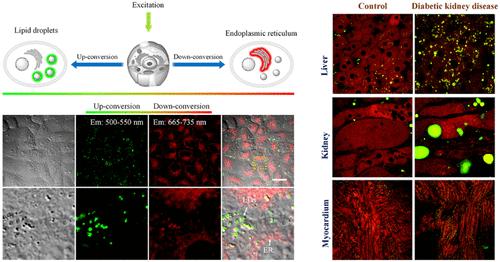
Diabetic kidney disease (DKD) is a leading cause of death among diabetic patients, primarily due to ectopic lipid accumulation in nonadipose tissues. The lack of molecular tools for quantitatively visualizing this lipid accumulation has hindered in-depth studies. This study aims to develop a dual-emissive up-conversion fluorescent probe, DSDM, for precise in vivo and ex vivo analyses of lipid accumulation. DSDM exhibits up-conversion green emission and down-conversion near-infrared (NIR) fluorescence when excited at 561 nm. This allows for the simultaneous imaging of lipid droplets (LDs) and the endoplasmic reticulum (ER), the primary sites for lipid synthesis and storage. With intracellular lipid consumption and accumulation, the green emission in LDs decreased or increased, while the NIR fluorescence in the ER remained constant. Using the NIR emission as an internal control, the green-to-NIR emission intensity ratio can quantify the LD amount accurately, overcoming the possible interferences from inhomogeneous staining, variation in cell population, and other factors. With the probe, we quantitatively analyzed LD accumulation in human kidney cells with either overexpressed or silenced aquaporin 7 (AQP7), induced by palmitic acid. Herein, AQP7 is specifically expressed in kidney tubules and is the only channel that regulates adipose glycerol transport. In DKD mice with kidney-specific AQP7 knockout, the probe successfully detected up-regulated lipid accumulation and ER stress. Tissue imaging revealed that the inhibited close contact between LDs and ER might facilitate the assessment of lipid accumulation in DKD. This approach effectively addresses the limitations of precise tissue biopsy in DKD, thereby improving DKD management.
期刊介绍:
ACS Sensors is a peer-reviewed research journal that focuses on the dissemination of new and original knowledge in the field of sensor science, particularly those that selectively sense chemical or biological species or processes. The journal covers a broad range of topics, including but not limited to biosensors, chemical sensors, gas sensors, intracellular sensors, single molecule sensors, cell chips, and microfluidic devices. It aims to publish articles that address conceptual advances in sensing technology applicable to various types of analytes or application papers that report on the use of existing sensing concepts in new ways or for new analytes.




 京公网安备 11010802042870号
京ICP备2023020795号-1
京公网安备 11010802042870号
京ICP备2023020795号-1

 分享
分享
 求助内容:
求助内容: 应助结果提醒方式:
 扫码关注我们
