Abid Alam, Yawen Li, Fuchun Ning, Tianrong Li, Yuhua Wang
{"title":"通过配体修饰、包封和与超疏水聚合物的相互作用增强CsPbBr3量子点的光学性质和稳定性","authors":"Abid Alam, Yawen Li, Fuchun Ning, Tianrong Li, Yuhua Wang","doi":"10.1021/acsami.4c21351","DOIUrl":null,"url":null,"abstract":"Reducing the detachment of ligands on all-inorganic cesium lead bromide perovskite quantum dots (CsPbBr<sub>3</sub> PQDs) presents a significant challenge to their practical applications, despite their remarkable optoelectronic properties. Herein, a novel strategy was introduced to passivate the surface defects of CsPbBr<sub>3</sub> PQDs by employing short-chain surface ligands and functional groups within a polymer matrix to enhance their processability. Guanidinopropanoic acid (GPA) was employed as a coligand alongside oleic acid and oleylamine to synthesize CsPbBr<sub>3</sub>-GPA PQDs via the hot injection method. A nitrogen-containing, superhydrophobic mesoporous polymer, poly(divinylbenzene)-vinylimidazole (PDVB-Vim), was utilized as an innovative encapsulation material for CsPbBr<sub>3</sub> PQDs, resulting in the formation of the CsPbBr<sub>3</sub>-GPA@PDVB-Vim composite. CsPbBr<sub>3</sub>-GPA PQDs were successfully protected from unfavorable external stimulation, such as water and UV light, by the protective PDVB-Vim. CsPbBr<sub>3</sub>-GPA@PDVB-Vim retains over 76% of its initial photoluminescence intensity after 31 days in water and 68% after 96 h of continuous exposure to 365 nm UV irradiation at an intensity of 15 mW·cm<sup>–2</sup>. The screen printing of CsPbBr<sub>3</sub>-GPA@PDVB-Vim with methyl methacrylate, butyl methacrylate, and styrene demonstrates its potential as a stable light conversion material for wearable devices. This breakthrough may pave the way for further advancements in using CsPbBr<sub>3</sub>-GPA@PDVB-Vim as a highly stable photoluminescent material for wearable luminescent textiles and light conversion applications.","PeriodicalId":5,"journal":{"name":"ACS Applied Materials & Interfaces","volume":"30 1","pages":""},"PeriodicalIF":8.2000,"publicationDate":"2025-03-05","publicationTypes":"Journal Article","fieldsOfStudy":null,"isOpenAccess":false,"openAccessPdf":"","citationCount":"0","resultStr":"{\"title\":\"Enhancing the Optical Properties and Stability of CsPbBr3 Quantum Dots through Ligand Modification, Encapsulation, and Interaction with a Superhydrophobic Polymer\",\"authors\":\"Abid Alam, Yawen Li, Fuchun Ning, Tianrong Li, Yuhua Wang\",\"doi\":\"10.1021/acsami.4c21351\",\"DOIUrl\":null,\"url\":null,\"abstract\":\"Reducing the detachment of ligands on all-inorganic cesium lead bromide perovskite quantum dots (CsPbBr<sub>3</sub> PQDs) presents a significant challenge to their practical applications, despite their remarkable optoelectronic properties. Herein, a novel strategy was introduced to passivate the surface defects of CsPbBr<sub>3</sub> PQDs by employing short-chain surface ligands and functional groups within a polymer matrix to enhance their processability. Guanidinopropanoic acid (GPA) was employed as a coligand alongside oleic acid and oleylamine to synthesize CsPbBr<sub>3</sub>-GPA PQDs via the hot injection method. A nitrogen-containing, superhydrophobic mesoporous polymer, poly(divinylbenzene)-vinylimidazole (PDVB-Vim), was utilized as an innovative encapsulation material for CsPbBr<sub>3</sub> PQDs, resulting in the formation of the CsPbBr<sub>3</sub>-GPA@PDVB-Vim composite. CsPbBr<sub>3</sub>-GPA PQDs were successfully protected from unfavorable external stimulation, such as water and UV light, by the protective PDVB-Vim. CsPbBr<sub>3</sub>-GPA@PDVB-Vim retains over 76% of its initial photoluminescence intensity after 31 days in water and 68% after 96 h of continuous exposure to 365 nm UV irradiation at an intensity of 15 mW·cm<sup>–2</sup>. The screen printing of CsPbBr<sub>3</sub>-GPA@PDVB-Vim with methyl methacrylate, butyl methacrylate, and styrene demonstrates its potential as a stable light conversion material for wearable devices. This breakthrough may pave the way for further advancements in using CsPbBr<sub>3</sub>-GPA@PDVB-Vim as a highly stable photoluminescent material for wearable luminescent textiles and light conversion applications.\",\"PeriodicalId\":5,\"journal\":{\"name\":\"ACS Applied Materials & Interfaces\",\"volume\":\"30 1\",\"pages\":\"\"},\"PeriodicalIF\":8.2000,\"publicationDate\":\"2025-03-05\",\"publicationTypes\":\"Journal Article\",\"fieldsOfStudy\":null,\"isOpenAccess\":false,\"openAccessPdf\":\"\",\"citationCount\":\"0\",\"resultStr\":null,\"platform\":\"Semanticscholar\",\"paperid\":null,\"PeriodicalName\":\"ACS Applied Materials & Interfaces\",\"FirstCategoryId\":\"88\",\"ListUrlMain\":\"https://doi.org/10.1021/acsami.4c21351\",\"RegionNum\":2,\"RegionCategory\":\"材料科学\",\"ArticlePicture\":[],\"TitleCN\":null,\"AbstractTextCN\":null,\"PMCID\":null,\"EPubDate\":\"\",\"PubModel\":\"\",\"JCR\":\"Q1\",\"JCRName\":\"MATERIALS SCIENCE, MULTIDISCIPLINARY\",\"Score\":null,\"Total\":0}","platform":"Semanticscholar","paperid":null,"PeriodicalName":"ACS Applied Materials & Interfaces","FirstCategoryId":"88","ListUrlMain":"https://doi.org/10.1021/acsami.4c21351","RegionNum":2,"RegionCategory":"材料科学","ArticlePicture":[],"TitleCN":null,"AbstractTextCN":null,"PMCID":null,"EPubDate":"","PubModel":"","JCR":"Q1","JCRName":"MATERIALS SCIENCE, MULTIDISCIPLINARY","Score":null,"Total":0}
Enhancing the Optical Properties and Stability of CsPbBr3 Quantum Dots through Ligand Modification, Encapsulation, and Interaction with a Superhydrophobic Polymer
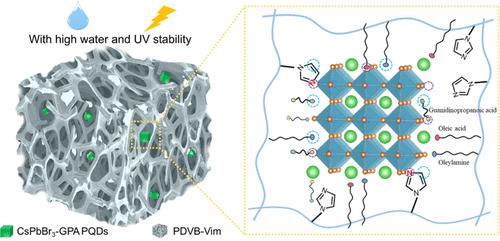
Reducing the detachment of ligands on all-inorganic cesium lead bromide perovskite quantum dots (CsPbBr3 PQDs) presents a significant challenge to their practical applications, despite their remarkable optoelectronic properties. Herein, a novel strategy was introduced to passivate the surface defects of CsPbBr3 PQDs by employing short-chain surface ligands and functional groups within a polymer matrix to enhance their processability. Guanidinopropanoic acid (GPA) was employed as a coligand alongside oleic acid and oleylamine to synthesize CsPbBr3-GPA PQDs via the hot injection method. A nitrogen-containing, superhydrophobic mesoporous polymer, poly(divinylbenzene)-vinylimidazole (PDVB-Vim), was utilized as an innovative encapsulation material for CsPbBr3 PQDs, resulting in the formation of the CsPbBr3-GPA@PDVB-Vim composite. CsPbBr3-GPA PQDs were successfully protected from unfavorable external stimulation, such as water and UV light, by the protective PDVB-Vim. CsPbBr3-GPA@PDVB-Vim retains over 76% of its initial photoluminescence intensity after 31 days in water and 68% after 96 h of continuous exposure to 365 nm UV irradiation at an intensity of 15 mW·cm–2. The screen printing of CsPbBr3-GPA@PDVB-Vim with methyl methacrylate, butyl methacrylate, and styrene demonstrates its potential as a stable light conversion material for wearable devices. This breakthrough may pave the way for further advancements in using CsPbBr3-GPA@PDVB-Vim as a highly stable photoluminescent material for wearable luminescent textiles and light conversion applications.
期刊介绍:
ACS Applied Materials & Interfaces is a leading interdisciplinary journal that brings together chemists, engineers, physicists, and biologists to explore the development and utilization of newly-discovered materials and interfacial processes for specific applications. Our journal has experienced remarkable growth since its establishment in 2009, both in terms of the number of articles published and the impact of the research showcased. We are proud to foster a truly global community, with the majority of published articles originating from outside the United States, reflecting the rapid growth of applied research worldwide.




 京公网安备 11010802042870号
京ICP备2023020795号-1
京公网安备 11010802042870号
京ICP备2023020795号-1

 分享
分享
 求助内容:
求助内容: 应助结果提醒方式:
 扫码关注我们
