Meenakshi Seshadhri Garapati, Esther de Prado, Viliam Vretenár, Tomáš Kovářík, Tomáš Němec
{"title":"火花烧蚀法制备Pt纳米电极增强质子交换膜燃料电池的催化活性","authors":"Meenakshi Seshadhri Garapati, Esther de Prado, Viliam Vretenár, Tomáš Kovářík, Tomáš Němec","doi":"10.1021/acsami.4c22587","DOIUrl":null,"url":null,"abstract":"Catalyst layers play a crucial role in determining the performance of proton exchange membrane fuel cells (PEMFCs). However, the deposition of catalyst layers poses challenges in PEMFC stack production due to the complexity of the fabrication steps. Herein, we present a simplified approach to synthesize Pt nanostructures via spark ablation and simultaneously deposit them onto gas diffusion layers (GDL). The in situ deposited catalyst layers on GDL serve as electrodes for membrane electrode assembly (MEA) fabrication. Moreover, the carrier gas in the spark ablation process significantly influences the nucleation and growth of the Pt nanostructures. Pt nanostructures produced in forming gas (Pt_FG, 95% nitrogen, and 5% hydrogen) exhibit dendritic morphology distinct from those obtained in pure N<sub>2</sub> (Pt_N<sub>2</sub>). Investigating the catalytic activity of Pt synthesized in different carrier gases reveals that the Pt_FG catalyst demonstrates enhanced half-wave potential, mass activity, and durability compared to those of Pt_N<sub>2</sub> and commercial Pt-black catalysts. Single-cell measurements evaluate the electrocatalytic activity of the ionomer-free, in situ deposited catalyst layers. The Pt_FG MEA (0.2 mg<sub>Pt</sub> cm<sup>–2</sup>) achieves a power density of 1285 mW cm<sup>–2</sup> at 70 °C, 200 kPa, approximately 1.8 and 2 times higher than Pt_N<sub>2</sub> and Pt-black MEAs, respectively. Further reduction of the catalyst loading to 0.1 mg<sub>Pt</sub> cm<sup>–2</sup> results in the Pt_FG MEA delivering 961 mW cm<sup>–2</sup>, indicating enhanced catalytic activity and Pt utilization efficiency. This study provides insights into fabricating catalytic layers using a facile strategy, circumventing the need for catalyst synthesis, ink formation, and electrode coating techniques.","PeriodicalId":5,"journal":{"name":"ACS Applied Materials & Interfaces","volume":"42 1","pages":""},"PeriodicalIF":7.8000,"publicationDate":"2025-03-05","publicationTypes":"Journal Article","fieldsOfStudy":null,"isOpenAccess":false,"openAccessPdf":"","citationCount":"0","resultStr":"{\"title\":\"Enhanced Catalytic Activity of Pt Nanostructured Electrodes Deposited by Spark Ablation for Proton Exchange Membrane Fuel Cells\",\"authors\":\"Meenakshi Seshadhri Garapati, Esther de Prado, Viliam Vretenár, Tomáš Kovářík, Tomáš Němec\",\"doi\":\"10.1021/acsami.4c22587\",\"DOIUrl\":null,\"url\":null,\"abstract\":\"Catalyst layers play a crucial role in determining the performance of proton exchange membrane fuel cells (PEMFCs). However, the deposition of catalyst layers poses challenges in PEMFC stack production due to the complexity of the fabrication steps. Herein, we present a simplified approach to synthesize Pt nanostructures via spark ablation and simultaneously deposit them onto gas diffusion layers (GDL). The in situ deposited catalyst layers on GDL serve as electrodes for membrane electrode assembly (MEA) fabrication. Moreover, the carrier gas in the spark ablation process significantly influences the nucleation and growth of the Pt nanostructures. Pt nanostructures produced in forming gas (Pt_FG, 95% nitrogen, and 5% hydrogen) exhibit dendritic morphology distinct from those obtained in pure N<sub>2</sub> (Pt_N<sub>2</sub>). Investigating the catalytic activity of Pt synthesized in different carrier gases reveals that the Pt_FG catalyst demonstrates enhanced half-wave potential, mass activity, and durability compared to those of Pt_N<sub>2</sub> and commercial Pt-black catalysts. Single-cell measurements evaluate the electrocatalytic activity of the ionomer-free, in situ deposited catalyst layers. The Pt_FG MEA (0.2 mg<sub>Pt</sub> cm<sup>–2</sup>) achieves a power density of 1285 mW cm<sup>–2</sup> at 70 °C, 200 kPa, approximately 1.8 and 2 times higher than Pt_N<sub>2</sub> and Pt-black MEAs, respectively. Further reduction of the catalyst loading to 0.1 mg<sub>Pt</sub> cm<sup>–2</sup> results in the Pt_FG MEA delivering 961 mW cm<sup>–2</sup>, indicating enhanced catalytic activity and Pt utilization efficiency. This study provides insights into fabricating catalytic layers using a facile strategy, circumventing the need for catalyst synthesis, ink formation, and electrode coating techniques.\",\"PeriodicalId\":5,\"journal\":{\"name\":\"ACS Applied Materials & Interfaces\",\"volume\":\"42 1\",\"pages\":\"\"},\"PeriodicalIF\":7.8000,\"publicationDate\":\"2025-03-05\",\"publicationTypes\":\"Journal Article\",\"fieldsOfStudy\":null,\"isOpenAccess\":false,\"openAccessPdf\":\"\",\"citationCount\":\"0\",\"resultStr\":null,\"platform\":\"Semanticscholar\",\"paperid\":null,\"PeriodicalName\":\"ACS Applied Materials & Interfaces\",\"FirstCategoryId\":\"88\",\"ListUrlMain\":\"https://doi.org/10.1021/acsami.4c22587\",\"RegionNum\":2,\"RegionCategory\":\"材料科学\",\"ArticlePicture\":[],\"TitleCN\":null,\"AbstractTextCN\":null,\"PMCID\":null,\"EPubDate\":\"\",\"PubModel\":\"\",\"JCR\":\"Q1\",\"JCRName\":\"MATERIALS SCIENCE, MULTIDISCIPLINARY\",\"Score\":null,\"Total\":0}","platform":"Semanticscholar","paperid":null,"PeriodicalName":"ACS Applied Materials & Interfaces","FirstCategoryId":"88","ListUrlMain":"https://doi.org/10.1021/acsami.4c22587","RegionNum":2,"RegionCategory":"材料科学","ArticlePicture":[],"TitleCN":null,"AbstractTextCN":null,"PMCID":null,"EPubDate":"","PubModel":"","JCR":"Q1","JCRName":"MATERIALS SCIENCE, MULTIDISCIPLINARY","Score":null,"Total":0}
Enhanced Catalytic Activity of Pt Nanostructured Electrodes Deposited by Spark Ablation for Proton Exchange Membrane Fuel Cells
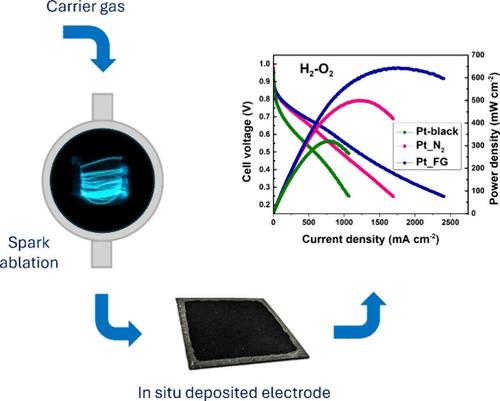
Catalyst layers play a crucial role in determining the performance of proton exchange membrane fuel cells (PEMFCs). However, the deposition of catalyst layers poses challenges in PEMFC stack production due to the complexity of the fabrication steps. Herein, we present a simplified approach to synthesize Pt nanostructures via spark ablation and simultaneously deposit them onto gas diffusion layers (GDL). The in situ deposited catalyst layers on GDL serve as electrodes for membrane electrode assembly (MEA) fabrication. Moreover, the carrier gas in the spark ablation process significantly influences the nucleation and growth of the Pt nanostructures. Pt nanostructures produced in forming gas (Pt_FG, 95% nitrogen, and 5% hydrogen) exhibit dendritic morphology distinct from those obtained in pure N2 (Pt_N2). Investigating the catalytic activity of Pt synthesized in different carrier gases reveals that the Pt_FG catalyst demonstrates enhanced half-wave potential, mass activity, and durability compared to those of Pt_N2 and commercial Pt-black catalysts. Single-cell measurements evaluate the electrocatalytic activity of the ionomer-free, in situ deposited catalyst layers. The Pt_FG MEA (0.2 mgPt cm–2) achieves a power density of 1285 mW cm–2 at 70 °C, 200 kPa, approximately 1.8 and 2 times higher than Pt_N2 and Pt-black MEAs, respectively. Further reduction of the catalyst loading to 0.1 mgPt cm–2 results in the Pt_FG MEA delivering 961 mW cm–2, indicating enhanced catalytic activity and Pt utilization efficiency. This study provides insights into fabricating catalytic layers using a facile strategy, circumventing the need for catalyst synthesis, ink formation, and electrode coating techniques.
期刊介绍:
ACS Applied Materials & Interfaces is a leading interdisciplinary journal that brings together chemists, engineers, physicists, and biologists to explore the development and utilization of newly-discovered materials and interfacial processes for specific applications. Our journal has experienced remarkable growth since its establishment in 2009, both in terms of the number of articles published and the impact of the research showcased. We are proud to foster a truly global community, with the majority of published articles originating from outside the United States, reflecting the rapid growth of applied research worldwide.




 京公网安备 11010802042870号
京ICP备2023020795号-1
京公网安备 11010802042870号
京ICP备2023020795号-1

 分享
分享
 求助内容:
求助内容: 应助结果提醒方式:
 扫码关注我们
