{"title":"强大的沼气升级过程,通过同质丙酮对抗氨和硫化物毒性","authors":"Linjie Zhou, Mengxiong Wu, Jianhua Guo","doi":"10.1016/j.watres.2025.123440","DOIUrl":null,"url":null,"abstract":"<div><div>Using hydrogen derived from surplus green energy (e.g., solar and wind) to convert carbon dioxide to acetate via homoacetogens represents a promising technology for simultaneous biogas upgrading and biochemical production. However, effects of hydrogen sulfide and ammonia on activities of homoacetogens remain unknown, hindering their applications in biogas upgrading. This study investigated the impacts of ammonia and sulfide on homoacetogen-dominated microbial community for biogas upgrading process by combining short-term batch tests and long-term membrane biofilm reactor (MBfR) operation. Results showed that sulfide concentrations ≤ 2 mM TDS (total dissolved sulfide) increased H<sub>2</sub> and CO<sub>2</sub> uptake rates and acetate production both in the short-term and long-term tests. The relative abundance of <em>Acetobacterium</em> (typical homoacetogens) in the MBfR also increased from 30 % without TDS addition to 40 % with the addition of 2 mM TDS. These results suggest that sulfide addition (≤ 2 mM TDS) likely promoted the growth of homoacetogens, thereby enhancing the biogas upgrading efficiency. In terms of ammonia, results suggested that 0.5 g NH<sub>4</sub><sup>+</sup>-N/L has negligible impacts on the homoacetogens’ activities, while concentrations ≥ 1 g NH<sub>4</sub><sup>+</sup>-N/L significantly inhibited homoacetogens’ activities, resulting in negligible acetate production during the short-term tests. However, the long-term biogas upgrading performance remained unaffected by 1 g NH<sub>4</sub><sup>+</sup>-N/L. Moreover, with the simultaneous additions of typical concentrations of sulfide (2 mM TDS, equivalent to the H<sub>2</sub>S concentration of 0.8 % in biogas) and ammonia (1 g NH<sub>4</sub><sup>+</sup>-N/L, equivalent to the NH<sub>3</sub> concentration of 0.1 % in biogas) in raw biogas, our MBfR still achieved high H<sub>2</sub> and CO<sub>2</sub> utilization efficiencies (95 % and 97 %, respectively) and acetate production rate (550 mg/L/d). These highlight the robustness of MBfR against ammonia and sulfide toxicities. Additionally, the injection of extra H<sub>2</sub> could alleviate the ammonia and sulfide inhibitions on homoacetogens with acetate production increased by 13–80 times. This provides a new strategy to enhance the tolerance of homoacetogens against high concentrations of hydrogen sulfide and ammonia. Collectively, our findings advance the understanding of the response of homoacetogens to ammonia and sulfide stress and facilitate the development of a resilient and efficient homoacetogen-mediated bioprocess for upgrading biogas to biomethane and chemicals simultaneously.</div></div>","PeriodicalId":443,"journal":{"name":"Water Research","volume":"279 ","pages":"Article 123440"},"PeriodicalIF":12.8000,"publicationDate":"2025-07-01","publicationTypes":"Journal Article","fieldsOfStudy":null,"isOpenAccess":false,"openAccessPdf":"","citationCount":"0","resultStr":"{\"title\":\"Robust biogas upgrading process via homoacetogens against ammonia and sulfide toxicities\",\"authors\":\"Linjie Zhou, Mengxiong Wu, Jianhua Guo\",\"doi\":\"10.1016/j.watres.2025.123440\",\"DOIUrl\":null,\"url\":null,\"abstract\":\"<div><div>Using hydrogen derived from surplus green energy (e.g., solar and wind) to convert carbon dioxide to acetate via homoacetogens represents a promising technology for simultaneous biogas upgrading and biochemical production. However, effects of hydrogen sulfide and ammonia on activities of homoacetogens remain unknown, hindering their applications in biogas upgrading. This study investigated the impacts of ammonia and sulfide on homoacetogen-dominated microbial community for biogas upgrading process by combining short-term batch tests and long-term membrane biofilm reactor (MBfR) operation. Results showed that sulfide concentrations ≤ 2 mM TDS (total dissolved sulfide) increased H<sub>2</sub> and CO<sub>2</sub> uptake rates and acetate production both in the short-term and long-term tests. The relative abundance of <em>Acetobacterium</em> (typical homoacetogens) in the MBfR also increased from 30 % without TDS addition to 40 % with the addition of 2 mM TDS. These results suggest that sulfide addition (≤ 2 mM TDS) likely promoted the growth of homoacetogens, thereby enhancing the biogas upgrading efficiency. In terms of ammonia, results suggested that 0.5 g NH<sub>4</sub><sup>+</sup>-N/L has negligible impacts on the homoacetogens’ activities, while concentrations ≥ 1 g NH<sub>4</sub><sup>+</sup>-N/L significantly inhibited homoacetogens’ activities, resulting in negligible acetate production during the short-term tests. However, the long-term biogas upgrading performance remained unaffected by 1 g NH<sub>4</sub><sup>+</sup>-N/L. Moreover, with the simultaneous additions of typical concentrations of sulfide (2 mM TDS, equivalent to the H<sub>2</sub>S concentration of 0.8 % in biogas) and ammonia (1 g NH<sub>4</sub><sup>+</sup>-N/L, equivalent to the NH<sub>3</sub> concentration of 0.1 % in biogas) in raw biogas, our MBfR still achieved high H<sub>2</sub> and CO<sub>2</sub> utilization efficiencies (95 % and 97 %, respectively) and acetate production rate (550 mg/L/d). These highlight the robustness of MBfR against ammonia and sulfide toxicities. Additionally, the injection of extra H<sub>2</sub> could alleviate the ammonia and sulfide inhibitions on homoacetogens with acetate production increased by 13–80 times. This provides a new strategy to enhance the tolerance of homoacetogens against high concentrations of hydrogen sulfide and ammonia. Collectively, our findings advance the understanding of the response of homoacetogens to ammonia and sulfide stress and facilitate the development of a resilient and efficient homoacetogen-mediated bioprocess for upgrading biogas to biomethane and chemicals simultaneously.</div></div>\",\"PeriodicalId\":443,\"journal\":{\"name\":\"Water Research\",\"volume\":\"279 \",\"pages\":\"Article 123440\"},\"PeriodicalIF\":12.8000,\"publicationDate\":\"2025-07-01\",\"publicationTypes\":\"Journal Article\",\"fieldsOfStudy\":null,\"isOpenAccess\":false,\"openAccessPdf\":\"\",\"citationCount\":\"0\",\"resultStr\":null,\"platform\":\"Semanticscholar\",\"paperid\":null,\"PeriodicalName\":\"Water Research\",\"FirstCategoryId\":\"93\",\"ListUrlMain\":\"https://www.sciencedirect.com/science/article/pii/S0043135425003537\",\"RegionNum\":1,\"RegionCategory\":\"环境科学与生态学\",\"ArticlePicture\":[],\"TitleCN\":null,\"AbstractTextCN\":null,\"PMCID\":null,\"EPubDate\":\"2025/3/5 0:00:00\",\"PubModel\":\"Epub\",\"JCR\":\"Q1\",\"JCRName\":\"ENGINEERING, ENVIRONMENTAL\",\"Score\":null,\"Total\":0}","platform":"Semanticscholar","paperid":null,"PeriodicalName":"Water Research","FirstCategoryId":"93","ListUrlMain":"https://www.sciencedirect.com/science/article/pii/S0043135425003537","RegionNum":1,"RegionCategory":"环境科学与生态学","ArticlePicture":[],"TitleCN":null,"AbstractTextCN":null,"PMCID":null,"EPubDate":"2025/3/5 0:00:00","PubModel":"Epub","JCR":"Q1","JCRName":"ENGINEERING, ENVIRONMENTAL","Score":null,"Total":0}
引用次数: 0
摘要
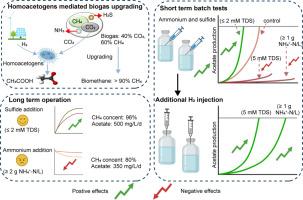
利用来自剩余绿色能源(如太阳能和风能)的氢,通过同质产氢剂将二氧化碳转化为醋酸盐,这是一种很有前途的沼气升级和生化生产同步技术。然而,硫化氢和氨对同质产氢酶活性的影响尚不清楚,阻碍了它们在沼气升级中的应用。本研究通过短期间歇试验和长期膜生物膜反应器(MBfR)运行相结合的方法,研究了氨和硫化物对沼气升级过程中均质乙基为主的微生物群落的影响。结果表明,在短期和长期试验中,硫化物浓度≤2 mM TDS(总溶解硫化物)均能提高H2和CO2的吸收率以及乙酸的产量。MBfR中醋酸杆菌(典型同质醋酸菌)的相对丰度也从未添加TDS时的30%增加到添加2 mM TDS时的40%。以上结果表明,硫化物的添加(≤2 mM TDS)可能促进了同质发酵菌的生长,从而提高了沼气的升级效率。在氨方面,0.5 g NH4+-N/L对同质醋酸菌活性的影响可以忽略不计,而≥1 g NH4+-N/L显著抑制同质醋酸菌活性,导致短期试验中乙酸产量可以忽略不计。然而,1 g NH4+-N/L对沼气的长期升级性能没有影响。此外,在原料沼气中同时添加典型浓度的硫化物(2 mM TDS,相当于沼气中H2S浓度的0.8%)和氨(1 g NH4+-N/L,相当于沼气中NH3浓度的0.1%),我们的MBfR仍然具有较高的H2和CO2利用效率(分别为95%和97%)和乙酸产率(550 mg/L/d)。这些突出了MBfR对氨和硫化物毒性的稳健性。另外,添加额外的H2可以缓解氨和硫化物对同质醋酸菌的抑制作用,乙酸产量提高13 ~ 80倍。这提供了一种新的策略,以提高对高浓度硫化氢和氨的同质醋酸的耐受性。总的来说,我们的研究结果促进了对同质乙醛对氨和硫化物胁迫的响应的理解,并促进了一种弹性和高效的同质乙醛介导的生物工艺的发展,该工艺可同时将沼气转化为生物甲烷和化学物质。
Robust biogas upgrading process via homoacetogens against ammonia and sulfide toxicities
Using hydrogen derived from surplus green energy (e.g., solar and wind) to convert carbon dioxide to acetate via homoacetogens represents a promising technology for simultaneous biogas upgrading and biochemical production. However, effects of hydrogen sulfide and ammonia on activities of homoacetogens remain unknown, hindering their applications in biogas upgrading. This study investigated the impacts of ammonia and sulfide on homoacetogen-dominated microbial community for biogas upgrading process by combining short-term batch tests and long-term membrane biofilm reactor (MBfR) operation. Results showed that sulfide concentrations ≤ 2 mM TDS (total dissolved sulfide) increased H2 and CO2 uptake rates and acetate production both in the short-term and long-term tests. The relative abundance of Acetobacterium (typical homoacetogens) in the MBfR also increased from 30 % without TDS addition to 40 % with the addition of 2 mM TDS. These results suggest that sulfide addition (≤ 2 mM TDS) likely promoted the growth of homoacetogens, thereby enhancing the biogas upgrading efficiency. In terms of ammonia, results suggested that 0.5 g NH4+-N/L has negligible impacts on the homoacetogens’ activities, while concentrations ≥ 1 g NH4+-N/L significantly inhibited homoacetogens’ activities, resulting in negligible acetate production during the short-term tests. However, the long-term biogas upgrading performance remained unaffected by 1 g NH4+-N/L. Moreover, with the simultaneous additions of typical concentrations of sulfide (2 mM TDS, equivalent to the H2S concentration of 0.8 % in biogas) and ammonia (1 g NH4+-N/L, equivalent to the NH3 concentration of 0.1 % in biogas) in raw biogas, our MBfR still achieved high H2 and CO2 utilization efficiencies (95 % and 97 %, respectively) and acetate production rate (550 mg/L/d). These highlight the robustness of MBfR against ammonia and sulfide toxicities. Additionally, the injection of extra H2 could alleviate the ammonia and sulfide inhibitions on homoacetogens with acetate production increased by 13–80 times. This provides a new strategy to enhance the tolerance of homoacetogens against high concentrations of hydrogen sulfide and ammonia. Collectively, our findings advance the understanding of the response of homoacetogens to ammonia and sulfide stress and facilitate the development of a resilient and efficient homoacetogen-mediated bioprocess for upgrading biogas to biomethane and chemicals simultaneously.
期刊介绍:
Water Research, along with its open access companion journal Water Research X, serves as a platform for publishing original research papers covering various aspects of the science and technology related to the anthropogenic water cycle, water quality, and its management worldwide. The audience targeted by the journal comprises biologists, chemical engineers, chemists, civil engineers, environmental engineers, limnologists, and microbiologists. The scope of the journal include:
•Treatment processes for water and wastewaters (municipal, agricultural, industrial, and on-site treatment), including resource recovery and residuals management;
•Urban hydrology including sewer systems, stormwater management, and green infrastructure;
•Drinking water treatment and distribution;
•Potable and non-potable water reuse;
•Sanitation, public health, and risk assessment;
•Anaerobic digestion, solid and hazardous waste management, including source characterization and the effects and control of leachates and gaseous emissions;
•Contaminants (chemical, microbial, anthropogenic particles such as nanoparticles or microplastics) and related water quality sensing, monitoring, fate, and assessment;
•Anthropogenic impacts on inland, tidal, coastal and urban waters, focusing on surface and ground waters, and point and non-point sources of pollution;
•Environmental restoration, linked to surface water, groundwater and groundwater remediation;
•Analysis of the interfaces between sediments and water, and between water and atmosphere, focusing specifically on anthropogenic impacts;
•Mathematical modelling, systems analysis, machine learning, and beneficial use of big data related to the anthropogenic water cycle;
•Socio-economic, policy, and regulations studies.




 京公网安备 11010802042870号
京ICP备2023020795号-1
京公网安备 11010802042870号
京ICP备2023020795号-1

 分享
分享
 求助内容:
求助内容: 应助结果提醒方式:
 扫码关注我们
