Zilin Wang , Meili Feng , Matthew F. Johnson , Aldo Lipani , Faith Chan
{"title":"水库规模对中国甲烷排放的影响","authors":"Zilin Wang , Meili Feng , Matthew F. Johnson , Aldo Lipani , Faith Chan","doi":"10.1016/j.watres.2025.123441","DOIUrl":null,"url":null,"abstract":"<div><div>Reservoirs play a crucial role as sources of methane (CH₄) emissions, with emission rates and quantities varying widely depending on reservoir size due to factors such as surface area, water depth, usage, operational methods, and spatial distribution. Gaining insights into emission characteristics across different reservoir sizes can aid in designing and managing reservoirs to mitigate CH₄ emissions effectively. In this study, machine learning models were applied to estimate both diffusive and ebullitive CH₄ emissions across 97,435 reservoirs in China, spanning five categories of storage capacity. This comprehensive assessment covers nearly all reservoirs within the country, revealing total CH₄ emissions of approximately 5,414 Gg. Reservoirs > 0.01 km<sup>3</sup> are responsible for about 90 % of these emissions, primarily due to high diffusive flux rates and extensive surface areas. Elevated CH₄ diffusion in reservoirs > 0.01 km<sup>3</sup> is largely influenced by their thermal stratification and capacity for organic matter accumulation. Furthermore, these reservoirs are particularly vulnerable to climate warming, which could accelerate CH₄ emission rates more rapidly in larger reservoirs than in smaller ones (below 0.01 km³). Consequently, prioritising CH₄ management in reservoirs > 0.01 km<sup>3</sup> is imperative. Nevertheless, the high ebullitive flux of CH₄ in reservoirs < 0.01 km<sup>3</sup>, linked to their shallow depth, highlighting the potential for significant CH₄ ebullition from smaller aquatic systems. Given large and small-ranged reservoirs' distinct spatial distribution patterns, targeted management strategies are recommended: project-level management for large reservoirs and basin-level approaches for smaller reservoirs.</div></div>","PeriodicalId":443,"journal":{"name":"Water Research","volume":"279 ","pages":"Article 123441"},"PeriodicalIF":12.8000,"publicationDate":"2025-07-01","publicationTypes":"Journal Article","fieldsOfStudy":null,"isOpenAccess":false,"openAccessPdf":"","citationCount":"0","resultStr":"{\"title\":\"The role of reservoir size in driving methane emissions in China\",\"authors\":\"Zilin Wang , Meili Feng , Matthew F. Johnson , Aldo Lipani , Faith Chan\",\"doi\":\"10.1016/j.watres.2025.123441\",\"DOIUrl\":null,\"url\":null,\"abstract\":\"<div><div>Reservoirs play a crucial role as sources of methane (CH₄) emissions, with emission rates and quantities varying widely depending on reservoir size due to factors such as surface area, water depth, usage, operational methods, and spatial distribution. Gaining insights into emission characteristics across different reservoir sizes can aid in designing and managing reservoirs to mitigate CH₄ emissions effectively. In this study, machine learning models were applied to estimate both diffusive and ebullitive CH₄ emissions across 97,435 reservoirs in China, spanning five categories of storage capacity. This comprehensive assessment covers nearly all reservoirs within the country, revealing total CH₄ emissions of approximately 5,414 Gg. Reservoirs > 0.01 km<sup>3</sup> are responsible for about 90 % of these emissions, primarily due to high diffusive flux rates and extensive surface areas. Elevated CH₄ diffusion in reservoirs > 0.01 km<sup>3</sup> is largely influenced by their thermal stratification and capacity for organic matter accumulation. Furthermore, these reservoirs are particularly vulnerable to climate warming, which could accelerate CH₄ emission rates more rapidly in larger reservoirs than in smaller ones (below 0.01 km³). Consequently, prioritising CH₄ management in reservoirs > 0.01 km<sup>3</sup> is imperative. Nevertheless, the high ebullitive flux of CH₄ in reservoirs < 0.01 km<sup>3</sup>, linked to their shallow depth, highlighting the potential for significant CH₄ ebullition from smaller aquatic systems. Given large and small-ranged reservoirs' distinct spatial distribution patterns, targeted management strategies are recommended: project-level management for large reservoirs and basin-level approaches for smaller reservoirs.</div></div>\",\"PeriodicalId\":443,\"journal\":{\"name\":\"Water Research\",\"volume\":\"279 \",\"pages\":\"Article 123441\"},\"PeriodicalIF\":12.8000,\"publicationDate\":\"2025-07-01\",\"publicationTypes\":\"Journal Article\",\"fieldsOfStudy\":null,\"isOpenAccess\":false,\"openAccessPdf\":\"\",\"citationCount\":\"0\",\"resultStr\":null,\"platform\":\"Semanticscholar\",\"paperid\":null,\"PeriodicalName\":\"Water Research\",\"FirstCategoryId\":\"93\",\"ListUrlMain\":\"https://www.sciencedirect.com/science/article/pii/S0043135425003549\",\"RegionNum\":1,\"RegionCategory\":\"环境科学与生态学\",\"ArticlePicture\":[],\"TitleCN\":null,\"AbstractTextCN\":null,\"PMCID\":null,\"EPubDate\":\"2025/3/5 0:00:00\",\"PubModel\":\"Epub\",\"JCR\":\"Q1\",\"JCRName\":\"ENGINEERING, ENVIRONMENTAL\",\"Score\":null,\"Total\":0}","platform":"Semanticscholar","paperid":null,"PeriodicalName":"Water Research","FirstCategoryId":"93","ListUrlMain":"https://www.sciencedirect.com/science/article/pii/S0043135425003549","RegionNum":1,"RegionCategory":"环境科学与生态学","ArticlePicture":[],"TitleCN":null,"AbstractTextCN":null,"PMCID":null,"EPubDate":"2025/3/5 0:00:00","PubModel":"Epub","JCR":"Q1","JCRName":"ENGINEERING, ENVIRONMENTAL","Score":null,"Total":0}
The role of reservoir size in driving methane emissions in China
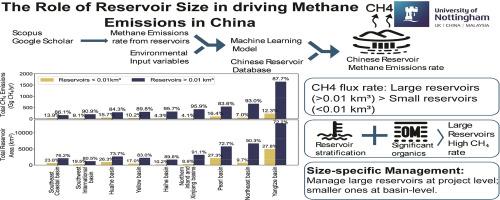
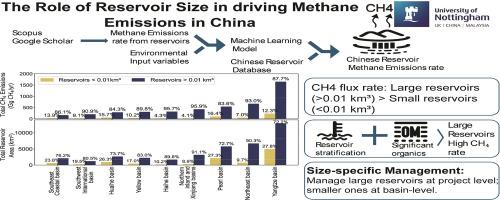
Reservoirs play a crucial role as sources of methane (CH₄) emissions, with emission rates and quantities varying widely depending on reservoir size due to factors such as surface area, water depth, usage, operational methods, and spatial distribution. Gaining insights into emission characteristics across different reservoir sizes can aid in designing and managing reservoirs to mitigate CH₄ emissions effectively. In this study, machine learning models were applied to estimate both diffusive and ebullitive CH₄ emissions across 97,435 reservoirs in China, spanning five categories of storage capacity. This comprehensive assessment covers nearly all reservoirs within the country, revealing total CH₄ emissions of approximately 5,414 Gg. Reservoirs > 0.01 km3 are responsible for about 90 % of these emissions, primarily due to high diffusive flux rates and extensive surface areas. Elevated CH₄ diffusion in reservoirs > 0.01 km3 is largely influenced by their thermal stratification and capacity for organic matter accumulation. Furthermore, these reservoirs are particularly vulnerable to climate warming, which could accelerate CH₄ emission rates more rapidly in larger reservoirs than in smaller ones (below 0.01 km³). Consequently, prioritising CH₄ management in reservoirs > 0.01 km3 is imperative. Nevertheless, the high ebullitive flux of CH₄ in reservoirs < 0.01 km3, linked to their shallow depth, highlighting the potential for significant CH₄ ebullition from smaller aquatic systems. Given large and small-ranged reservoirs' distinct spatial distribution patterns, targeted management strategies are recommended: project-level management for large reservoirs and basin-level approaches for smaller reservoirs.
期刊介绍:
Water Research, along with its open access companion journal Water Research X, serves as a platform for publishing original research papers covering various aspects of the science and technology related to the anthropogenic water cycle, water quality, and its management worldwide. The audience targeted by the journal comprises biologists, chemical engineers, chemists, civil engineers, environmental engineers, limnologists, and microbiologists. The scope of the journal include:
•Treatment processes for water and wastewaters (municipal, agricultural, industrial, and on-site treatment), including resource recovery and residuals management;
•Urban hydrology including sewer systems, stormwater management, and green infrastructure;
•Drinking water treatment and distribution;
•Potable and non-potable water reuse;
•Sanitation, public health, and risk assessment;
•Anaerobic digestion, solid and hazardous waste management, including source characterization and the effects and control of leachates and gaseous emissions;
•Contaminants (chemical, microbial, anthropogenic particles such as nanoparticles or microplastics) and related water quality sensing, monitoring, fate, and assessment;
•Anthropogenic impacts on inland, tidal, coastal and urban waters, focusing on surface and ground waters, and point and non-point sources of pollution;
•Environmental restoration, linked to surface water, groundwater and groundwater remediation;
•Analysis of the interfaces between sediments and water, and between water and atmosphere, focusing specifically on anthropogenic impacts;
•Mathematical modelling, systems analysis, machine learning, and beneficial use of big data related to the anthropogenic water cycle;
•Socio-economic, policy, and regulations studies.




 京公网安备 11010802042870号
京ICP备2023020795号-1
京公网安备 11010802042870号
京ICP备2023020795号-1

 分享
分享
 求助内容:
求助内容: 应助结果提醒方式:
 扫码关注我们
