{"title":"有机碳-锰氧化物相互作用对水生环境胶体稳定性和污染物金属的影响","authors":"Qianqian Li, Debra M. Hausladen","doi":"10.1016/j.watres.2025.123445","DOIUrl":null,"url":null,"abstract":"<div><div>Interactions between organic carbon and Mn oxides can lead to the formation of C-Mn colloids, which play a crucial role in regulating Mn mobility in the environment. Despite the significance of these interactions, the impact of C-Mn oxide interactions on the mobility of these colloids, particularly in the presence of contaminant metals, remains poorly understood. This study investigated the aggregation kinetics of C-Mn colloids formed through the reaction between humic acid and Mn oxides at three C:Mn molar ratios in the presence of divalent cations (Ca<sup>2+</sup> and Mg<sup>2+</sup>). The introduction of organic carbon increased the stability (i.e., ability to resist aggregation) of C-Mn colloids compared to pure Mn(IV) colloids, as reflected in the higher critical coagulation concentration (CCC). As C:Mn molar ratios rose from 0.5 to 3 during colloid formation, the CCCs for the resulting C-Mn colloids increased from 3.6 mM to 7.2 mM Ca<sup>2+</sup>. However, at the highest C:Mn ratio (C:Mn=15), the CCCs decreased slightly to 7.0 mM Ca<sup>2+</sup>, with a similar trend observed for Mg<sup>2+</sup>. The stability of C-Mn colloids was affected by characteristics including electrostatic repulsion, surface functional groups, and Mn(II) content, resulting from reaction with dissolved organic carbon. Based on CCCs, C-Mn colloids were most stable in the presence of Mn<sup>2+</sup> (6.9 mM), followed by Co<sup>2+</sup> (5.9 mM), Zn<sup>2+</sup> (2.7 mM), and Cd<sup>2+</sup> (1.9 mM). The capacity of contaminant metals to destabilize C-Mn colloids followed the reverse order, with Cd<sup>2+</sup> having the greatest destabilizing effect. Variations among the metals were influenced by factors such as atomic radius, hydration shell, electronegativity, and electrostatic repulsion. These results provide new insight into the aggregation behavior of C-Mn colloids and the mechanisms controlling the fate and mobility of associated contaminant metals. This knowledge has important implications for understanding contaminant transport in natural waters and optimizing water treatment processes.</div></div>","PeriodicalId":443,"journal":{"name":"Water Research","volume":"280 ","pages":"Article 123445"},"PeriodicalIF":12.8000,"publicationDate":"2025-07-15","publicationTypes":"Journal Article","fieldsOfStudy":null,"isOpenAccess":false,"openAccessPdf":"","citationCount":"0","resultStr":"{\"title\":\"Impact of organic carbon-Mn oxide interactions on colloid stability and contaminant metals in aquatic environments\",\"authors\":\"Qianqian Li, Debra M. Hausladen\",\"doi\":\"10.1016/j.watres.2025.123445\",\"DOIUrl\":null,\"url\":null,\"abstract\":\"<div><div>Interactions between organic carbon and Mn oxides can lead to the formation of C-Mn colloids, which play a crucial role in regulating Mn mobility in the environment. Despite the significance of these interactions, the impact of C-Mn oxide interactions on the mobility of these colloids, particularly in the presence of contaminant metals, remains poorly understood. This study investigated the aggregation kinetics of C-Mn colloids formed through the reaction between humic acid and Mn oxides at three C:Mn molar ratios in the presence of divalent cations (Ca<sup>2+</sup> and Mg<sup>2+</sup>). The introduction of organic carbon increased the stability (i.e., ability to resist aggregation) of C-Mn colloids compared to pure Mn(IV) colloids, as reflected in the higher critical coagulation concentration (CCC). As C:Mn molar ratios rose from 0.5 to 3 during colloid formation, the CCCs for the resulting C-Mn colloids increased from 3.6 mM to 7.2 mM Ca<sup>2+</sup>. However, at the highest C:Mn ratio (C:Mn=15), the CCCs decreased slightly to 7.0 mM Ca<sup>2+</sup>, with a similar trend observed for Mg<sup>2+</sup>. The stability of C-Mn colloids was affected by characteristics including electrostatic repulsion, surface functional groups, and Mn(II) content, resulting from reaction with dissolved organic carbon. Based on CCCs, C-Mn colloids were most stable in the presence of Mn<sup>2+</sup> (6.9 mM), followed by Co<sup>2+</sup> (5.9 mM), Zn<sup>2+</sup> (2.7 mM), and Cd<sup>2+</sup> (1.9 mM). The capacity of contaminant metals to destabilize C-Mn colloids followed the reverse order, with Cd<sup>2+</sup> having the greatest destabilizing effect. Variations among the metals were influenced by factors such as atomic radius, hydration shell, electronegativity, and electrostatic repulsion. These results provide new insight into the aggregation behavior of C-Mn colloids and the mechanisms controlling the fate and mobility of associated contaminant metals. This knowledge has important implications for understanding contaminant transport in natural waters and optimizing water treatment processes.</div></div>\",\"PeriodicalId\":443,\"journal\":{\"name\":\"Water Research\",\"volume\":\"280 \",\"pages\":\"Article 123445\"},\"PeriodicalIF\":12.8000,\"publicationDate\":\"2025-07-15\",\"publicationTypes\":\"Journal Article\",\"fieldsOfStudy\":null,\"isOpenAccess\":false,\"openAccessPdf\":\"\",\"citationCount\":\"0\",\"resultStr\":null,\"platform\":\"Semanticscholar\",\"paperid\":null,\"PeriodicalName\":\"Water Research\",\"FirstCategoryId\":\"93\",\"ListUrlMain\":\"https://www.sciencedirect.com/science/article/pii/S0043135425003586\",\"RegionNum\":1,\"RegionCategory\":\"环境科学与生态学\",\"ArticlePicture\":[],\"TitleCN\":null,\"AbstractTextCN\":null,\"PMCID\":null,\"EPubDate\":\"2025/3/5 0:00:00\",\"PubModel\":\"Epub\",\"JCR\":\"Q1\",\"JCRName\":\"ENGINEERING, ENVIRONMENTAL\",\"Score\":null,\"Total\":0}","platform":"Semanticscholar","paperid":null,"PeriodicalName":"Water Research","FirstCategoryId":"93","ListUrlMain":"https://www.sciencedirect.com/science/article/pii/S0043135425003586","RegionNum":1,"RegionCategory":"环境科学与生态学","ArticlePicture":[],"TitleCN":null,"AbstractTextCN":null,"PMCID":null,"EPubDate":"2025/3/5 0:00:00","PubModel":"Epub","JCR":"Q1","JCRName":"ENGINEERING, ENVIRONMENTAL","Score":null,"Total":0}
引用次数: 0
摘要
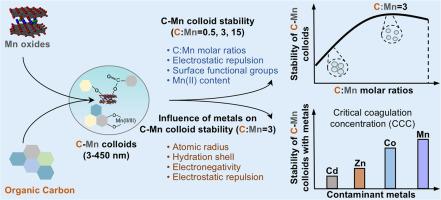
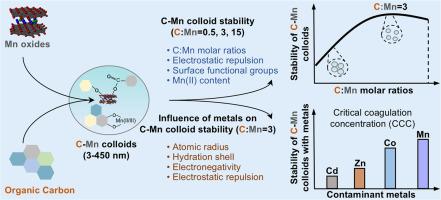
有机碳和锰氧化物之间的相互作用可以导致C-Mn胶体的形成,这在调节锰在环境中的迁移性方面起着至关重要的作用。然而,尽管这些相互作用具有重要意义,但C-Mn氧化物相互作用对这些胶体流动性的影响,特别是在污染金属存在的情况下,仍然知之甚少。本研究考察了腐殖酸与锰氧化物在三种C:Mn摩尔比下,在二价阳离子(Ca2+和Mg2+)存在下形成的C-Mn胶体的聚集动力学。与纯Mn(IV)胶体相比,有机碳的引入提高了C-Mn胶体的稳定性(即抗聚集能力),这反映在更高的临界混凝浓度(CCC)上。当C:Mn的摩尔比从0.5增加到3时,C-Mn胶体的CCCs从3.6 mM增加到7.2 mM Ca2+。然而,在最高C:Mn比(C:Mn=15)时,CCCs略有下降至7.0 mM Ca2+, Mg2+也有类似的趋势。C-Mn胶体的稳定性受其静电斥力、表面官能团和Mn(II)含量等特性的影响,这些特性与溶解的有机碳反应有关。基于CCCs, C-Mn胶体在Mn2+ (6.9 mM)存在下最稳定,其次是Co2+ (5.9 mM)、Zn2+ (2.7 mM)和Cd2+ (1.9 mM)。污染金属对C-Mn胶体的破坏能力依次相反,其中Cd2+的破坏作用最大。不同金属间的差异受原子半径、水合壳层、电负性和静电斥力等因素影响。这些结果为C-Mn胶体的聚集行为以及相关污染金属的命运和迁移控制机制提供了新的见解。这一知识对于理解自然水体中的污染物迁移和优化水处理工艺具有重要意义。
Impact of organic carbon-Mn oxide interactions on colloid stability and contaminant metals in aquatic environments
Interactions between organic carbon and Mn oxides can lead to the formation of C-Mn colloids, which play a crucial role in regulating Mn mobility in the environment. Despite the significance of these interactions, the impact of C-Mn oxide interactions on the mobility of these colloids, particularly in the presence of contaminant metals, remains poorly understood. This study investigated the aggregation kinetics of C-Mn colloids formed through the reaction between humic acid and Mn oxides at three C:Mn molar ratios in the presence of divalent cations (Ca2+ and Mg2+). The introduction of organic carbon increased the stability (i.e., ability to resist aggregation) of C-Mn colloids compared to pure Mn(IV) colloids, as reflected in the higher critical coagulation concentration (CCC). As C:Mn molar ratios rose from 0.5 to 3 during colloid formation, the CCCs for the resulting C-Mn colloids increased from 3.6 mM to 7.2 mM Ca2+. However, at the highest C:Mn ratio (C:Mn=15), the CCCs decreased slightly to 7.0 mM Ca2+, with a similar trend observed for Mg2+. The stability of C-Mn colloids was affected by characteristics including electrostatic repulsion, surface functional groups, and Mn(II) content, resulting from reaction with dissolved organic carbon. Based on CCCs, C-Mn colloids were most stable in the presence of Mn2+ (6.9 mM), followed by Co2+ (5.9 mM), Zn2+ (2.7 mM), and Cd2+ (1.9 mM). The capacity of contaminant metals to destabilize C-Mn colloids followed the reverse order, with Cd2+ having the greatest destabilizing effect. Variations among the metals were influenced by factors such as atomic radius, hydration shell, electronegativity, and electrostatic repulsion. These results provide new insight into the aggregation behavior of C-Mn colloids and the mechanisms controlling the fate and mobility of associated contaminant metals. This knowledge has important implications for understanding contaminant transport in natural waters and optimizing water treatment processes.
期刊介绍:
Water Research, along with its open access companion journal Water Research X, serves as a platform for publishing original research papers covering various aspects of the science and technology related to the anthropogenic water cycle, water quality, and its management worldwide. The audience targeted by the journal comprises biologists, chemical engineers, chemists, civil engineers, environmental engineers, limnologists, and microbiologists. The scope of the journal include:
•Treatment processes for water and wastewaters (municipal, agricultural, industrial, and on-site treatment), including resource recovery and residuals management;
•Urban hydrology including sewer systems, stormwater management, and green infrastructure;
•Drinking water treatment and distribution;
•Potable and non-potable water reuse;
•Sanitation, public health, and risk assessment;
•Anaerobic digestion, solid and hazardous waste management, including source characterization and the effects and control of leachates and gaseous emissions;
•Contaminants (chemical, microbial, anthropogenic particles such as nanoparticles or microplastics) and related water quality sensing, monitoring, fate, and assessment;
•Anthropogenic impacts on inland, tidal, coastal and urban waters, focusing on surface and ground waters, and point and non-point sources of pollution;
•Environmental restoration, linked to surface water, groundwater and groundwater remediation;
•Analysis of the interfaces between sediments and water, and between water and atmosphere, focusing specifically on anthropogenic impacts;
•Mathematical modelling, systems analysis, machine learning, and beneficial use of big data related to the anthropogenic water cycle;
•Socio-economic, policy, and regulations studies.




 京公网安备 11010802042870号
京ICP备2023020795号-1
京公网安备 11010802042870号
京ICP备2023020795号-1

 分享
分享
 求助内容:
求助内容: 应助结果提醒方式:
 扫码关注我们
