Vanessa Kirschner BS , Ophelia Yin MD , Lisa Coscia RN, BSN , Prisca C. Diala MD , Negeen Shahandeh MD , Roxanna A. Irani MD, PhD , Serban Constantinescu MD, PhD , Michael J. Moritz MD , Yalda Afshar MD, PhD
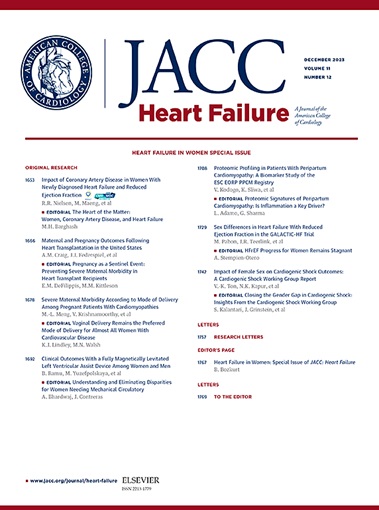
{"title":"心脏移植与妊娠","authors":"Vanessa Kirschner BS , Ophelia Yin MD , Lisa Coscia RN, BSN , Prisca C. Diala MD , Negeen Shahandeh MD , Roxanna A. Irani MD, PhD , Serban Constantinescu MD, PhD , Michael J. Moritz MD , Yalda Afshar MD, PhD","doi":"10.1016/j.jchf.2024.11.016","DOIUrl":null,"url":null,"abstract":"<div><h3>Background</h3><div>Heart transplant recipients (HTRs) during pregnancy are at greater risk for maternal and obstetrical complications and hypertensive disease of pregnancy exacerbates these risks. The impact of preeclampsia on HTRs is unknown.</div></div><div><h3>Objectives</h3><div>The authors describe characteristics of HTRs who developed preeclampsia and the effect of preeclampsia on graft and pregnancy outcomes.</div></div><div><h3>Methods</h3><div>This is a retrospective group study of adult HTRs with subsequent pregnancy outcomes of ≥20 weeks’ gestation enrolled in the Transplant Pregnancy Registry International between 1986 and 2022. The primary outcome was graft loss within 2 years from delivery. Secondary outcomes included maternal and neonatal outcomes.</div></div><div><h3>Results</h3><div>A total of 146 pregnancies and 149 neonates met inclusion criteria. All were livebirths. Forty-two pregnancies (28.8%) were complicated by preeclampsia. HTRs in the preeclampsia group were more likely to be nulliparous (81.0% vs 54.8%; <em>P</em> < 0.01), and have chronic hypertension (73.8% vs 34.6%; <em>P</em> < 0.01). There was no difference in incidence of graft loss at 2 years with (4.8%) or without (2.9%) preeclampsia (<em>P =</em> 0.72). There was no clinically important difference in graft survival in pregnancies with preeclampsia compared with pregnancies without preeclampsia (adjusted HR: 0.79 [95% CI: 0.37-1.69]; <em>P =</em> 0.54). However, rates of severe maternal morbidity were high in both groups: 16.7% in the preeclampsia group and 10.6% in those without preeclampsia. Furthermore, preeclampsia was associated with earlier gestational age at birth (35.0 vs 37.0 weeks; <em>P</em> < 0.01) and lower birth weight (2,310 vs 2,801 grams; <em>P</em> < 0.01).</div></div><div><h3>Conclusions</h3><div>There was no difference in graft loss from delivery in HTRs who developed preeclampsia during pregnancy. Regardless of preeclampsia, pregnant HTRs are more likely than the general population to experience severe maternal morbidity. These findings provide pertinent information for counseling heart transplant recipients who pursue pregnancy.</div></div>","PeriodicalId":14687,"journal":{"name":"JACC. Heart failure","volume":"13 3","pages":"Pages 498-507"},"PeriodicalIF":11.8000,"publicationDate":"2025-03-01","publicationTypes":"Journal Article","fieldsOfStudy":null,"isOpenAccess":false,"openAccessPdf":"","citationCount":"0","resultStr":"{\"title\":\"Heart Transplant and Pregnancy\",\"authors\":\"Vanessa Kirschner BS , Ophelia Yin MD , Lisa Coscia RN, BSN , Prisca C. Diala MD , Negeen Shahandeh MD , Roxanna A. Irani MD, PhD , Serban Constantinescu MD, PhD , Michael J. Moritz MD , Yalda Afshar MD, PhD\",\"doi\":\"10.1016/j.jchf.2024.11.016\",\"DOIUrl\":null,\"url\":null,\"abstract\":\"<div><h3>Background</h3><div>Heart transplant recipients (HTRs) during pregnancy are at greater risk for maternal and obstetrical complications and hypertensive disease of pregnancy exacerbates these risks. The impact of preeclampsia on HTRs is unknown.</div></div><div><h3>Objectives</h3><div>The authors describe characteristics of HTRs who developed preeclampsia and the effect of preeclampsia on graft and pregnancy outcomes.</div></div><div><h3>Methods</h3><div>This is a retrospective group study of adult HTRs with subsequent pregnancy outcomes of ≥20 weeks’ gestation enrolled in the Transplant Pregnancy Registry International between 1986 and 2022. The primary outcome was graft loss within 2 years from delivery. Secondary outcomes included maternal and neonatal outcomes.</div></div><div><h3>Results</h3><div>A total of 146 pregnancies and 149 neonates met inclusion criteria. All were livebirths. Forty-two pregnancies (28.8%) were complicated by preeclampsia. HTRs in the preeclampsia group were more likely to be nulliparous (81.0% vs 54.8%; <em>P</em> < 0.01), and have chronic hypertension (73.8% vs 34.6%; <em>P</em> < 0.01). There was no difference in incidence of graft loss at 2 years with (4.8%) or without (2.9%) preeclampsia (<em>P =</em> 0.72). There was no clinically important difference in graft survival in pregnancies with preeclampsia compared with pregnancies without preeclampsia (adjusted HR: 0.79 [95% CI: 0.37-1.69]; <em>P =</em> 0.54). However, rates of severe maternal morbidity were high in both groups: 16.7% in the preeclampsia group and 10.6% in those without preeclampsia. Furthermore, preeclampsia was associated with earlier gestational age at birth (35.0 vs 37.0 weeks; <em>P</em> < 0.01) and lower birth weight (2,310 vs 2,801 grams; <em>P</em> < 0.01).</div></div><div><h3>Conclusions</h3><div>There was no difference in graft loss from delivery in HTRs who developed preeclampsia during pregnancy. Regardless of preeclampsia, pregnant HTRs are more likely than the general population to experience severe maternal morbidity. These findings provide pertinent information for counseling heart transplant recipients who pursue pregnancy.</div></div>\",\"PeriodicalId\":14687,\"journal\":{\"name\":\"JACC. Heart failure\",\"volume\":\"13 3\",\"pages\":\"Pages 498-507\"},\"PeriodicalIF\":11.8000,\"publicationDate\":\"2025-03-01\",\"publicationTypes\":\"Journal Article\",\"fieldsOfStudy\":null,\"isOpenAccess\":false,\"openAccessPdf\":\"\",\"citationCount\":\"0\",\"resultStr\":null,\"platform\":\"Semanticscholar\",\"paperid\":null,\"PeriodicalName\":\"JACC. Heart failure\",\"FirstCategoryId\":\"3\",\"ListUrlMain\":\"https://www.sciencedirect.com/science/article/pii/S2213177925000502\",\"RegionNum\":1,\"RegionCategory\":\"医学\",\"ArticlePicture\":[],\"TitleCN\":null,\"AbstractTextCN\":null,\"PMCID\":null,\"EPubDate\":\"2025/3/3 0:00:00\",\"PubModel\":\"Epub\",\"JCR\":\"Q1\",\"JCRName\":\"CARDIAC & CARDIOVASCULAR SYSTEMS\",\"Score\":null,\"Total\":0}","platform":"Semanticscholar","paperid":null,"PeriodicalName":"JACC. Heart failure","FirstCategoryId":"3","ListUrlMain":"https://www.sciencedirect.com/science/article/pii/S2213177925000502","RegionNum":1,"RegionCategory":"医学","ArticlePicture":[],"TitleCN":null,"AbstractTextCN":null,"PMCID":null,"EPubDate":"2025/3/3 0:00:00","PubModel":"Epub","JCR":"Q1","JCRName":"CARDIAC & CARDIOVASCULAR SYSTEMS","Score":null,"Total":0}
引用次数: 0
摘要
背景:妊娠期心脏移植受者(HTRs)发生孕产妇和产科并发症的风险更高,妊娠期高血压疾病加剧了这些风险。子痫前期对htr的影响尚不清楚。目的探讨妊高征先兆子痫患者的特点及先兆子痫对移植及妊娠结局的影响。方法:这是一项回顾性研究,研究对象为1986年至2022年间在国际移植妊娠登记处登记的妊娠结局≥20周的成人htr。主要结局是分娩后2年内移植物丢失。次要结局包括产妇和新生儿结局。结果146例孕妇和149例新生儿符合纳入标准。都是活产。42例(28.8%)合并先兆子痫。先兆子痫组的HTRs更容易无产(81.0% vs 54.8%;P & lt;0.01),并且患有慢性高血压(73.8% vs 34.6%;P & lt;0.01)。子痫前期患者(4.8%)和非子痫前期患者(2.9%)2年移植物丢失发生率无差异(P = 0.72)。有先兆子痫的妊娠与无先兆子痫的妊娠相比,移植物存活率无显著差异(调整后HR: 0.79 [95% CI: 0.37-1.69];P = 0.54)。然而,两组产妇的严重发病率都很高:子痫前期组为16.7%,无子痫前期组为10.6%。此外,子痫前期与出生时胎龄较早有关(35.0 vs 37.0周;P & lt;0.01)和较低的出生体重(2,310克对2,801克;P & lt;0.01)。结论妊娠期间发生先兆子痫的htr患者分娩后移植物丢失无差异。无论是否有先兆子痫,怀孕的htr患者比一般人群更有可能经历严重的孕产妇发病率。这些发现为寻求怀孕的心脏移植受者提供了相关的咨询信息。
Heart transplant recipients (HTRs) during pregnancy are at greater risk for maternal and obstetrical complications and hypertensive disease of pregnancy exacerbates these risks. The impact of preeclampsia on HTRs is unknown.
Objectives
The authors describe characteristics of HTRs who developed preeclampsia and the effect of preeclampsia on graft and pregnancy outcomes.
Methods
This is a retrospective group study of adult HTRs with subsequent pregnancy outcomes of ≥20 weeks’ gestation enrolled in the Transplant Pregnancy Registry International between 1986 and 2022. The primary outcome was graft loss within 2 years from delivery. Secondary outcomes included maternal and neonatal outcomes.
Results
A total of 146 pregnancies and 149 neonates met inclusion criteria. All were livebirths. Forty-two pregnancies (28.8%) were complicated by preeclampsia. HTRs in the preeclampsia group were more likely to be nulliparous (81.0% vs 54.8%; P < 0.01), and have chronic hypertension (73.8% vs 34.6%; P < 0.01). There was no difference in incidence of graft loss at 2 years with (4.8%) or without (2.9%) preeclampsia (P = 0.72). There was no clinically important difference in graft survival in pregnancies with preeclampsia compared with pregnancies without preeclampsia (adjusted HR: 0.79 [95% CI: 0.37-1.69]; P = 0.54). However, rates of severe maternal morbidity were high in both groups: 16.7% in the preeclampsia group and 10.6% in those without preeclampsia. Furthermore, preeclampsia was associated with earlier gestational age at birth (35.0 vs 37.0 weeks; P < 0.01) and lower birth weight (2,310 vs 2,801 grams; P < 0.01).
Conclusions
There was no difference in graft loss from delivery in HTRs who developed preeclampsia during pregnancy. Regardless of preeclampsia, pregnant HTRs are more likely than the general population to experience severe maternal morbidity. These findings provide pertinent information for counseling heart transplant recipients who pursue pregnancy.
期刊介绍:
JACC: Heart Failure publishes crucial findings on the pathophysiology, diagnosis, treatment, and care of heart failure patients. The goal is to enhance understanding through timely scientific communication on disease, clinical trials, outcomes, and therapeutic advances. The Journal fosters interdisciplinary connections with neuroscience, pulmonary medicine, nephrology, electrophysiology, and surgery related to heart failure. It also covers articles on pharmacogenetics, biomarkers, and metabolomics.




 京公网安备 11010802042870号
京ICP备2023020795号-1
京公网安备 11010802042870号
京ICP备2023020795号-1

 分享
分享
 求助内容:
求助内容: 应助结果提醒方式:
 扫码关注我们
