Yiru Chen , Nan Zhang , Xiaolei Zhang , Guangpeng Wang , Yun Wang , Ronghua Liu , Meihong Ma
{"title":"基于分布式水文建模的新型山洪动态预警框架","authors":"Yiru Chen , Nan Zhang , Xiaolei Zhang , Guangpeng Wang , Yun Wang , Ronghua Liu , Meihong Ma","doi":"10.1016/j.ecolind.2025.113247","DOIUrl":null,"url":null,"abstract":"<div><div>Flash flood disaster prevention urgently requires high-precision hydrological models. However, extreme weather increases the uncertainty of flash flood risks, making it difficult for existing hydrological models to accurately simulate the flash flood processes. This study focuses on the Daxi River watershed in Guangdong Province. Based on verifying the applicability of the China Flash Flood Hydrological Modeling System (CNFF), the Manning formula is introduced to invert the calculation of the critical rainfall threshold for flash floods. The flash flood-inducing factors were then qualitatively analyzed using multiple indicators to determine their risk levels, thereby proposing a dynamic early warning framework for flash flood disasters. Results indicate that: 1) the CNFF demonstrated relatively high simulation accuracy, with the average Nash-Sutcliffe Efficiency (NSE) during the calibration and validation periods being 0.79 and 0.89, respectively; 2) dynamic rainfall warning indicators for 1-hour intervals were obtained under different soil moisture conditions. The warning, danger, and extreme danger flow rates were determined to be 176.3 m<sup>3</sup>/s, 308 m<sup>3</sup>/s, and 483.6 m<sup>3</sup>/s, respectively; 3) utilizing flood disaster risk assessment indicators, the risk distribution of flash floods has been evaluated, with the relatively high-risk areas, high-risk areas, and low-risk areas accounting for 31.1 %, 7.26 %, and 6.42 %, respectively; 4) the delay times for issuing warnings in different risk zones were determined, achieving dynamic early warning for flash flood disasters. The above research results will provide theoretical references for improving the flash flood defense methods.</div></div>","PeriodicalId":11459,"journal":{"name":"Ecological Indicators","volume":"172 ","pages":"Article 113247"},"PeriodicalIF":7.0000,"publicationDate":"2025-03-01","publicationTypes":"Journal Article","fieldsOfStudy":null,"isOpenAccess":false,"openAccessPdf":"","citationCount":"0","resultStr":"{\"title\":\"A novel dynamic flash flood early warning framework based on distributed hydrologic modeling\",\"authors\":\"Yiru Chen , Nan Zhang , Xiaolei Zhang , Guangpeng Wang , Yun Wang , Ronghua Liu , Meihong Ma\",\"doi\":\"10.1016/j.ecolind.2025.113247\",\"DOIUrl\":null,\"url\":null,\"abstract\":\"<div><div>Flash flood disaster prevention urgently requires high-precision hydrological models. However, extreme weather increases the uncertainty of flash flood risks, making it difficult for existing hydrological models to accurately simulate the flash flood processes. This study focuses on the Daxi River watershed in Guangdong Province. Based on verifying the applicability of the China Flash Flood Hydrological Modeling System (CNFF), the Manning formula is introduced to invert the calculation of the critical rainfall threshold for flash floods. The flash flood-inducing factors were then qualitatively analyzed using multiple indicators to determine their risk levels, thereby proposing a dynamic early warning framework for flash flood disasters. Results indicate that: 1) the CNFF demonstrated relatively high simulation accuracy, with the average Nash-Sutcliffe Efficiency (NSE) during the calibration and validation periods being 0.79 and 0.89, respectively; 2) dynamic rainfall warning indicators for 1-hour intervals were obtained under different soil moisture conditions. The warning, danger, and extreme danger flow rates were determined to be 176.3 m<sup>3</sup>/s, 308 m<sup>3</sup>/s, and 483.6 m<sup>3</sup>/s, respectively; 3) utilizing flood disaster risk assessment indicators, the risk distribution of flash floods has been evaluated, with the relatively high-risk areas, high-risk areas, and low-risk areas accounting for 31.1 %, 7.26 %, and 6.42 %, respectively; 4) the delay times for issuing warnings in different risk zones were determined, achieving dynamic early warning for flash flood disasters. The above research results will provide theoretical references for improving the flash flood defense methods.</div></div>\",\"PeriodicalId\":11459,\"journal\":{\"name\":\"Ecological Indicators\",\"volume\":\"172 \",\"pages\":\"Article 113247\"},\"PeriodicalIF\":7.0000,\"publicationDate\":\"2025-03-01\",\"publicationTypes\":\"Journal Article\",\"fieldsOfStudy\":null,\"isOpenAccess\":false,\"openAccessPdf\":\"\",\"citationCount\":\"0\",\"resultStr\":null,\"platform\":\"Semanticscholar\",\"paperid\":null,\"PeriodicalName\":\"Ecological Indicators\",\"FirstCategoryId\":\"93\",\"ListUrlMain\":\"https://www.sciencedirect.com/science/article/pii/S1470160X25001761\",\"RegionNum\":2,\"RegionCategory\":\"环境科学与生态学\",\"ArticlePicture\":[],\"TitleCN\":null,\"AbstractTextCN\":null,\"PMCID\":null,\"EPubDate\":\"2025/3/5 0:00:00\",\"PubModel\":\"Epub\",\"JCR\":\"Q1\",\"JCRName\":\"ENVIRONMENTAL SCIENCES\",\"Score\":null,\"Total\":0}","platform":"Semanticscholar","paperid":null,"PeriodicalName":"Ecological Indicators","FirstCategoryId":"93","ListUrlMain":"https://www.sciencedirect.com/science/article/pii/S1470160X25001761","RegionNum":2,"RegionCategory":"环境科学与生态学","ArticlePicture":[],"TitleCN":null,"AbstractTextCN":null,"PMCID":null,"EPubDate":"2025/3/5 0:00:00","PubModel":"Epub","JCR":"Q1","JCRName":"ENVIRONMENTAL SCIENCES","Score":null,"Total":0}
A novel dynamic flash flood early warning framework based on distributed hydrologic modeling
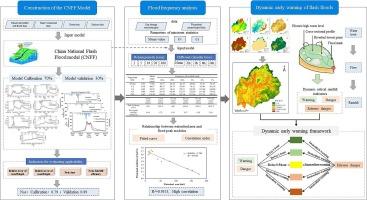
Flash flood disaster prevention urgently requires high-precision hydrological models. However, extreme weather increases the uncertainty of flash flood risks, making it difficult for existing hydrological models to accurately simulate the flash flood processes. This study focuses on the Daxi River watershed in Guangdong Province. Based on verifying the applicability of the China Flash Flood Hydrological Modeling System (CNFF), the Manning formula is introduced to invert the calculation of the critical rainfall threshold for flash floods. The flash flood-inducing factors were then qualitatively analyzed using multiple indicators to determine their risk levels, thereby proposing a dynamic early warning framework for flash flood disasters. Results indicate that: 1) the CNFF demonstrated relatively high simulation accuracy, with the average Nash-Sutcliffe Efficiency (NSE) during the calibration and validation periods being 0.79 and 0.89, respectively; 2) dynamic rainfall warning indicators for 1-hour intervals were obtained under different soil moisture conditions. The warning, danger, and extreme danger flow rates were determined to be 176.3 m3/s, 308 m3/s, and 483.6 m3/s, respectively; 3) utilizing flood disaster risk assessment indicators, the risk distribution of flash floods has been evaluated, with the relatively high-risk areas, high-risk areas, and low-risk areas accounting for 31.1 %, 7.26 %, and 6.42 %, respectively; 4) the delay times for issuing warnings in different risk zones were determined, achieving dynamic early warning for flash flood disasters. The above research results will provide theoretical references for improving the flash flood defense methods.
期刊介绍:
The ultimate aim of Ecological Indicators is to integrate the monitoring and assessment of ecological and environmental indicators with management practices. The journal provides a forum for the discussion of the applied scientific development and review of traditional indicator approaches as well as for theoretical, modelling and quantitative applications such as index development. Research into the following areas will be published.
• All aspects of ecological and environmental indicators and indices.
• New indicators, and new approaches and methods for indicator development, testing and use.
• Development and modelling of indices, e.g. application of indicator suites across multiple scales and resources.
• Analysis and research of resource, system- and scale-specific indicators.
• Methods for integration of social and other valuation metrics for the production of scientifically rigorous and politically-relevant assessments using indicator-based monitoring and assessment programs.
• How research indicators can be transformed into direct application for management purposes.
• Broader assessment objectives and methods, e.g. biodiversity, biological integrity, and sustainability, through the use of indicators.
• Resource-specific indicators such as landscape, agroecosystems, forests, wetlands, etc.




 京公网安备 11010802042870号
京ICP备2023020795号-1
京公网安备 11010802042870号
京ICP备2023020795号-1

 分享
分享
 求助内容:
求助内容: 应助结果提醒方式:
 扫码关注我们
