Roopam Jain , Ravi Sankar Haridas , Prithvi Awasthi , Abhijeet Dhal , Rajiv S. Mishra
{"title":"亚稳工程层状金属复合材料中强度-延性平衡的规避","authors":"Roopam Jain , Ravi Sankar Haridas , Prithvi Awasthi , Abhijeet Dhal , Rajiv S. Mishra","doi":"10.1016/j.matdes.2025.113786","DOIUrl":null,"url":null,"abstract":"<div><div>This investigation demonstrates a unique layered metallic composite (LMC) design strategy which exploits the metastability tunability of the transformative complex concentrate alloys (CCAs). Metastability engineered LMC (ME-LMC) was prepared by sandwiching a relatively less metastable Fe<sub>38.5</sub>Mn<sub>20</sub>Co<sub>20</sub>Cr<sub>15</sub>Si<sub>5</sub>Cu<sub>1.5</sub> CCA (SFE = 12 mJ/m<sup>2</sup>) between the two layers of the highly metastable Fe<sub>40</sub>Mn<sub>20</sub>Co<sub>20</sub>Cr<sub>15</sub>Si<sub>5</sub> CCA (SFE = 6 mJ/m<sup>2</sup>). In ME-LMC, plastic instability of highly metastable alloy got delayed resulting in slight increase in the ultimate tensile strength (UTS) while maintaining comparable ductility compared to the monolithic CCAs. Superior properties of the ME-LMC are attributed to the enhanced activation of transformation and twin systems in the HCP phase due to the generation of biaxial state of stresses originating from the CCA interface affected zones. Enhanced transformation and twinning led to the greater dynamic refinement of the microstructure providing higher strain hardening enabling greater ductility while benefitting from the dynamic Hall-Petch strengthening. A dislocation density evolution based modelling framework is developed to elucidate the enhancement in mechanical properties.</div></div>","PeriodicalId":383,"journal":{"name":"Materials & Design","volume":"252 ","pages":"Article 113786"},"PeriodicalIF":7.9000,"publicationDate":"2025-04-01","publicationTypes":"Journal Article","fieldsOfStudy":null,"isOpenAccess":false,"openAccessPdf":"","citationCount":"0","resultStr":"{\"title\":\"Evading strength-ductility trade-off in a metastability engineered layered metallic composite\",\"authors\":\"Roopam Jain , Ravi Sankar Haridas , Prithvi Awasthi , Abhijeet Dhal , Rajiv S. Mishra\",\"doi\":\"10.1016/j.matdes.2025.113786\",\"DOIUrl\":null,\"url\":null,\"abstract\":\"<div><div>This investigation demonstrates a unique layered metallic composite (LMC) design strategy which exploits the metastability tunability of the transformative complex concentrate alloys (CCAs). Metastability engineered LMC (ME-LMC) was prepared by sandwiching a relatively less metastable Fe<sub>38.5</sub>Mn<sub>20</sub>Co<sub>20</sub>Cr<sub>15</sub>Si<sub>5</sub>Cu<sub>1.5</sub> CCA (SFE = 12 mJ/m<sup>2</sup>) between the two layers of the highly metastable Fe<sub>40</sub>Mn<sub>20</sub>Co<sub>20</sub>Cr<sub>15</sub>Si<sub>5</sub> CCA (SFE = 6 mJ/m<sup>2</sup>). In ME-LMC, plastic instability of highly metastable alloy got delayed resulting in slight increase in the ultimate tensile strength (UTS) while maintaining comparable ductility compared to the monolithic CCAs. Superior properties of the ME-LMC are attributed to the enhanced activation of transformation and twin systems in the HCP phase due to the generation of biaxial state of stresses originating from the CCA interface affected zones. Enhanced transformation and twinning led to the greater dynamic refinement of the microstructure providing higher strain hardening enabling greater ductility while benefitting from the dynamic Hall-Petch strengthening. A dislocation density evolution based modelling framework is developed to elucidate the enhancement in mechanical properties.</div></div>\",\"PeriodicalId\":383,\"journal\":{\"name\":\"Materials & Design\",\"volume\":\"252 \",\"pages\":\"Article 113786\"},\"PeriodicalIF\":7.9000,\"publicationDate\":\"2025-04-01\",\"publicationTypes\":\"Journal Article\",\"fieldsOfStudy\":null,\"isOpenAccess\":false,\"openAccessPdf\":\"\",\"citationCount\":\"0\",\"resultStr\":null,\"platform\":\"Semanticscholar\",\"paperid\":null,\"PeriodicalName\":\"Materials & Design\",\"FirstCategoryId\":\"88\",\"ListUrlMain\":\"https://www.sciencedirect.com/science/article/pii/S0264127525002060\",\"RegionNum\":2,\"RegionCategory\":\"材料科学\",\"ArticlePicture\":[],\"TitleCN\":null,\"AbstractTextCN\":null,\"PMCID\":null,\"EPubDate\":\"2025/3/1 0:00:00\",\"PubModel\":\"Epub\",\"JCR\":\"Q1\",\"JCRName\":\"MATERIALS SCIENCE, MULTIDISCIPLINARY\",\"Score\":null,\"Total\":0}","platform":"Semanticscholar","paperid":null,"PeriodicalName":"Materials & Design","FirstCategoryId":"88","ListUrlMain":"https://www.sciencedirect.com/science/article/pii/S0264127525002060","RegionNum":2,"RegionCategory":"材料科学","ArticlePicture":[],"TitleCN":null,"AbstractTextCN":null,"PMCID":null,"EPubDate":"2025/3/1 0:00:00","PubModel":"Epub","JCR":"Q1","JCRName":"MATERIALS SCIENCE, MULTIDISCIPLINARY","Score":null,"Total":0}
引用次数: 0
摘要
本研究展示了一种独特的层状金属复合材料(LMC)设计策略,该策略利用了转化复杂精矿合金(CCAs)的亚稳态可调性。通过在高亚稳Fe40Mn20Co20Cr15Si5 CCA (SFE = 6 mJ/m2)层之间夹入相对亚稳性较低的fe38.5 mn20co20cr15cu1.5 CCA (SFE = 12 mJ/m2),制备了melmc。在ME-LMC中,高亚稳合金的塑性失稳得到延迟,导致极限抗拉强度(UTS)略有增加,同时保持与单片CCAs相当的延展性。ME-LMC的优异性能归因于源自CCA界面影响区的双轴应力的产生,增强了HCP相的相变和孪晶系统的激活。增强的相变和孪生导致微观组织的更大的动态细化,提供更高的应变硬化,从而获得更高的延展性,同时受益于动态Hall-Petch强化。提出了一种基于位错密度演化的模型框架来解释力学性能的增强。
Evading strength-ductility trade-off in a metastability engineered layered metallic composite
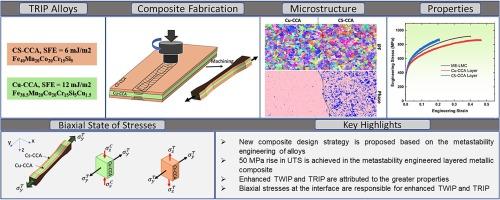
This investigation demonstrates a unique layered metallic composite (LMC) design strategy which exploits the metastability tunability of the transformative complex concentrate alloys (CCAs). Metastability engineered LMC (ME-LMC) was prepared by sandwiching a relatively less metastable Fe38.5Mn20Co20Cr15Si5Cu1.5 CCA (SFE = 12 mJ/m2) between the two layers of the highly metastable Fe40Mn20Co20Cr15Si5 CCA (SFE = 6 mJ/m2). In ME-LMC, plastic instability of highly metastable alloy got delayed resulting in slight increase in the ultimate tensile strength (UTS) while maintaining comparable ductility compared to the monolithic CCAs. Superior properties of the ME-LMC are attributed to the enhanced activation of transformation and twin systems in the HCP phase due to the generation of biaxial state of stresses originating from the CCA interface affected zones. Enhanced transformation and twinning led to the greater dynamic refinement of the microstructure providing higher strain hardening enabling greater ductility while benefitting from the dynamic Hall-Petch strengthening. A dislocation density evolution based modelling framework is developed to elucidate the enhancement in mechanical properties.
期刊介绍:
Materials and Design is a multi-disciplinary journal that publishes original research reports, review articles, and express communications. The journal focuses on studying the structure and properties of inorganic and organic materials, advancements in synthesis, processing, characterization, and testing, the design of materials and engineering systems, and their applications in technology. It aims to bring together various aspects of materials science, engineering, physics, and chemistry.
The journal explores themes ranging from materials to design and aims to reveal the connections between natural and artificial materials, as well as experiment and modeling. Manuscripts submitted to Materials and Design should contain elements of discovery and surprise, as they often contribute new insights into the architecture and function of matter.



 京公网安备 11010802042870号
京ICP备2023020795号-1
京公网安备 11010802042870号
京ICP备2023020795号-1

 分享
分享
 求助内容:
求助内容: 应助结果提醒方式:
 扫码关注我们
