Yi Zhang , Yanji Hao , Yu Fu , Yijing Feng , Yeqing Li , Xiaonan Wang , Junting Pan , Yongming Han , Chunming Xu
{"title":"生物质能生产的GAN-MAML策略:克服小数据集限制","authors":"Yi Zhang , Yanji Hao , Yu Fu , Yijing Feng , Yeqing Li , Xiaonan Wang , Junting Pan , Yongming Han , Chunming Xu","doi":"10.1016/j.apenergy.2025.125568","DOIUrl":null,"url":null,"abstract":"<div><div>Data-driven machine learning (ML) has the potential to improve biomass energy production methods such as incineration, composting, pyrolysis, and anaerobic digestion. However, due to the scarcity and variability of data in the field, there is currently no universal model that excels across all production technique domains. To address these challenges, this study combines Model-Agnostic Meta-Learning (MAML) with Generative Adversarial Networks (GANs) to improve ML generalization in complex biomass conversion scenarios. Compared to the best ML models, the GAN-MAML models demonstrated superior performance in various domains and scales. During the testing phase, the GAN-MAML models mitigated the limitations associated with data scarcity and variability, improving performance by up to 33.1 % over the best ML models. This represents a significant improvement over the initial increase of up to 28.2 % for the MAML models. Subsequently, models trained on literature data were deployed in a real energy production factory and predicted samples they had never seen before. The results showed that the GAN-MAML models outperformed the best ML models, with the highest improvement being 28.6 %. This is a significant improvement over traditional ML and offers a flexible framework for research and practice in biomass energy production, promoting sustainable environmental solutions.</div></div>","PeriodicalId":246,"journal":{"name":"Applied Energy","volume":"387 ","pages":"Article 125568"},"PeriodicalIF":11.0000,"publicationDate":"2025-06-01","publicationTypes":"Journal Article","fieldsOfStudy":null,"isOpenAccess":false,"openAccessPdf":"","citationCount":"0","resultStr":"{\"title\":\"GAN-MAML strategy for biomass energy production: Overcoming small dataset limitations\",\"authors\":\"Yi Zhang , Yanji Hao , Yu Fu , Yijing Feng , Yeqing Li , Xiaonan Wang , Junting Pan , Yongming Han , Chunming Xu\",\"doi\":\"10.1016/j.apenergy.2025.125568\",\"DOIUrl\":null,\"url\":null,\"abstract\":\"<div><div>Data-driven machine learning (ML) has the potential to improve biomass energy production methods such as incineration, composting, pyrolysis, and anaerobic digestion. However, due to the scarcity and variability of data in the field, there is currently no universal model that excels across all production technique domains. To address these challenges, this study combines Model-Agnostic Meta-Learning (MAML) with Generative Adversarial Networks (GANs) to improve ML generalization in complex biomass conversion scenarios. Compared to the best ML models, the GAN-MAML models demonstrated superior performance in various domains and scales. During the testing phase, the GAN-MAML models mitigated the limitations associated with data scarcity and variability, improving performance by up to 33.1 % over the best ML models. This represents a significant improvement over the initial increase of up to 28.2 % for the MAML models. Subsequently, models trained on literature data were deployed in a real energy production factory and predicted samples they had never seen before. The results showed that the GAN-MAML models outperformed the best ML models, with the highest improvement being 28.6 %. This is a significant improvement over traditional ML and offers a flexible framework for research and practice in biomass energy production, promoting sustainable environmental solutions.</div></div>\",\"PeriodicalId\":246,\"journal\":{\"name\":\"Applied Energy\",\"volume\":\"387 \",\"pages\":\"Article 125568\"},\"PeriodicalIF\":11.0000,\"publicationDate\":\"2025-06-01\",\"publicationTypes\":\"Journal Article\",\"fieldsOfStudy\":null,\"isOpenAccess\":false,\"openAccessPdf\":\"\",\"citationCount\":\"0\",\"resultStr\":null,\"platform\":\"Semanticscholar\",\"paperid\":null,\"PeriodicalName\":\"Applied Energy\",\"FirstCategoryId\":\"5\",\"ListUrlMain\":\"https://www.sciencedirect.com/science/article/pii/S0306261925002983\",\"RegionNum\":1,\"RegionCategory\":\"工程技术\",\"ArticlePicture\":[],\"TitleCN\":null,\"AbstractTextCN\":null,\"PMCID\":null,\"EPubDate\":\"2025/3/4 0:00:00\",\"PubModel\":\"Epub\",\"JCR\":\"Q1\",\"JCRName\":\"ENERGY & FUELS\",\"Score\":null,\"Total\":0}","platform":"Semanticscholar","paperid":null,"PeriodicalName":"Applied Energy","FirstCategoryId":"5","ListUrlMain":"https://www.sciencedirect.com/science/article/pii/S0306261925002983","RegionNum":1,"RegionCategory":"工程技术","ArticlePicture":[],"TitleCN":null,"AbstractTextCN":null,"PMCID":null,"EPubDate":"2025/3/4 0:00:00","PubModel":"Epub","JCR":"Q1","JCRName":"ENERGY & FUELS","Score":null,"Total":0}
GAN-MAML strategy for biomass energy production: Overcoming small dataset limitations
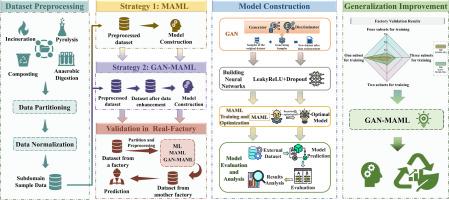
Data-driven machine learning (ML) has the potential to improve biomass energy production methods such as incineration, composting, pyrolysis, and anaerobic digestion. However, due to the scarcity and variability of data in the field, there is currently no universal model that excels across all production technique domains. To address these challenges, this study combines Model-Agnostic Meta-Learning (MAML) with Generative Adversarial Networks (GANs) to improve ML generalization in complex biomass conversion scenarios. Compared to the best ML models, the GAN-MAML models demonstrated superior performance in various domains and scales. During the testing phase, the GAN-MAML models mitigated the limitations associated with data scarcity and variability, improving performance by up to 33.1 % over the best ML models. This represents a significant improvement over the initial increase of up to 28.2 % for the MAML models. Subsequently, models trained on literature data were deployed in a real energy production factory and predicted samples they had never seen before. The results showed that the GAN-MAML models outperformed the best ML models, with the highest improvement being 28.6 %. This is a significant improvement over traditional ML and offers a flexible framework for research and practice in biomass energy production, promoting sustainable environmental solutions.
期刊介绍:
Applied Energy serves as a platform for sharing innovations, research, development, and demonstrations in energy conversion, conservation, and sustainable energy systems. The journal covers topics such as optimal energy resource use, environmental pollutant mitigation, and energy process analysis. It welcomes original papers, review articles, technical notes, and letters to the editor. Authors are encouraged to submit manuscripts that bridge the gap between research, development, and implementation. The journal addresses a wide spectrum of topics, including fossil and renewable energy technologies, energy economics, and environmental impacts. Applied Energy also explores modeling and forecasting, conservation strategies, and the social and economic implications of energy policies, including climate change mitigation. It is complemented by the open-access journal Advances in Applied Energy.




 京公网安备 11010802042870号
京ICP备2023020795号-1
京公网安备 11010802042870号
京ICP备2023020795号-1

 分享
分享
 求助内容:
求助内容: 应助结果提醒方式:
 扫码关注我们
