Cheng Chen , Shao-shuo Li , Jun-feng Li , Lei Zhang , Juan Yang
{"title":"大型漏斗流试验与DEM模拟对压载物级配对休止角的影响","authors":"Cheng Chen , Shao-shuo Li , Jun-feng Li , Lei Zhang , Juan Yang","doi":"10.1016/j.powtec.2025.120852","DOIUrl":null,"url":null,"abstract":"<div><div>This study investigates the influence of ballast gradation on the repose angle through a series of large-scale hopper flow tests and discrete element method (DEM) simulations. Bulk-scale and micro analyses of the entire ballast pile formation process reveal three stages: platform-stacking, peak-stacking, and peak-shaving, with particle interlocking during these stages playing a crucial role in establishing the angle of repose. Results indicate that ballast gradation significantly affects the repose angle, the maximum repose angle is observed at <em>d</em><sub>50</sub> = 40.0 mm, within the tested range of 36.8 mm to 45.0 mm. As the gradation of the ballast transitions from uniform to non-uniform, the repose angle initially increases and then decreases, peaking at <em>d</em><sub>50</sub> = 40.0 mm and <em>C</em><sub>u</sub> = 1.46. The spatial distribution of particles within the ballast pile follows a distinct pattern, large particles within the ballast pile is relatively uniform, while small and medium particles are more concentrated in the core regions. A better particle gradation allows smaller particles to fill the voids between larger particles, thereby optimizing the load distribution between strong and weak force chains. This research underscores the importance of proper gradation for ensuring stability and effective load-bearing capacity in ballast systems.</div></div>","PeriodicalId":407,"journal":{"name":"Powder Technology","volume":"456 ","pages":"Article 120852"},"PeriodicalIF":5.5000,"publicationDate":"2025-04-30","publicationTypes":"Journal Article","fieldsOfStudy":null,"isOpenAccess":false,"openAccessPdf":"","citationCount":"0","resultStr":"{\"title\":\"Influence of ballast gradation on repose angle using large-scale hopper flow tests and DEM simulation\",\"authors\":\"Cheng Chen , Shao-shuo Li , Jun-feng Li , Lei Zhang , Juan Yang\",\"doi\":\"10.1016/j.powtec.2025.120852\",\"DOIUrl\":null,\"url\":null,\"abstract\":\"<div><div>This study investigates the influence of ballast gradation on the repose angle through a series of large-scale hopper flow tests and discrete element method (DEM) simulations. Bulk-scale and micro analyses of the entire ballast pile formation process reveal three stages: platform-stacking, peak-stacking, and peak-shaving, with particle interlocking during these stages playing a crucial role in establishing the angle of repose. Results indicate that ballast gradation significantly affects the repose angle, the maximum repose angle is observed at <em>d</em><sub>50</sub> = 40.0 mm, within the tested range of 36.8 mm to 45.0 mm. As the gradation of the ballast transitions from uniform to non-uniform, the repose angle initially increases and then decreases, peaking at <em>d</em><sub>50</sub> = 40.0 mm and <em>C</em><sub>u</sub> = 1.46. The spatial distribution of particles within the ballast pile follows a distinct pattern, large particles within the ballast pile is relatively uniform, while small and medium particles are more concentrated in the core regions. A better particle gradation allows smaller particles to fill the voids between larger particles, thereby optimizing the load distribution between strong and weak force chains. This research underscores the importance of proper gradation for ensuring stability and effective load-bearing capacity in ballast systems.</div></div>\",\"PeriodicalId\":407,\"journal\":{\"name\":\"Powder Technology\",\"volume\":\"456 \",\"pages\":\"Article 120852\"},\"PeriodicalIF\":5.5000,\"publicationDate\":\"2025-04-30\",\"publicationTypes\":\"Journal Article\",\"fieldsOfStudy\":null,\"isOpenAccess\":false,\"openAccessPdf\":\"\",\"citationCount\":\"0\",\"resultStr\":null,\"platform\":\"Semanticscholar\",\"paperid\":null,\"PeriodicalName\":\"Powder Technology\",\"FirstCategoryId\":\"5\",\"ListUrlMain\":\"https://www.sciencedirect.com/science/article/pii/S0032591025002475\",\"RegionNum\":2,\"RegionCategory\":\"工程技术\",\"ArticlePicture\":[],\"TitleCN\":null,\"AbstractTextCN\":null,\"PMCID\":null,\"EPubDate\":\"2025/2/27 0:00:00\",\"PubModel\":\"Epub\",\"JCR\":\"Q2\",\"JCRName\":\"ENGINEERING, CHEMICAL\",\"Score\":null,\"Total\":0}","platform":"Semanticscholar","paperid":null,"PeriodicalName":"Powder Technology","FirstCategoryId":"5","ListUrlMain":"https://www.sciencedirect.com/science/article/pii/S0032591025002475","RegionNum":2,"RegionCategory":"工程技术","ArticlePicture":[],"TitleCN":null,"AbstractTextCN":null,"PMCID":null,"EPubDate":"2025/2/27 0:00:00","PubModel":"Epub","JCR":"Q2","JCRName":"ENGINEERING, CHEMICAL","Score":null,"Total":0}
Influence of ballast gradation on repose angle using large-scale hopper flow tests and DEM simulation
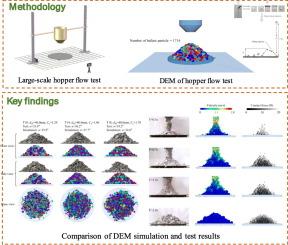
This study investigates the influence of ballast gradation on the repose angle through a series of large-scale hopper flow tests and discrete element method (DEM) simulations. Bulk-scale and micro analyses of the entire ballast pile formation process reveal three stages: platform-stacking, peak-stacking, and peak-shaving, with particle interlocking during these stages playing a crucial role in establishing the angle of repose. Results indicate that ballast gradation significantly affects the repose angle, the maximum repose angle is observed at d50 = 40.0 mm, within the tested range of 36.8 mm to 45.0 mm. As the gradation of the ballast transitions from uniform to non-uniform, the repose angle initially increases and then decreases, peaking at d50 = 40.0 mm and Cu = 1.46. The spatial distribution of particles within the ballast pile follows a distinct pattern, large particles within the ballast pile is relatively uniform, while small and medium particles are more concentrated in the core regions. A better particle gradation allows smaller particles to fill the voids between larger particles, thereby optimizing the load distribution between strong and weak force chains. This research underscores the importance of proper gradation for ensuring stability and effective load-bearing capacity in ballast systems.
期刊介绍:
Powder Technology is an International Journal on the Science and Technology of Wet and Dry Particulate Systems. Powder Technology publishes papers on all aspects of the formation of particles and their characterisation and on the study of systems containing particulate solids. No limitation is imposed on the size of the particles, which may range from nanometre scale, as in pigments or aerosols, to that of mined or quarried materials. The following list of topics is not intended to be comprehensive, but rather to indicate typical subjects which fall within the scope of the journal's interests:
Formation and synthesis of particles by precipitation and other methods.
Modification of particles by agglomeration, coating, comminution and attrition.
Characterisation of the size, shape, surface area, pore structure and strength of particles and agglomerates (including the origins and effects of inter particle forces).
Packing, failure, flow and permeability of assemblies of particles.
Particle-particle interactions and suspension rheology.
Handling and processing operations such as slurry flow, fluidization, pneumatic conveying.
Interactions between particles and their environment, including delivery of particulate products to the body.
Applications of particle technology in production of pharmaceuticals, chemicals, foods, pigments, structural, and functional materials and in environmental and energy related matters.
For materials-oriented contributions we are looking for articles revealing the effect of particle/powder characteristics (size, morphology and composition, in that order) on material performance or functionality and, ideally, comparison to any industrial standard.




 京公网安备 11010802042870号
京ICP备2023020795号-1
京公网安备 11010802042870号
京ICP备2023020795号-1

 分享
分享
 求助内容:
求助内容: 应助结果提醒方式:
 扫码关注我们
