Li-Feng Li , Meng-Di Wang , Chen-Yang Zhang , Meng-Yao Jin , Hua-Lei Chen , Huan Luo , Tian-Yu Hou , Zhi-Jun Zhang , He Li
{"title":"羟基取代对黄酮类化合物抑制葡萄糖-赖氨酸-精氨酸美拉德反应晚期糖基化终产物形成的影响","authors":"Li-Feng Li , Meng-Di Wang , Chen-Yang Zhang , Meng-Yao Jin , Hua-Lei Chen , Huan Luo , Tian-Yu Hou , Zhi-Jun Zhang , He Li","doi":"10.1016/j.foodres.2025.116068","DOIUrl":null,"url":null,"abstract":"<div><div>Advanced glycation end products (AGEs) generated from the Maillard reaction (MR) during food processing in the human physiological environment, have been proven to be significantly associated with various chronic metabolic diseases. In this study, 18 flavonoids were investigated to study their effects on AGEs formation during MR within a glucose-lysine-arginine model system. Five AGEs— <em>N</em><sup><em>ε</em></sup>-carboxymethyl-lysine (CML), <em>N</em><sup><em>ε</em></sup>-carboxyethyl-lysine (CEL), pyrraline, pentosidine, and argpyrimidine—were determined by high-performance liquid chromatography-mass spectrometry, with inhibitory rates ranging between 0 % and 71.35 %. Isorhamnetin and naringenin exhibited the strongest inhibitory effect on the formation of CML and CEL, respectively, whereas myricetin exhibited the strongest inhibitory effect on pyrraline, pentosidine, and argpyrimidine formation. In addition, each flavonoid was reacted with glyoxal (GO) and methylglyoxal (MGO) to investigate their trapping activities and adducts. The results showed that the 18 flavonoids could effectively clear GO and MGO, with clearance rates of 1.03 %–71.42 % and 0.93 %–69.37 % for GO and MGO, respectively. Six flavonoids—chrysin, naringenin, apigenin, luteolin, diosmetin, and kaempferol—could form adduct products with mono-/di-MGO, with flavonoid to mono-/di-MGO adduct ratios of approximately 6:1, 2:1, 8:1, 23:1, 10:1, and 3:1, respectively. The number and site of phenolic hydroxyl groups, as well as methoxy substitution on the B-ring in flavonoids, had little effect, but phenolic hydroxyl groups at the C-3 position in the C-ring impeded adduct formation. The flavonoids lowered the degradation of glucose itself, and decreased ammonia-induced degradation and Amadori rearrangement product oxidation due to their antioxidant activities, and they trapped the reactive 1,2-di‑carbonyl species via nucleophilic addition reaction to form AGEs.</div></div>","PeriodicalId":323,"journal":{"name":"Food Research International","volume":"207 ","pages":"Article 116068"},"PeriodicalIF":8.8000,"publicationDate":"2025-04-01","publicationTypes":"Journal Article","fieldsOfStudy":null,"isOpenAccess":false,"openAccessPdf":"","citationCount":"0","resultStr":"{\"title\":\"Influence of hydroxyl substitution on the inhibition of flavonoids in advanced glycation end-products formation in glucose-lysine-arginine Maillard reaction models\",\"authors\":\"Li-Feng Li , Meng-Di Wang , Chen-Yang Zhang , Meng-Yao Jin , Hua-Lei Chen , Huan Luo , Tian-Yu Hou , Zhi-Jun Zhang , He Li\",\"doi\":\"10.1016/j.foodres.2025.116068\",\"DOIUrl\":null,\"url\":null,\"abstract\":\"<div><div>Advanced glycation end products (AGEs) generated from the Maillard reaction (MR) during food processing in the human physiological environment, have been proven to be significantly associated with various chronic metabolic diseases. In this study, 18 flavonoids were investigated to study their effects on AGEs formation during MR within a glucose-lysine-arginine model system. Five AGEs— <em>N</em><sup><em>ε</em></sup>-carboxymethyl-lysine (CML), <em>N</em><sup><em>ε</em></sup>-carboxyethyl-lysine (CEL), pyrraline, pentosidine, and argpyrimidine—were determined by high-performance liquid chromatography-mass spectrometry, with inhibitory rates ranging between 0 % and 71.35 %. Isorhamnetin and naringenin exhibited the strongest inhibitory effect on the formation of CML and CEL, respectively, whereas myricetin exhibited the strongest inhibitory effect on pyrraline, pentosidine, and argpyrimidine formation. In addition, each flavonoid was reacted with glyoxal (GO) and methylglyoxal (MGO) to investigate their trapping activities and adducts. The results showed that the 18 flavonoids could effectively clear GO and MGO, with clearance rates of 1.03 %–71.42 % and 0.93 %–69.37 % for GO and MGO, respectively. Six flavonoids—chrysin, naringenin, apigenin, luteolin, diosmetin, and kaempferol—could form adduct products with mono-/di-MGO, with flavonoid to mono-/di-MGO adduct ratios of approximately 6:1, 2:1, 8:1, 23:1, 10:1, and 3:1, respectively. The number and site of phenolic hydroxyl groups, as well as methoxy substitution on the B-ring in flavonoids, had little effect, but phenolic hydroxyl groups at the C-3 position in the C-ring impeded adduct formation. The flavonoids lowered the degradation of glucose itself, and decreased ammonia-induced degradation and Amadori rearrangement product oxidation due to their antioxidant activities, and they trapped the reactive 1,2-di‑carbonyl species via nucleophilic addition reaction to form AGEs.</div></div>\",\"PeriodicalId\":323,\"journal\":{\"name\":\"Food Research International\",\"volume\":\"207 \",\"pages\":\"Article 116068\"},\"PeriodicalIF\":8.8000,\"publicationDate\":\"2025-04-01\",\"publicationTypes\":\"Journal Article\",\"fieldsOfStudy\":null,\"isOpenAccess\":false,\"openAccessPdf\":\"\",\"citationCount\":\"0\",\"resultStr\":null,\"platform\":\"Semanticscholar\",\"paperid\":null,\"PeriodicalName\":\"Food Research International\",\"FirstCategoryId\":\"97\",\"ListUrlMain\":\"https://www.sciencedirect.com/science/article/pii/S0963996925004053\",\"RegionNum\":1,\"RegionCategory\":\"农林科学\",\"ArticlePicture\":[],\"TitleCN\":null,\"AbstractTextCN\":null,\"PMCID\":null,\"EPubDate\":\"2025/2/27 0:00:00\",\"PubModel\":\"Epub\",\"JCR\":\"Q1\",\"JCRName\":\"FOOD SCIENCE & TECHNOLOGY\",\"Score\":null,\"Total\":0}","platform":"Semanticscholar","paperid":null,"PeriodicalName":"Food Research International","FirstCategoryId":"97","ListUrlMain":"https://www.sciencedirect.com/science/article/pii/S0963996925004053","RegionNum":1,"RegionCategory":"农林科学","ArticlePicture":[],"TitleCN":null,"AbstractTextCN":null,"PMCID":null,"EPubDate":"2025/2/27 0:00:00","PubModel":"Epub","JCR":"Q1","JCRName":"FOOD SCIENCE & TECHNOLOGY","Score":null,"Total":0}
Influence of hydroxyl substitution on the inhibition of flavonoids in advanced glycation end-products formation in glucose-lysine-arginine Maillard reaction models
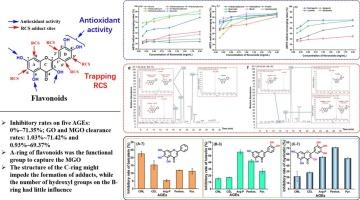
Advanced glycation end products (AGEs) generated from the Maillard reaction (MR) during food processing in the human physiological environment, have been proven to be significantly associated with various chronic metabolic diseases. In this study, 18 flavonoids were investigated to study their effects on AGEs formation during MR within a glucose-lysine-arginine model system. Five AGEs— Nε-carboxymethyl-lysine (CML), Nε-carboxyethyl-lysine (CEL), pyrraline, pentosidine, and argpyrimidine—were determined by high-performance liquid chromatography-mass spectrometry, with inhibitory rates ranging between 0 % and 71.35 %. Isorhamnetin and naringenin exhibited the strongest inhibitory effect on the formation of CML and CEL, respectively, whereas myricetin exhibited the strongest inhibitory effect on pyrraline, pentosidine, and argpyrimidine formation. In addition, each flavonoid was reacted with glyoxal (GO) and methylglyoxal (MGO) to investigate their trapping activities and adducts. The results showed that the 18 flavonoids could effectively clear GO and MGO, with clearance rates of 1.03 %–71.42 % and 0.93 %–69.37 % for GO and MGO, respectively. Six flavonoids—chrysin, naringenin, apigenin, luteolin, diosmetin, and kaempferol—could form adduct products with mono-/di-MGO, with flavonoid to mono-/di-MGO adduct ratios of approximately 6:1, 2:1, 8:1, 23:1, 10:1, and 3:1, respectively. The number and site of phenolic hydroxyl groups, as well as methoxy substitution on the B-ring in flavonoids, had little effect, but phenolic hydroxyl groups at the C-3 position in the C-ring impeded adduct formation. The flavonoids lowered the degradation of glucose itself, and decreased ammonia-induced degradation and Amadori rearrangement product oxidation due to their antioxidant activities, and they trapped the reactive 1,2-di‑carbonyl species via nucleophilic addition reaction to form AGEs.
期刊介绍:
Food Research International serves as a rapid dissemination platform for significant and impactful research in food science, technology, engineering, and nutrition. The journal focuses on publishing novel, high-quality, and high-impact review papers, original research papers, and letters to the editors across various disciplines in the science and technology of food. Additionally, it follows a policy of publishing special issues on topical and emergent subjects in food research or related areas. Selected, peer-reviewed papers from scientific meetings, workshops, and conferences on the science, technology, and engineering of foods are also featured in special issues.




 京公网安备 11010802042870号
京ICP备2023020795号-1
京公网安备 11010802042870号
京ICP备2023020795号-1

 分享
分享
 求助内容:
求助内容: 应助结果提醒方式:
 扫码关注我们
