Dongliang Jing, Gang Yan, Yinlong Li, Tong Xiong, Guoqiang Liu
{"title":"基于制冷剂的涡流管分离特性综述:装置、热力学循环和系统实验","authors":"Dongliang Jing, Gang Yan, Yinlong Li, Tong Xiong, Guoqiang Liu","doi":"10.1016/j.energy.2025.135334","DOIUrl":null,"url":null,"abstract":"<div><div>Vortex tube is a device with energy self-separation and no moving parts. The existing studies mainly focused on the energy separation mechanism of vortex tube with air as the working fluid. The environmental impact of refrigerants needs to be considered when integrating vortex tube into refrigeration systems. Closed systems complicate the separation environment. Refrigerants, as non-ideal gases, may undergo phase change during energy separation in vortex tube, and the generated two-phase flow may lead to a deterioration or loss of energy separation. The separation characteristics of refrigerant as working fluid and its application in refrigeration systems are challenging and have not been systematically summarized. Therefore, this review innovatively analyzes the separation characteristics of refrigerant-based vortex tube (RBVT) from three aspects: devices, thermodynamic cycles and system experiments. The analysis indicated that RBVT can enhance the coefficient of performance (COP) of theoretical cycles when used as a throttling, cooling or separating device. Moreover, the optimal separation characteristics of RBVT in system require a deeper understanding of refrigerant behavior, vortex tube optimization mechanism, cycle construction and matching between components. This review completes the research progress of vortex tube at cryogenic temperature and provides a reference and future research directions for integrating vortex tube into refrigeration systems.</div></div>","PeriodicalId":11647,"journal":{"name":"Energy","volume":"320 ","pages":"Article 135334"},"PeriodicalIF":10.1000,"publicationDate":"2025-04-01","publicationTypes":"Journal Article","fieldsOfStudy":null,"isOpenAccess":false,"openAccessPdf":"","citationCount":"0","resultStr":"{\"title\":\"A review of refrigerant-based vortex tube separation characteristics: Devices, thermodynamic cycles and system experiments\",\"authors\":\"Dongliang Jing, Gang Yan, Yinlong Li, Tong Xiong, Guoqiang Liu\",\"doi\":\"10.1016/j.energy.2025.135334\",\"DOIUrl\":null,\"url\":null,\"abstract\":\"<div><div>Vortex tube is a device with energy self-separation and no moving parts. The existing studies mainly focused on the energy separation mechanism of vortex tube with air as the working fluid. The environmental impact of refrigerants needs to be considered when integrating vortex tube into refrigeration systems. Closed systems complicate the separation environment. Refrigerants, as non-ideal gases, may undergo phase change during energy separation in vortex tube, and the generated two-phase flow may lead to a deterioration or loss of energy separation. The separation characteristics of refrigerant as working fluid and its application in refrigeration systems are challenging and have not been systematically summarized. Therefore, this review innovatively analyzes the separation characteristics of refrigerant-based vortex tube (RBVT) from three aspects: devices, thermodynamic cycles and system experiments. The analysis indicated that RBVT can enhance the coefficient of performance (COP) of theoretical cycles when used as a throttling, cooling or separating device. Moreover, the optimal separation characteristics of RBVT in system require a deeper understanding of refrigerant behavior, vortex tube optimization mechanism, cycle construction and matching between components. This review completes the research progress of vortex tube at cryogenic temperature and provides a reference and future research directions for integrating vortex tube into refrigeration systems.</div></div>\",\"PeriodicalId\":11647,\"journal\":{\"name\":\"Energy\",\"volume\":\"320 \",\"pages\":\"Article 135334\"},\"PeriodicalIF\":10.1000,\"publicationDate\":\"2025-04-01\",\"publicationTypes\":\"Journal Article\",\"fieldsOfStudy\":null,\"isOpenAccess\":false,\"openAccessPdf\":\"\",\"citationCount\":\"0\",\"resultStr\":null,\"platform\":\"Semanticscholar\",\"paperid\":null,\"PeriodicalName\":\"Energy\",\"FirstCategoryId\":\"5\",\"ListUrlMain\":\"https://www.sciencedirect.com/science/article/pii/S0360544225009764\",\"RegionNum\":1,\"RegionCategory\":\"工程技术\",\"ArticlePicture\":[],\"TitleCN\":null,\"AbstractTextCN\":null,\"PMCID\":null,\"EPubDate\":\"2025/3/1 0:00:00\",\"PubModel\":\"Epub\",\"JCR\":\"Q1\",\"JCRName\":\"ENERGY & FUELS\",\"Score\":null,\"Total\":0}","platform":"Semanticscholar","paperid":null,"PeriodicalName":"Energy","FirstCategoryId":"5","ListUrlMain":"https://www.sciencedirect.com/science/article/pii/S0360544225009764","RegionNum":1,"RegionCategory":"工程技术","ArticlePicture":[],"TitleCN":null,"AbstractTextCN":null,"PMCID":null,"EPubDate":"2025/3/1 0:00:00","PubModel":"Epub","JCR":"Q1","JCRName":"ENERGY & FUELS","Score":null,"Total":0}
A review of refrigerant-based vortex tube separation characteristics: Devices, thermodynamic cycles and system experiments
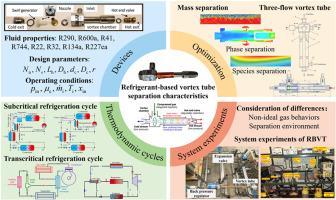
Vortex tube is a device with energy self-separation and no moving parts. The existing studies mainly focused on the energy separation mechanism of vortex tube with air as the working fluid. The environmental impact of refrigerants needs to be considered when integrating vortex tube into refrigeration systems. Closed systems complicate the separation environment. Refrigerants, as non-ideal gases, may undergo phase change during energy separation in vortex tube, and the generated two-phase flow may lead to a deterioration or loss of energy separation. The separation characteristics of refrigerant as working fluid and its application in refrigeration systems are challenging and have not been systematically summarized. Therefore, this review innovatively analyzes the separation characteristics of refrigerant-based vortex tube (RBVT) from three aspects: devices, thermodynamic cycles and system experiments. The analysis indicated that RBVT can enhance the coefficient of performance (COP) of theoretical cycles when used as a throttling, cooling or separating device. Moreover, the optimal separation characteristics of RBVT in system require a deeper understanding of refrigerant behavior, vortex tube optimization mechanism, cycle construction and matching between components. This review completes the research progress of vortex tube at cryogenic temperature and provides a reference and future research directions for integrating vortex tube into refrigeration systems.
期刊介绍:
Energy is a multidisciplinary, international journal that publishes research and analysis in the field of energy engineering. Our aim is to become a leading peer-reviewed platform and a trusted source of information for energy-related topics.
The journal covers a range of areas including mechanical engineering, thermal sciences, and energy analysis. We are particularly interested in research on energy modelling, prediction, integrated energy systems, planning, and management.
Additionally, we welcome papers on energy conservation, efficiency, biomass and bioenergy, renewable energy, electricity supply and demand, energy storage, buildings, and economic and policy issues. These topics should align with our broader multidisciplinary focus.




 京公网安备 11010802042870号
京ICP备2023020795号-1
京公网安备 11010802042870号
京ICP备2023020795号-1

 分享
分享
 求助内容:
求助内容: 应助结果提醒方式:
 扫码关注我们
