Margot Cazals, Emilie Bédard, Juan Francisco Guerra Maldonado, Michèle Prévost
{"title":"你的供水系统发生了什么?材料、温度、停滞和加氯对水质和生物膜形成的影响","authors":"Margot Cazals, Emilie Bédard, Juan Francisco Guerra Maldonado, Michèle Prévost","doi":"10.1016/j.chemosphere.2025.144248","DOIUrl":null,"url":null,"abstract":"<div><div>Building water distribution system materials are diverse and their impact on water quality depends on nutrients, stagnation, and temperature. The main objective was to investigate the interplay between material type, temperature and stagnation on water quality and biofilm formation potential. CDC biofilm reactors were used to compare concentrations of metals, total (DOC) and biodegradable (BDOC) dissolved organic carbon, and total and viable cells densities in water and biofilms in contact with coupons of 6 materials: polypropylene (PP), polyvinyl chloride (PVC), ethylene propylene diene monomer (EPDM), cross-linked polyethylene (PEX), stainless steel (SS) and copper (Cu). All materials were colonized by bacteria, with denser biofilm observed on EPDM > PP > PVC > PEX > Cu – SS. Copper and EPDM reactors showed different dynamics of accumulation and release of Cu and Pb, with bulk Pb concentrations exceeding 5 μg/L. Increasing temperatures from 25 °C to 40, 55 and 60 °C resulted in an increase by at least a factor 2 of DOC and BDOC, a temporary decrease in cell viability (%) and contrasting trends for suspended total bacteria (up to 1.4-log). Biofilm densities remained lower for all reactors after two months of constant heating at 40 °C, even further for copper reactors heated to 55 °C (2.5-log) and 60 °C (2.7-log). A 4-week stagnation at room temperature promoted total bacteria recovery in water and biofilm for all materials except copper. Extending stagnation to 6 months (COVID-19 shutdown) further increased total bacteria and the viable fraction in water, except in copper reactors.</div></div>","PeriodicalId":276,"journal":{"name":"Chemosphere","volume":"376 ","pages":"Article 144248"},"PeriodicalIF":8.1000,"publicationDate":"2025-05-01","publicationTypes":"Journal Article","fieldsOfStudy":null,"isOpenAccess":false,"openAccessPdf":"","citationCount":"0","resultStr":"{\"title\":\"What happens in your water system? Impact of materials, temperature, stagnation and chlorination on water quality and biofilm formation\",\"authors\":\"Margot Cazals, Emilie Bédard, Juan Francisco Guerra Maldonado, Michèle Prévost\",\"doi\":\"10.1016/j.chemosphere.2025.144248\",\"DOIUrl\":null,\"url\":null,\"abstract\":\"<div><div>Building water distribution system materials are diverse and their impact on water quality depends on nutrients, stagnation, and temperature. The main objective was to investigate the interplay between material type, temperature and stagnation on water quality and biofilm formation potential. CDC biofilm reactors were used to compare concentrations of metals, total (DOC) and biodegradable (BDOC) dissolved organic carbon, and total and viable cells densities in water and biofilms in contact with coupons of 6 materials: polypropylene (PP), polyvinyl chloride (PVC), ethylene propylene diene monomer (EPDM), cross-linked polyethylene (PEX), stainless steel (SS) and copper (Cu). All materials were colonized by bacteria, with denser biofilm observed on EPDM > PP > PVC > PEX > Cu – SS. Copper and EPDM reactors showed different dynamics of accumulation and release of Cu and Pb, with bulk Pb concentrations exceeding 5 μg/L. Increasing temperatures from 25 °C to 40, 55 and 60 °C resulted in an increase by at least a factor 2 of DOC and BDOC, a temporary decrease in cell viability (%) and contrasting trends for suspended total bacteria (up to 1.4-log). Biofilm densities remained lower for all reactors after two months of constant heating at 40 °C, even further for copper reactors heated to 55 °C (2.5-log) and 60 °C (2.7-log). A 4-week stagnation at room temperature promoted total bacteria recovery in water and biofilm for all materials except copper. Extending stagnation to 6 months (COVID-19 shutdown) further increased total bacteria and the viable fraction in water, except in copper reactors.</div></div>\",\"PeriodicalId\":276,\"journal\":{\"name\":\"Chemosphere\",\"volume\":\"376 \",\"pages\":\"Article 144248\"},\"PeriodicalIF\":8.1000,\"publicationDate\":\"2025-05-01\",\"publicationTypes\":\"Journal Article\",\"fieldsOfStudy\":null,\"isOpenAccess\":false,\"openAccessPdf\":\"\",\"citationCount\":\"0\",\"resultStr\":null,\"platform\":\"Semanticscholar\",\"paperid\":null,\"PeriodicalName\":\"Chemosphere\",\"FirstCategoryId\":\"93\",\"ListUrlMain\":\"https://www.sciencedirect.com/science/article/pii/S0045653525001900\",\"RegionNum\":2,\"RegionCategory\":\"环境科学与生态学\",\"ArticlePicture\":[],\"TitleCN\":null,\"AbstractTextCN\":null,\"PMCID\":null,\"EPubDate\":\"2025/3/4 0:00:00\",\"PubModel\":\"Epub\",\"JCR\":\"Q1\",\"JCRName\":\"ENVIRONMENTAL SCIENCES\",\"Score\":null,\"Total\":0}","platform":"Semanticscholar","paperid":null,"PeriodicalName":"Chemosphere","FirstCategoryId":"93","ListUrlMain":"https://www.sciencedirect.com/science/article/pii/S0045653525001900","RegionNum":2,"RegionCategory":"环境科学与生态学","ArticlePicture":[],"TitleCN":null,"AbstractTextCN":null,"PMCID":null,"EPubDate":"2025/3/4 0:00:00","PubModel":"Epub","JCR":"Q1","JCRName":"ENVIRONMENTAL SCIENCES","Score":null,"Total":0}
What happens in your water system? Impact of materials, temperature, stagnation and chlorination on water quality and biofilm formation
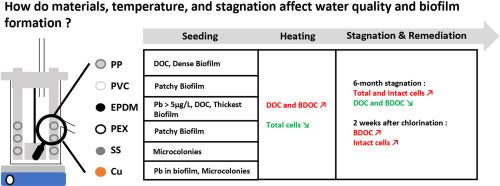
Building water distribution system materials are diverse and their impact on water quality depends on nutrients, stagnation, and temperature. The main objective was to investigate the interplay between material type, temperature and stagnation on water quality and biofilm formation potential. CDC biofilm reactors were used to compare concentrations of metals, total (DOC) and biodegradable (BDOC) dissolved organic carbon, and total and viable cells densities in water and biofilms in contact with coupons of 6 materials: polypropylene (PP), polyvinyl chloride (PVC), ethylene propylene diene monomer (EPDM), cross-linked polyethylene (PEX), stainless steel (SS) and copper (Cu). All materials were colonized by bacteria, with denser biofilm observed on EPDM > PP > PVC > PEX > Cu – SS. Copper and EPDM reactors showed different dynamics of accumulation and release of Cu and Pb, with bulk Pb concentrations exceeding 5 μg/L. Increasing temperatures from 25 °C to 40, 55 and 60 °C resulted in an increase by at least a factor 2 of DOC and BDOC, a temporary decrease in cell viability (%) and contrasting trends for suspended total bacteria (up to 1.4-log). Biofilm densities remained lower for all reactors after two months of constant heating at 40 °C, even further for copper reactors heated to 55 °C (2.5-log) and 60 °C (2.7-log). A 4-week stagnation at room temperature promoted total bacteria recovery in water and biofilm for all materials except copper. Extending stagnation to 6 months (COVID-19 shutdown) further increased total bacteria and the viable fraction in water, except in copper reactors.
期刊介绍:
Chemosphere, being an international multidisciplinary journal, is dedicated to publishing original communications and review articles on chemicals in the environment. The scope covers a wide range of topics, including the identification, quantification, behavior, fate, toxicology, treatment, and remediation of chemicals in the bio-, hydro-, litho-, and atmosphere, ensuring the broad dissemination of research in this field.




 京公网安备 11010802042870号
京ICP备2023020795号-1
京公网安备 11010802042870号
京ICP备2023020795号-1

 分享
分享
 求助内容:
求助内容: 应助结果提醒方式:
 扫码关注我们
