Manfeng Li , Mengmeng Wang , Kaiyang Zhu , Hailong Li , Rui Ye , Hongyan Shi , Tianbiao He
{"title":"PV/ t -风-钻孔- orc一体化地源热泵系统多目标优化及3E分析","authors":"Manfeng Li , Mengmeng Wang , Kaiyang Zhu , Hailong Li , Rui Ye , Hongyan Shi , Tianbiao He","doi":"10.1016/j.psep.2025.106930","DOIUrl":null,"url":null,"abstract":"<div><div>In response to the rising energy demands and environmental challenges, a multi-renewable system combining photovoltaic/thermal (PV/T), wind turbines, battery, borehole heat exchangers and Organic Rankine Cycle driven ground source heat pump is proposed. This system aims to enhance energy efficiency, achieve economic viability, and improve flexibility. The independent and interactive effects of area of PV/T, number of wind turbines, number of borehole heat exchangers, and mass flow per unit PV/T area are analyzed to assess their influences on energy efficiency (η<sub>e</sub>), overall energy consumption (OEC), investment energy ratio (IER). Using robust response surface methodology and the Box-Behnken method, the optimal configuration is determined, revealing a PV/T area of 170.385 m<sup>2</sup>, 8 wind turbines, 5 borehole heat exchangers, and a mass flow of 0.285 kg/s per unit of PV/T area. This configuration produced promising outcomes: an η<sub>e</sub> of 0.383, an OEC of −24656.88 kW·h/year, and IER of $0.120/kW·h. Compared to the ground source heat pump powered by the grid, this system achieves annual reductions in pollutants: 51,605.06 kg of CO₂, 167.42 kg of SO₂, and 145.75 kg of NOₓ. These findings provide valuable insights for integrated multi-renewable energy systems, highlighting their feasibility and flexibility.</div></div>","PeriodicalId":20743,"journal":{"name":"Process Safety and Environmental Protection","volume":"196 ","pages":"Article 106930"},"PeriodicalIF":7.8000,"publicationDate":"2025-04-01","publicationTypes":"Journal Article","fieldsOfStudy":null,"isOpenAccess":false,"openAccessPdf":"","citationCount":"0","resultStr":"{\"title\":\"Multi-objective optimization and 3E analysis of an integrated PV/T-wind-borehole-ORC driven ground source heat pump system\",\"authors\":\"Manfeng Li , Mengmeng Wang , Kaiyang Zhu , Hailong Li , Rui Ye , Hongyan Shi , Tianbiao He\",\"doi\":\"10.1016/j.psep.2025.106930\",\"DOIUrl\":null,\"url\":null,\"abstract\":\"<div><div>In response to the rising energy demands and environmental challenges, a multi-renewable system combining photovoltaic/thermal (PV/T), wind turbines, battery, borehole heat exchangers and Organic Rankine Cycle driven ground source heat pump is proposed. This system aims to enhance energy efficiency, achieve economic viability, and improve flexibility. The independent and interactive effects of area of PV/T, number of wind turbines, number of borehole heat exchangers, and mass flow per unit PV/T area are analyzed to assess their influences on energy efficiency (η<sub>e</sub>), overall energy consumption (OEC), investment energy ratio (IER). Using robust response surface methodology and the Box-Behnken method, the optimal configuration is determined, revealing a PV/T area of 170.385 m<sup>2</sup>, 8 wind turbines, 5 borehole heat exchangers, and a mass flow of 0.285 kg/s per unit of PV/T area. This configuration produced promising outcomes: an η<sub>e</sub> of 0.383, an OEC of −24656.88 kW·h/year, and IER of $0.120/kW·h. Compared to the ground source heat pump powered by the grid, this system achieves annual reductions in pollutants: 51,605.06 kg of CO₂, 167.42 kg of SO₂, and 145.75 kg of NOₓ. These findings provide valuable insights for integrated multi-renewable energy systems, highlighting their feasibility and flexibility.</div></div>\",\"PeriodicalId\":20743,\"journal\":{\"name\":\"Process Safety and Environmental Protection\",\"volume\":\"196 \",\"pages\":\"Article 106930\"},\"PeriodicalIF\":7.8000,\"publicationDate\":\"2025-04-01\",\"publicationTypes\":\"Journal Article\",\"fieldsOfStudy\":null,\"isOpenAccess\":false,\"openAccessPdf\":\"\",\"citationCount\":\"0\",\"resultStr\":null,\"platform\":\"Semanticscholar\",\"paperid\":null,\"PeriodicalName\":\"Process Safety and Environmental Protection\",\"FirstCategoryId\":\"93\",\"ListUrlMain\":\"https://www.sciencedirect.com/science/article/pii/S0957582025001971\",\"RegionNum\":2,\"RegionCategory\":\"环境科学与生态学\",\"ArticlePicture\":[],\"TitleCN\":null,\"AbstractTextCN\":null,\"PMCID\":null,\"EPubDate\":\"2025/2/27 0:00:00\",\"PubModel\":\"Epub\",\"JCR\":\"Q1\",\"JCRName\":\"ENGINEERING, CHEMICAL\",\"Score\":null,\"Total\":0}","platform":"Semanticscholar","paperid":null,"PeriodicalName":"Process Safety and Environmental Protection","FirstCategoryId":"93","ListUrlMain":"https://www.sciencedirect.com/science/article/pii/S0957582025001971","RegionNum":2,"RegionCategory":"环境科学与生态学","ArticlePicture":[],"TitleCN":null,"AbstractTextCN":null,"PMCID":null,"EPubDate":"2025/2/27 0:00:00","PubModel":"Epub","JCR":"Q1","JCRName":"ENGINEERING, CHEMICAL","Score":null,"Total":0}
引用次数: 0
摘要
为了应对日益增长的能源需求和环境挑战,提出了一种结合光伏/热(PV/T)、风力涡轮机、电池、井下热交换器和有机朗肯循环驱动的地源热泵的多可再生能源系统。该系统旨在提高能源效率,实现经济可行性,并提高灵活性。分析了PV/T面积、风力机数量、钻孔热交换器数量和单位PV/T面积质量流量的独立效应和交互效应,评价了它们对能效ηe、总能耗OEC、投资能比IER的影响。采用鲁棒响应面法和Box-Behnken方法,确定了最优配置,PV/T面积为170.385 m2, 8个风力涡轮机,5个钻孔热交换器,单位PV/T面积的质量流量为0.285 kg/s。该配置产生了令人满意的结果:ηe为0.383,OEC为−24656.88 kW·h/年,IER为0.120美元/kW·h。与电网供电的地源热泵相比,该系统每年减少污染物:51,605.06 kg CO₂,167.42 kg SO₂,145.75 kg NOₓ。这些发现为集成多可再生能源系统提供了有价值的见解,突出了其可行性和灵活性。
Multi-objective optimization and 3E analysis of an integrated PV/T-wind-borehole-ORC driven ground source heat pump system
In response to the rising energy demands and environmental challenges, a multi-renewable system combining photovoltaic/thermal (PV/T), wind turbines, battery, borehole heat exchangers and Organic Rankine Cycle driven ground source heat pump is proposed. This system aims to enhance energy efficiency, achieve economic viability, and improve flexibility. The independent and interactive effects of area of PV/T, number of wind turbines, number of borehole heat exchangers, and mass flow per unit PV/T area are analyzed to assess their influences on energy efficiency (ηe), overall energy consumption (OEC), investment energy ratio (IER). Using robust response surface methodology and the Box-Behnken method, the optimal configuration is determined, revealing a PV/T area of 170.385 m2, 8 wind turbines, 5 borehole heat exchangers, and a mass flow of 0.285 kg/s per unit of PV/T area. This configuration produced promising outcomes: an ηe of 0.383, an OEC of −24656.88 kW·h/year, and IER of $0.120/kW·h. Compared to the ground source heat pump powered by the grid, this system achieves annual reductions in pollutants: 51,605.06 kg of CO₂, 167.42 kg of SO₂, and 145.75 kg of NOₓ. These findings provide valuable insights for integrated multi-renewable energy systems, highlighting their feasibility and flexibility.
期刊介绍:
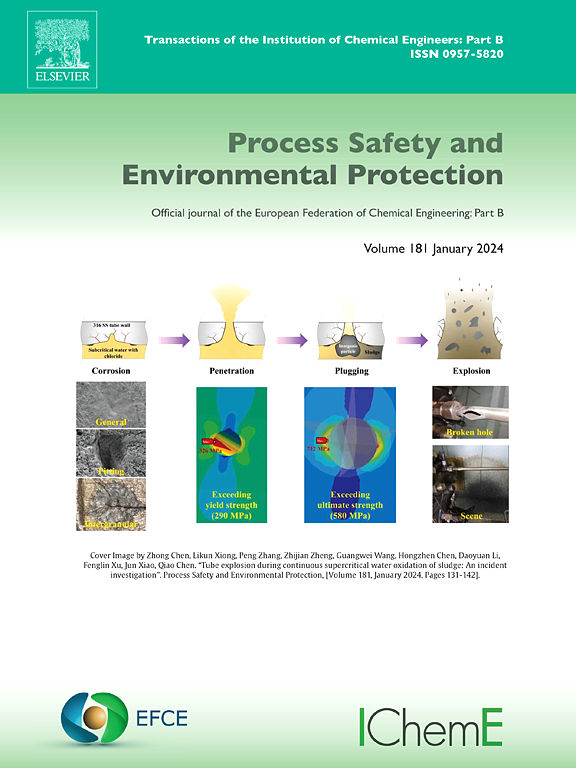
The Process Safety and Environmental Protection (PSEP) journal is a leading international publication that focuses on the publication of high-quality, original research papers in the field of engineering, specifically those related to the safety of industrial processes and environmental protection. The journal encourages submissions that present new developments in safety and environmental aspects, particularly those that show how research findings can be applied in process engineering design and practice.
PSEP is particularly interested in research that brings fresh perspectives to established engineering principles, identifies unsolved problems, or suggests directions for future research. The journal also values contributions that push the boundaries of traditional engineering and welcomes multidisciplinary papers.
PSEP's articles are abstracted and indexed by a range of databases and services, which helps to ensure that the journal's research is accessible and recognized in the academic and professional communities. These databases include ANTE, Chemical Abstracts, Chemical Hazards in Industry, Current Contents, Elsevier Engineering Information database, Pascal Francis, Web of Science, Scopus, Engineering Information Database EnCompass LIT (Elsevier), and INSPEC. This wide coverage facilitates the dissemination of the journal's content to a global audience interested in process safety and environmental engineering.




 京公网安备 11010802042870号
京ICP备2023020795号-1
京公网安备 11010802042870号
京ICP备2023020795号-1

 分享
分享
 求助内容:
求助内容: 应助结果提醒方式:
 扫码关注我们
