{"title":"自愈环氧玻璃体†在SAOED/环氧应力传感器中恢复机械发光","authors":"Cigdem Caglayan, Geonwoo Kim and Gun Jin Yun","doi":"10.1039/D4RA08911A","DOIUrl":null,"url":null,"abstract":"<p >In mechanoluminescence stress sensors, understanding the relationship between light emission performance and sensor structural stability is crucial to ensure the accuracy, sensitivity, and reliability of stress sensing during operation. Any minor structural damage or debonding at the particle–epoxy interface will reduce stress transfer capacity and hamper the light emission from SAOED particles. Instead of replacing the sensors with reduced light emission performance, self-healing epoxy vitrimers can open up new opportunities for recovering mechanoluminescence, offering durable and environmentally friendly high-performance stress sensors. This study investigates two epoxy vitrimer systems for ML stress sensors compared to commercial epoxy. Siloxane bond exchange-based ML stress sensors are found to be promising in terms of light intensity, stress sensitivity, and ML recovery. Exposing sensors to a thermal treatment revealed an increase in light intensity, which is associated with a temperature effect on SAOED particles and self-healing bond exchange in dynamic epoxy networks.</p>","PeriodicalId":102,"journal":{"name":"RSC Advances","volume":" 9","pages":" 7160-7171"},"PeriodicalIF":6.1000,"publicationDate":"2025-03-06","publicationTypes":"Journal Article","fieldsOfStudy":null,"isOpenAccess":false,"openAccessPdf":"https://pubs.rsc.org/en/content/articlepdf/2025/ra/d4ra08911a?page=search","citationCount":"0","resultStr":"{\"title\":\"Recovering mechanoluminescence in SAOED/epoxy stress sensors with self-healing epoxy vitrimers†\",\"authors\":\"Cigdem Caglayan, Geonwoo Kim and Gun Jin Yun\",\"doi\":\"10.1039/D4RA08911A\",\"DOIUrl\":null,\"url\":null,\"abstract\":\"<p >In mechanoluminescence stress sensors, understanding the relationship between light emission performance and sensor structural stability is crucial to ensure the accuracy, sensitivity, and reliability of stress sensing during operation. Any minor structural damage or debonding at the particle–epoxy interface will reduce stress transfer capacity and hamper the light emission from SAOED particles. Instead of replacing the sensors with reduced light emission performance, self-healing epoxy vitrimers can open up new opportunities for recovering mechanoluminescence, offering durable and environmentally friendly high-performance stress sensors. This study investigates two epoxy vitrimer systems for ML stress sensors compared to commercial epoxy. Siloxane bond exchange-based ML stress sensors are found to be promising in terms of light intensity, stress sensitivity, and ML recovery. Exposing sensors to a thermal treatment revealed an increase in light intensity, which is associated with a temperature effect on SAOED particles and self-healing bond exchange in dynamic epoxy networks.</p>\",\"PeriodicalId\":102,\"journal\":{\"name\":\"RSC Advances\",\"volume\":\" 9\",\"pages\":\" 7160-7171\"},\"PeriodicalIF\":6.1000,\"publicationDate\":\"2025-03-06\",\"publicationTypes\":\"Journal Article\",\"fieldsOfStudy\":null,\"isOpenAccess\":false,\"openAccessPdf\":\"https://pubs.rsc.org/en/content/articlepdf/2025/ra/d4ra08911a?page=search\",\"citationCount\":\"0\",\"resultStr\":null,\"platform\":\"Semanticscholar\",\"paperid\":null,\"PeriodicalName\":\"RSC Advances\",\"FirstCategoryId\":\"92\",\"ListUrlMain\":\"https://pubs.rsc.org/en/content/articlelanding/2025/ra/d4ra08911a\",\"RegionNum\":3,\"RegionCategory\":\"化学\",\"ArticlePicture\":[],\"TitleCN\":null,\"AbstractTextCN\":null,\"PMCID\":null,\"EPubDate\":\"\",\"PubModel\":\"\",\"JCR\":\"Q2\",\"JCRName\":\"CHEMISTRY, MULTIDISCIPLINARY\",\"Score\":null,\"Total\":0}","platform":"Semanticscholar","paperid":null,"PeriodicalName":"RSC Advances","FirstCategoryId":"92","ListUrlMain":"https://pubs.rsc.org/en/content/articlelanding/2025/ra/d4ra08911a","RegionNum":3,"RegionCategory":"化学","ArticlePicture":[],"TitleCN":null,"AbstractTextCN":null,"PMCID":null,"EPubDate":"","PubModel":"","JCR":"Q2","JCRName":"CHEMISTRY, MULTIDISCIPLINARY","Score":null,"Total":0}
Recovering mechanoluminescence in SAOED/epoxy stress sensors with self-healing epoxy vitrimers†
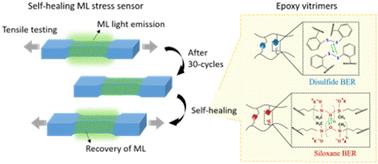
In mechanoluminescence stress sensors, understanding the relationship between light emission performance and sensor structural stability is crucial to ensure the accuracy, sensitivity, and reliability of stress sensing during operation. Any minor structural damage or debonding at the particle–epoxy interface will reduce stress transfer capacity and hamper the light emission from SAOED particles. Instead of replacing the sensors with reduced light emission performance, self-healing epoxy vitrimers can open up new opportunities for recovering mechanoluminescence, offering durable and environmentally friendly high-performance stress sensors. This study investigates two epoxy vitrimer systems for ML stress sensors compared to commercial epoxy. Siloxane bond exchange-based ML stress sensors are found to be promising in terms of light intensity, stress sensitivity, and ML recovery. Exposing sensors to a thermal treatment revealed an increase in light intensity, which is associated with a temperature effect on SAOED particles and self-healing bond exchange in dynamic epoxy networks.
期刊介绍:
An international, peer-reviewed journal covering all of the chemical sciences, including multidisciplinary and emerging areas. RSC Advances is a gold open access journal allowing researchers free access to research articles, and offering an affordable open access publishing option for authors around the world.





 京公网安备 11010802042870号
京ICP备2023020795号-1
京公网安备 11010802042870号
京ICP备2023020795号-1

 分享
分享
 求助内容:
求助内容: 应助结果提醒方式:
 扫码关注我们
