{"title":"生活必需品与帕金森病的关系:一项基于人群的研究","authors":"Chenguang Zhou, Oumei Cheng","doi":"10.3389/fnagi.2025.1510411","DOIUrl":null,"url":null,"abstract":"<p><strong>Background: </strong>Parkinson's disease (PD) is a progressive neurodegenerative disorder with increasing global prevalence. This study investigated the association between the American Heart Association's Life's Essential 8 (LE8) and PD prevalence using a large, nationally representative database.</p><p><strong>Methods: </strong>We analyzed data from 18,277 participants aged 40 years and older from the National Health and Nutrition Examination Survey (NHANES) 2005-2018. LE8 scores were calculated based on diet, physical activity, nicotine exposure, sleep, body mass index, blood lipids, blood glucose, and blood pressure. PD cases were identified through self-reported anti-PD medication use. Multivariate logistic regression models were employed to examine the association between LE8 and PD prevalence, adjusting for various demographic and clinical factors. In addition, we performed restricted cubic splines (RCS), subgroup analyses, and weighted quantile sum (WQS) regression to verify the robustness of the study results.</p><p><strong>Results: </strong>The prevalence of PD was 1.3% in the study population. After full adjustment, individuals with moderate (50-79) and high (80-100) LE8 scores showed lower odds of PD compared to those with low (0-49) scores (OR 0.53, 95% CI 0.29-0.97 and OR 0.43, 95% CI 0.17-1.04, respectively; <i>p</i> for trend <0.05). A dose-response relationship was observed between LE8 scores and PD prevalence. WQS regression identified dietary factors and glycemic health as the main contributors to the inverse association between LE8 and PD.</p><p><strong>Conclusion: </strong>Our findings suggest a significant inverse association between Life's Essential 8 (LE8) and PD prevalence, with dietary factors and glycemic health emerging as the most influential components.</p>","PeriodicalId":12450,"journal":{"name":"Frontiers in Aging Neuroscience","volume":"17 ","pages":"1510411"},"PeriodicalIF":4.5000,"publicationDate":"2025-02-18","publicationTypes":"Journal Article","fieldsOfStudy":null,"isOpenAccess":false,"openAccessPdf":"https://www.ncbi.nlm.nih.gov/pmc/articles/PMC11876173/pdf/","citationCount":"0","resultStr":"{\"title\":\"Associations of the Life's Essential 8 with Parkinson's disease: a population-based study.\",\"authors\":\"Chenguang Zhou, Oumei Cheng\",\"doi\":\"10.3389/fnagi.2025.1510411\",\"DOIUrl\":null,\"url\":null,\"abstract\":\"<p><strong>Background: </strong>Parkinson's disease (PD) is a progressive neurodegenerative disorder with increasing global prevalence. This study investigated the association between the American Heart Association's Life's Essential 8 (LE8) and PD prevalence using a large, nationally representative database.</p><p><strong>Methods: </strong>We analyzed data from 18,277 participants aged 40 years and older from the National Health and Nutrition Examination Survey (NHANES) 2005-2018. LE8 scores were calculated based on diet, physical activity, nicotine exposure, sleep, body mass index, blood lipids, blood glucose, and blood pressure. PD cases were identified through self-reported anti-PD medication use. Multivariate logistic regression models were employed to examine the association between LE8 and PD prevalence, adjusting for various demographic and clinical factors. In addition, we performed restricted cubic splines (RCS), subgroup analyses, and weighted quantile sum (WQS) regression to verify the robustness of the study results.</p><p><strong>Results: </strong>The prevalence of PD was 1.3% in the study population. After full adjustment, individuals with moderate (50-79) and high (80-100) LE8 scores showed lower odds of PD compared to those with low (0-49) scores (OR 0.53, 95% CI 0.29-0.97 and OR 0.43, 95% CI 0.17-1.04, respectively; <i>p</i> for trend <0.05). A dose-response relationship was observed between LE8 scores and PD prevalence. WQS regression identified dietary factors and glycemic health as the main contributors to the inverse association between LE8 and PD.</p><p><strong>Conclusion: </strong>Our findings suggest a significant inverse association between Life's Essential 8 (LE8) and PD prevalence, with dietary factors and glycemic health emerging as the most influential components.</p>\",\"PeriodicalId\":12450,\"journal\":{\"name\":\"Frontiers in Aging Neuroscience\",\"volume\":\"17 \",\"pages\":\"1510411\"},\"PeriodicalIF\":4.5000,\"publicationDate\":\"2025-02-18\",\"publicationTypes\":\"Journal Article\",\"fieldsOfStudy\":null,\"isOpenAccess\":false,\"openAccessPdf\":\"https://www.ncbi.nlm.nih.gov/pmc/articles/PMC11876173/pdf/\",\"citationCount\":\"0\",\"resultStr\":null,\"platform\":\"Semanticscholar\",\"paperid\":null,\"PeriodicalName\":\"Frontiers in Aging Neuroscience\",\"FirstCategoryId\":\"3\",\"ListUrlMain\":\"https://doi.org/10.3389/fnagi.2025.1510411\",\"RegionNum\":2,\"RegionCategory\":\"医学\",\"ArticlePicture\":[],\"TitleCN\":null,\"AbstractTextCN\":null,\"PMCID\":null,\"EPubDate\":\"2025/1/1 0:00:00\",\"PubModel\":\"eCollection\",\"JCR\":\"Q2\",\"JCRName\":\"GERIATRICS & GERONTOLOGY\",\"Score\":null,\"Total\":0}","platform":"Semanticscholar","paperid":null,"PeriodicalName":"Frontiers in Aging Neuroscience","FirstCategoryId":"3","ListUrlMain":"https://doi.org/10.3389/fnagi.2025.1510411","RegionNum":2,"RegionCategory":"医学","ArticlePicture":[],"TitleCN":null,"AbstractTextCN":null,"PMCID":null,"EPubDate":"2025/1/1 0:00:00","PubModel":"eCollection","JCR":"Q2","JCRName":"GERIATRICS & GERONTOLOGY","Score":null,"Total":0}
引用次数: 0
摘要
背景:帕金森病(PD)是一种全球患病率不断上升的进行性神经退行性疾病。本研究调查了美国心脏协会的生活基本8 (LE8)和PD患病率之间的关系,使用了一个大型的,具有全国代表性的数据库。方法:我们分析了2005-2018年国家健康与营养检查调查(NHANES)中年龄在40 岁及以上的18277名参与者的数据。LE8评分是根据饮食、身体活动、尼古丁暴露、睡眠、体重指数、血脂、血糖和血压计算的。PD病例通过自我报告的抗PD药物使用情况来确定。采用多变量logistic回归模型检验LE8与PD患病率之间的关系,并对各种人口统计学和临床因素进行调整。此外,我们还进行了限制性三次样条(RCS)、亚组分析和加权分位数和(WQS)回归来验证研究结果的稳健性。结果:研究人群PD患病率为1.3%。完全调整后,中等(50-79)和高(80-100)LE8得分的个体与低(0-49)得分的个体相比,PD的几率较低(OR 0.53, 95% CI 0.29-0.97)和OR 0.43, 95% CI 0.17-1.04;结论:我们的研究结果表明,生命必需8 (LE8)与PD患病率之间存在显著的负相关,饮食因素和血糖健康是最具影响力的因素。
Associations of the Life's Essential 8 with Parkinson's disease: a population-based study.
Background: Parkinson's disease (PD) is a progressive neurodegenerative disorder with increasing global prevalence. This study investigated the association between the American Heart Association's Life's Essential 8 (LE8) and PD prevalence using a large, nationally representative database.
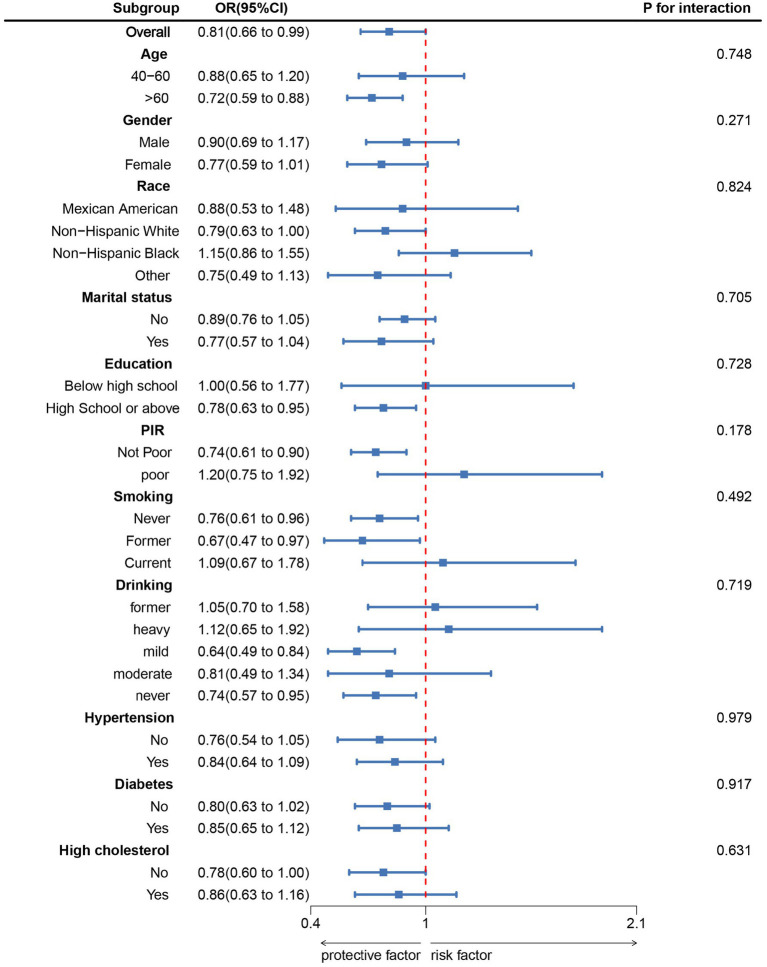
Methods: We analyzed data from 18,277 participants aged 40 years and older from the National Health and Nutrition Examination Survey (NHANES) 2005-2018. LE8 scores were calculated based on diet, physical activity, nicotine exposure, sleep, body mass index, blood lipids, blood glucose, and blood pressure. PD cases were identified through self-reported anti-PD medication use. Multivariate logistic regression models were employed to examine the association between LE8 and PD prevalence, adjusting for various demographic and clinical factors. In addition, we performed restricted cubic splines (RCS), subgroup analyses, and weighted quantile sum (WQS) regression to verify the robustness of the study results.
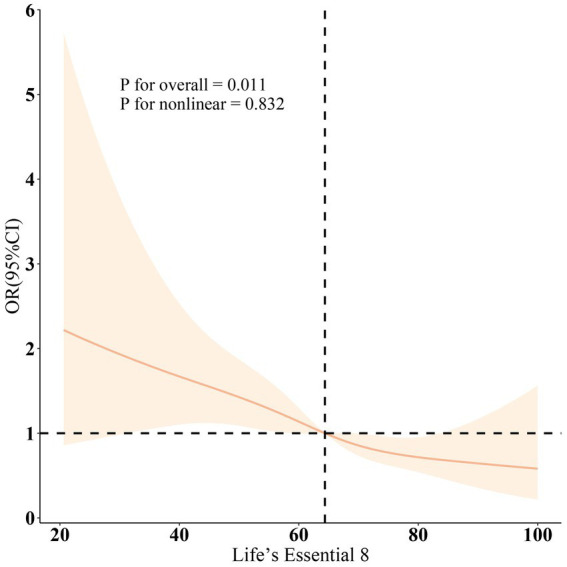
Results: The prevalence of PD was 1.3% in the study population. After full adjustment, individuals with moderate (50-79) and high (80-100) LE8 scores showed lower odds of PD compared to those with low (0-49) scores (OR 0.53, 95% CI 0.29-0.97 and OR 0.43, 95% CI 0.17-1.04, respectively; p for trend <0.05). A dose-response relationship was observed between LE8 scores and PD prevalence. WQS regression identified dietary factors and glycemic health as the main contributors to the inverse association between LE8 and PD.
Conclusion: Our findings suggest a significant inverse association between Life's Essential 8 (LE8) and PD prevalence, with dietary factors and glycemic health emerging as the most influential components.
期刊介绍:
Frontiers in Aging Neuroscience is a leading journal in its field, publishing rigorously peer-reviewed research that advances our understanding of the mechanisms of Central Nervous System aging and age-related neural diseases. Specialty Chief Editor Thomas Wisniewski at the New York University School of Medicine is supported by an outstanding Editorial Board of international researchers. This multidisciplinary open-access journal is at the forefront of disseminating and communicating scientific knowledge and impactful discoveries to researchers, academics, clinicians and the public worldwide.





 京公网安备 11010802042870号
京ICP备2023020795号-1
京公网安备 11010802042870号
京ICP备2023020795号-1

 分享
分享
 求助内容:
求助内容: 应助结果提醒方式:
 扫码关注我们
