Guanyu Song, Meifeng Deng, Yunzhi Chen, Shijie Jia, Zhenguo Nie
{"title":"NciaNet:一种非共价相互作用感知图神经网络,用于药物发现中蛋白质-配体相互作用的预测。","authors":"Guanyu Song, Meifeng Deng, Yunzhi Chen, Shijie Jia, Zhenguo Nie","doi":"10.1109/JBHI.2025.3547741","DOIUrl":null,"url":null,"abstract":"<p><p>Precise quantification of protein-ligand interaction is critical in early-stage drug discovery. Artificial intelligence (AI) has gained massive popularity in this area, with deep-learning models used to extract features from ligand and protein molecules. However, these models often fail to capture intermolecular non-covalent interactions, the primary factor influencing binding, leading to lower accuracy and interpretability. Moreover, such models overlook the spatial structure of protein-ligand complexes, resulting in weaker generalization. To address these issues, we propose Non-covalent Interaction-aware Graph Neural Network (NciaNet), a novel method that effectively utilizes intermolecular non-covalent interactions and 3D protein-ligand structure. Our approach achieves excellent predictive performance on multiple benchmark datasets and outperforms competitive baseline models in the binding affinity task, with the benchmark core set v.2016 achieving an RMSE of 1.208 and an R of 0.833, and the core set v.2013 achieving an RMSE of 1.409 and an R of 0.805, under the high-quality refined v.2016 training conditions. Importantly, NciaNet successfully learns vital features related to protein-ligand interactions, providing biochemical insights and demonstrating practical utility and reliability.</p>","PeriodicalId":13073,"journal":{"name":"IEEE Journal of Biomedical and Health Informatics","volume":"PP ","pages":"6055-6068"},"PeriodicalIF":7.7000,"publicationDate":"2025-08-01","publicationTypes":"Journal Article","fieldsOfStudy":null,"isOpenAccess":false,"openAccessPdf":"","citationCount":"0","resultStr":"{\"title\":\"NciaNet: A Non-Covalent Interaction-Aware Graph Neural Network for the Prediction of Protein-Ligand Interaction in Drug Discovery.\",\"authors\":\"Guanyu Song, Meifeng Deng, Yunzhi Chen, Shijie Jia, Zhenguo Nie\",\"doi\":\"10.1109/JBHI.2025.3547741\",\"DOIUrl\":null,\"url\":null,\"abstract\":\"<p><p>Precise quantification of protein-ligand interaction is critical in early-stage drug discovery. Artificial intelligence (AI) has gained massive popularity in this area, with deep-learning models used to extract features from ligand and protein molecules. However, these models often fail to capture intermolecular non-covalent interactions, the primary factor influencing binding, leading to lower accuracy and interpretability. Moreover, such models overlook the spatial structure of protein-ligand complexes, resulting in weaker generalization. To address these issues, we propose Non-covalent Interaction-aware Graph Neural Network (NciaNet), a novel method that effectively utilizes intermolecular non-covalent interactions and 3D protein-ligand structure. Our approach achieves excellent predictive performance on multiple benchmark datasets and outperforms competitive baseline models in the binding affinity task, with the benchmark core set v.2016 achieving an RMSE of 1.208 and an R of 0.833, and the core set v.2013 achieving an RMSE of 1.409 and an R of 0.805, under the high-quality refined v.2016 training conditions. Importantly, NciaNet successfully learns vital features related to protein-ligand interactions, providing biochemical insights and demonstrating practical utility and reliability.</p>\",\"PeriodicalId\":13073,\"journal\":{\"name\":\"IEEE Journal of Biomedical and Health Informatics\",\"volume\":\"PP \",\"pages\":\"6055-6068\"},\"PeriodicalIF\":7.7000,\"publicationDate\":\"2025-08-01\",\"publicationTypes\":\"Journal Article\",\"fieldsOfStudy\":null,\"isOpenAccess\":false,\"openAccessPdf\":\"\",\"citationCount\":\"0\",\"resultStr\":null,\"platform\":\"Semanticscholar\",\"paperid\":null,\"PeriodicalName\":\"IEEE Journal of Biomedical and Health Informatics\",\"FirstCategoryId\":\"5\",\"ListUrlMain\":\"https://doi.org/10.1109/JBHI.2025.3547741\",\"RegionNum\":2,\"RegionCategory\":\"医学\",\"ArticlePicture\":[],\"TitleCN\":null,\"AbstractTextCN\":null,\"PMCID\":null,\"EPubDate\":\"\",\"PubModel\":\"\",\"JCR\":\"Q1\",\"JCRName\":\"COMPUTER SCIENCE, INFORMATION SYSTEMS\",\"Score\":null,\"Total\":0}","platform":"Semanticscholar","paperid":null,"PeriodicalName":"IEEE Journal of Biomedical and Health Informatics","FirstCategoryId":"5","ListUrlMain":"https://doi.org/10.1109/JBHI.2025.3547741","RegionNum":2,"RegionCategory":"医学","ArticlePicture":[],"TitleCN":null,"AbstractTextCN":null,"PMCID":null,"EPubDate":"","PubModel":"","JCR":"Q1","JCRName":"COMPUTER SCIENCE, INFORMATION SYSTEMS","Score":null,"Total":0}
NciaNet: A Non-Covalent Interaction-Aware Graph Neural Network for the Prediction of Protein-Ligand Interaction in Drug Discovery.
Precise quantification of protein-ligand interaction is critical in early-stage drug discovery. Artificial intelligence (AI) has gained massive popularity in this area, with deep-learning models used to extract features from ligand and protein molecules. However, these models often fail to capture intermolecular non-covalent interactions, the primary factor influencing binding, leading to lower accuracy and interpretability. Moreover, such models overlook the spatial structure of protein-ligand complexes, resulting in weaker generalization. To address these issues, we propose Non-covalent Interaction-aware Graph Neural Network (NciaNet), a novel method that effectively utilizes intermolecular non-covalent interactions and 3D protein-ligand structure. Our approach achieves excellent predictive performance on multiple benchmark datasets and outperforms competitive baseline models in the binding affinity task, with the benchmark core set v.2016 achieving an RMSE of 1.208 and an R of 0.833, and the core set v.2013 achieving an RMSE of 1.409 and an R of 0.805, under the high-quality refined v.2016 training conditions. Importantly, NciaNet successfully learns vital features related to protein-ligand interactions, providing biochemical insights and demonstrating practical utility and reliability.
期刊介绍:
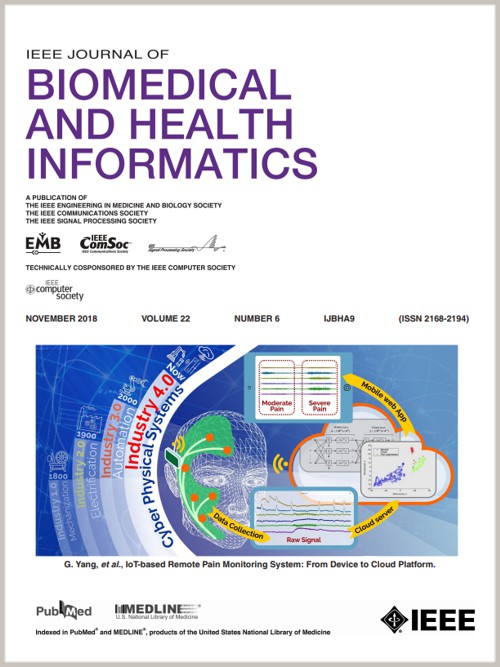
IEEE Journal of Biomedical and Health Informatics publishes original papers presenting recent advances where information and communication technologies intersect with health, healthcare, life sciences, and biomedicine. Topics include acquisition, transmission, storage, retrieval, management, and analysis of biomedical and health information. The journal covers applications of information technologies in healthcare, patient monitoring, preventive care, early disease diagnosis, therapy discovery, and personalized treatment protocols. It explores electronic medical and health records, clinical information systems, decision support systems, medical and biological imaging informatics, wearable systems, body area/sensor networks, and more. Integration-related topics like interoperability, evidence-based medicine, and secure patient data are also addressed.




 京公网安备 11010802042870号
京ICP备2023020795号-1
京公网安备 11010802042870号
京ICP备2023020795号-1

 分享
分享
 求助内容:
求助内容: 应助结果提醒方式:
 扫码关注我们
