Sibo Qiao;Qiang Guo;Fengdong Shi;Min Wang;Haohao Zhu;Fazlullah Khan;Joel J. P. C. Rodrigues;Zhihan Lyu
{"title":"SIBW:一种基于群智能的网络流水印方法用于数字医疗系统中的隐私泄漏检测。","authors":"Sibo Qiao;Qiang Guo;Fengdong Shi;Min Wang;Haohao Zhu;Fazlullah Khan;Joel J. P. C. Rodrigues;Zhihan Lyu","doi":"10.1109/JBHI.2025.3542561","DOIUrl":null,"url":null,"abstract":"The exponential growth of sensitive patient information and diagnostic records in digital healthcare systems has increased the complexity of data protection, while frequent medical data breaches severely compromise system security and reliability. Existing privacy protection techniques often lack robustness and real-time capabilities in high-noise, high-packet-loss, and dynamic network environments, limiting their effectiveness in detecting healthcare data leaks. To address these challenges, we propose a Swarm Intelligence-Based Network Watermarking (SIBW) method for real-time privacy data leakage detection in digital healthcare systems. SIBW integrates fountain codes with outer error correction codes and employs a Multi-Phase Synergistic Swarm Optimization Algorithm (MPSSOA) to dynamically optimize encoding parameters, significantly enhancing the robustness and interference resistance of watermark detection. Additionally, a reliable synchronization sequence and lightweight embedding mechanism are designed to ensure adaptability to complex, dynamic networks. Experimental results demonstrate that SIBW achieves over 90% detection accuracy under high latency jitter and packet loss conditions, surpassing existing methods in both robustness and efficiency. With a compact design of only 3.7 MB, SIBW is particularly suited for rapid deployment in resource-constrained digital healthcare systems.","PeriodicalId":13073,"journal":{"name":"IEEE Journal of Biomedical and Health Informatics","volume":"30 3","pages":"1912-1924"},"PeriodicalIF":7.7000,"publicationDate":"2026-03-01","publicationTypes":"Journal Article","fieldsOfStudy":null,"isOpenAccess":false,"openAccessPdf":"","citationCount":"0","resultStr":"{\"title\":\"SIBW: A Swarm Intelligence-Based Network Flow Watermarking Approach for Privacy Leakage Detection in Digital Healthcare Systems\",\"authors\":\"Sibo Qiao;Qiang Guo;Fengdong Shi;Min Wang;Haohao Zhu;Fazlullah Khan;Joel J. P. C. Rodrigues;Zhihan Lyu\",\"doi\":\"10.1109/JBHI.2025.3542561\",\"DOIUrl\":null,\"url\":null,\"abstract\":\"The exponential growth of sensitive patient information and diagnostic records in digital healthcare systems has increased the complexity of data protection, while frequent medical data breaches severely compromise system security and reliability. Existing privacy protection techniques often lack robustness and real-time capabilities in high-noise, high-packet-loss, and dynamic network environments, limiting their effectiveness in detecting healthcare data leaks. To address these challenges, we propose a Swarm Intelligence-Based Network Watermarking (SIBW) method for real-time privacy data leakage detection in digital healthcare systems. SIBW integrates fountain codes with outer error correction codes and employs a Multi-Phase Synergistic Swarm Optimization Algorithm (MPSSOA) to dynamically optimize encoding parameters, significantly enhancing the robustness and interference resistance of watermark detection. Additionally, a reliable synchronization sequence and lightweight embedding mechanism are designed to ensure adaptability to complex, dynamic networks. Experimental results demonstrate that SIBW achieves over 90% detection accuracy under high latency jitter and packet loss conditions, surpassing existing methods in both robustness and efficiency. With a compact design of only 3.7 MB, SIBW is particularly suited for rapid deployment in resource-constrained digital healthcare systems.\",\"PeriodicalId\":13073,\"journal\":{\"name\":\"IEEE Journal of Biomedical and Health Informatics\",\"volume\":\"30 3\",\"pages\":\"1912-1924\"},\"PeriodicalIF\":7.7000,\"publicationDate\":\"2026-03-01\",\"publicationTypes\":\"Journal Article\",\"fieldsOfStudy\":null,\"isOpenAccess\":false,\"openAccessPdf\":\"\",\"citationCount\":\"0\",\"resultStr\":null,\"platform\":\"Semanticscholar\",\"paperid\":null,\"PeriodicalName\":\"IEEE Journal of Biomedical and Health Informatics\",\"FirstCategoryId\":\"5\",\"ListUrlMain\":\"https://ieeexplore.ieee.org/document/10890993/\",\"RegionNum\":2,\"RegionCategory\":\"医学\",\"ArticlePicture\":[],\"TitleCN\":null,\"AbstractTextCN\":null,\"PMCID\":null,\"EPubDate\":\"2025/2/14 0:00:00\",\"PubModel\":\"Epub\",\"JCR\":\"Q1\",\"JCRName\":\"COMPUTER SCIENCE, INFORMATION SYSTEMS\",\"Score\":null,\"Total\":0}","platform":"Semanticscholar","paperid":null,"PeriodicalName":"IEEE Journal of Biomedical and Health Informatics","FirstCategoryId":"5","ListUrlMain":"https://ieeexplore.ieee.org/document/10890993/","RegionNum":2,"RegionCategory":"医学","ArticlePicture":[],"TitleCN":null,"AbstractTextCN":null,"PMCID":null,"EPubDate":"2025/2/14 0:00:00","PubModel":"Epub","JCR":"Q1","JCRName":"COMPUTER SCIENCE, INFORMATION SYSTEMS","Score":null,"Total":0}
SIBW: A Swarm Intelligence-Based Network Flow Watermarking Approach for Privacy Leakage Detection in Digital Healthcare Systems
The exponential growth of sensitive patient information and diagnostic records in digital healthcare systems has increased the complexity of data protection, while frequent medical data breaches severely compromise system security and reliability. Existing privacy protection techniques often lack robustness and real-time capabilities in high-noise, high-packet-loss, and dynamic network environments, limiting their effectiveness in detecting healthcare data leaks. To address these challenges, we propose a Swarm Intelligence-Based Network Watermarking (SIBW) method for real-time privacy data leakage detection in digital healthcare systems. SIBW integrates fountain codes with outer error correction codes and employs a Multi-Phase Synergistic Swarm Optimization Algorithm (MPSSOA) to dynamically optimize encoding parameters, significantly enhancing the robustness and interference resistance of watermark detection. Additionally, a reliable synchronization sequence and lightweight embedding mechanism are designed to ensure adaptability to complex, dynamic networks. Experimental results demonstrate that SIBW achieves over 90% detection accuracy under high latency jitter and packet loss conditions, surpassing existing methods in both robustness and efficiency. With a compact design of only 3.7 MB, SIBW is particularly suited for rapid deployment in resource-constrained digital healthcare systems.
期刊介绍:
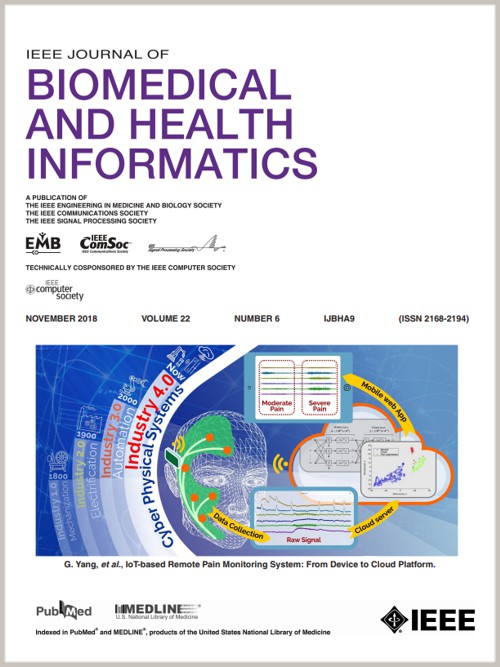
IEEE Journal of Biomedical and Health Informatics publishes original papers presenting recent advances where information and communication technologies intersect with health, healthcare, life sciences, and biomedicine. Topics include acquisition, transmission, storage, retrieval, management, and analysis of biomedical and health information. The journal covers applications of information technologies in healthcare, patient monitoring, preventive care, early disease diagnosis, therapy discovery, and personalized treatment protocols. It explores electronic medical and health records, clinical information systems, decision support systems, medical and biological imaging informatics, wearable systems, body area/sensor networks, and more. Integration-related topics like interoperability, evidence-based medicine, and secure patient data are also addressed.




 京公网安备 11010802042870号
京ICP备2023020795号-1
京公网安备 11010802042870号
京ICP备2023020795号-1

 分享
分享
 求助内容:
求助内容: 应助结果提醒方式:
 扫码关注我们
