{"title":"基于游戏场景评估球技的工具:系统回顾和相关见解。","authors":"Duoyao Zhang, Peng Shi, Teng Jin, Kai Zhang","doi":"10.1186/s13102-025-01077-7","DOIUrl":null,"url":null,"abstract":"<p><strong>Background: </strong>Physical education teachers commonly use single or combined technique tests to assess to assess the skills performance of their students, but these tests still have limitations for ball skills that involve the perceptual-cognitive system and urgently need to adopt ball skill assessment tools based on game scenarios for evaluation.</p><p><strong>Objective: </strong>To provide a systematic review of ball skills performance assessment tools based on game scenarios, provide references for the development, application and pedagogical reflection of related tools.</p><p><strong>Methods: </strong>Computer searches of the Web of Science (WOS), PubMed, Scopus, SPORT Discus, and SciELO databases were conducted. Two researchers independently selected documents, and extracted information.</p><p><strong>Results: </strong>Sixteen tools for the assessment of ball sport skills performance based on game scenarios were obtained. Depending on the item being assessed, the tools can be divided into comprehensive item assessment tools (4) and single item assessment tools (12); depending on the phase of the sport being assessed, the tools can be divided into offensive phase skill performance assessment tools (15) and defensive phase skill performance assessment tools (10); depending on the type of skill being assessed, the tools can be divided into with-ball skill assessment tools (14) and without-ball skill assessment tools (15). The WOS database contains eight of these tools, and the Game Performance Assessment Instrument, Performance Assessment in Team Sports, Sistema de avaliação táctica no Futebol and Game Performance Evaluation Tool have a citation frequency of more than 100 citations and an average annual citation frequency of more than 10 citations. 87.5% and 50.0% of the tools passed inter-observer reliability and intra-observer reliability. 100.0% of the tools passed content validity and 37.5% passed structural validity.</p><p><strong>Conclusions: </strong>Ball skill assessment tools based on game situations can evaluate students' technical and tactical performance in real game scenarios, reflecting their sports decision-making and awareness of thinking. In practice, ball sport skills performance can be assessed, fed back and improved through four stages of tool selection, observation recording, data analysis and data interpretation, depending on the actual situation. Based on the development ideas of foreign ball skills performance assessment tools, the following insights are proposed: 1) to promote the development and improvement of single ball skills performance assessment tools; 2) to select reasonable and effective tools for assessment according to the teaching progress; 3) to provide suitable assessment tools for the training and selection of reserve talents; 4) to push PE teachers to explore the structured teaching of ball skills.</p>","PeriodicalId":48585,"journal":{"name":"BMC Sports Science Medicine and Rehabilitation","volume":"17 1","pages":"36"},"PeriodicalIF":2.8000,"publicationDate":"2025-03-04","publicationTypes":"Journal Article","fieldsOfStudy":null,"isOpenAccess":false,"openAccessPdf":"https://www.ncbi.nlm.nih.gov/pmc/articles/PMC11877956/pdf/","citationCount":"0","resultStr":"{\"title\":\"Tools for assessing ball skills based on game scenarios: a systematic review and related insights.\",\"authors\":\"Duoyao Zhang, Peng Shi, Teng Jin, Kai Zhang\",\"doi\":\"10.1186/s13102-025-01077-7\",\"DOIUrl\":null,\"url\":null,\"abstract\":\"<p><strong>Background: </strong>Physical education teachers commonly use single or combined technique tests to assess to assess the skills performance of their students, but these tests still have limitations for ball skills that involve the perceptual-cognitive system and urgently need to adopt ball skill assessment tools based on game scenarios for evaluation.</p><p><strong>Objective: </strong>To provide a systematic review of ball skills performance assessment tools based on game scenarios, provide references for the development, application and pedagogical reflection of related tools.</p><p><strong>Methods: </strong>Computer searches of the Web of Science (WOS), PubMed, Scopus, SPORT Discus, and SciELO databases were conducted. Two researchers independently selected documents, and extracted information.</p><p><strong>Results: </strong>Sixteen tools for the assessment of ball sport skills performance based on game scenarios were obtained. Depending on the item being assessed, the tools can be divided into comprehensive item assessment tools (4) and single item assessment tools (12); depending on the phase of the sport being assessed, the tools can be divided into offensive phase skill performance assessment tools (15) and defensive phase skill performance assessment tools (10); depending on the type of skill being assessed, the tools can be divided into with-ball skill assessment tools (14) and without-ball skill assessment tools (15). The WOS database contains eight of these tools, and the Game Performance Assessment Instrument, Performance Assessment in Team Sports, Sistema de avaliação táctica no Futebol and Game Performance Evaluation Tool have a citation frequency of more than 100 citations and an average annual citation frequency of more than 10 citations. 87.5% and 50.0% of the tools passed inter-observer reliability and intra-observer reliability. 100.0% of the tools passed content validity and 37.5% passed structural validity.</p><p><strong>Conclusions: </strong>Ball skill assessment tools based on game situations can evaluate students' technical and tactical performance in real game scenarios, reflecting their sports decision-making and awareness of thinking. In practice, ball sport skills performance can be assessed, fed back and improved through four stages of tool selection, observation recording, data analysis and data interpretation, depending on the actual situation. Based on the development ideas of foreign ball skills performance assessment tools, the following insights are proposed: 1) to promote the development and improvement of single ball skills performance assessment tools; 2) to select reasonable and effective tools for assessment according to the teaching progress; 3) to provide suitable assessment tools for the training and selection of reserve talents; 4) to push PE teachers to explore the structured teaching of ball skills.</p>\",\"PeriodicalId\":48585,\"journal\":{\"name\":\"BMC Sports Science Medicine and Rehabilitation\",\"volume\":\"17 1\",\"pages\":\"36\"},\"PeriodicalIF\":2.8000,\"publicationDate\":\"2025-03-04\",\"publicationTypes\":\"Journal Article\",\"fieldsOfStudy\":null,\"isOpenAccess\":false,\"openAccessPdf\":\"https://www.ncbi.nlm.nih.gov/pmc/articles/PMC11877956/pdf/\",\"citationCount\":\"0\",\"resultStr\":null,\"platform\":\"Semanticscholar\",\"paperid\":null,\"PeriodicalName\":\"BMC Sports Science Medicine and Rehabilitation\",\"FirstCategoryId\":\"3\",\"ListUrlMain\":\"https://doi.org/10.1186/s13102-025-01077-7\",\"RegionNum\":3,\"RegionCategory\":\"医学\",\"ArticlePicture\":[],\"TitleCN\":null,\"AbstractTextCN\":null,\"PMCID\":null,\"EPubDate\":\"\",\"PubModel\":\"\",\"JCR\":\"Q1\",\"JCRName\":\"REHABILITATION\",\"Score\":null,\"Total\":0}","platform":"Semanticscholar","paperid":null,"PeriodicalName":"BMC Sports Science Medicine and Rehabilitation","FirstCategoryId":"3","ListUrlMain":"https://doi.org/10.1186/s13102-025-01077-7","RegionNum":3,"RegionCategory":"医学","ArticlePicture":[],"TitleCN":null,"AbstractTextCN":null,"PMCID":null,"EPubDate":"","PubModel":"","JCR":"Q1","JCRName":"REHABILITATION","Score":null,"Total":0}
引用次数: 0
摘要
背景:体育教师通常采用单一或组合技术测试来评估学生的技术表现,但这些测试对于涉及感知-认知系统的球技仍然存在局限性,迫切需要采用基于游戏场景的球技评估工具进行评估。目的:对基于比赛场景的球技绩效评估工具进行系统综述,为相关工具的开发、应用及教学反思提供参考。方法:计算机检索Web of Science (WOS)、PubMed、Scopus、SPORT Discus和SciELO数据库。两名研究人员独立选择文件,并提取信息。结果:获得了16种基于游戏场景的球类运动技能评价工具。根据评估项目的不同,工具可分为综合项目评估工具(4)和单项评估工具(12);根据所评估的运动阶段,所述工具可分为进攻阶段技能绩效评估工具(15)和防守阶段技能绩效评估工具(10);根据所评估的技能类型,工具可分为有球技能评估工具(14)和无球技能评估工具(15)。WOS数据库包含其中的8个工具,其中《游戏绩效评估工具》、《团队体育绩效评估》、《Sistema de avalia o táctica no Futebol》和《游戏绩效评估工具》被引用次数超过100次,年平均被引用次数超过10次。87.5%和50.0%的工具通过了观察者间信度和观察者内信度。内容效度合格率为100.0%,结构效度合格率为37.5%。结论:基于比赛情境的球技评估工具可以评估学生在真实比赛场景中的技战术表现,反映学生的运动决策和思维意识。在实践中,根据实际情况,通过工具选择、观察记录、数据分析和数据解释四个阶段,对球类运动技能表现进行评估、反馈和提高。根据国外球类技术绩效评估工具的发展思路,提出以下几点见解:1)推动单球技术绩效评估工具的发展与完善;2)根据教学进度选择合理有效的考核工具;3)为后备人才的培养和选拔提供合适的评估工具;4)推动体育教师探索球类技术的结构化教学。
Tools for assessing ball skills based on game scenarios: a systematic review and related insights.
Background: Physical education teachers commonly use single or combined technique tests to assess to assess the skills performance of their students, but these tests still have limitations for ball skills that involve the perceptual-cognitive system and urgently need to adopt ball skill assessment tools based on game scenarios for evaluation.
Objective: To provide a systematic review of ball skills performance assessment tools based on game scenarios, provide references for the development, application and pedagogical reflection of related tools.
Methods: Computer searches of the Web of Science (WOS), PubMed, Scopus, SPORT Discus, and SciELO databases were conducted. Two researchers independently selected documents, and extracted information.
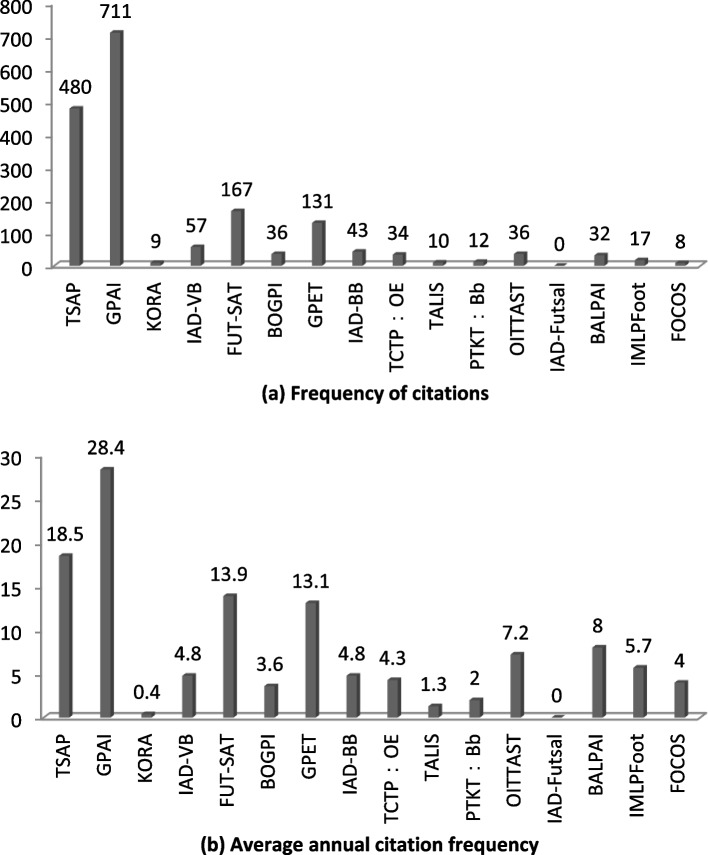
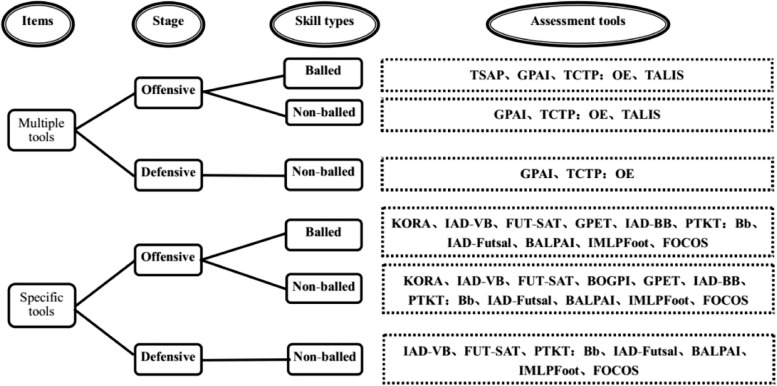
Results: Sixteen tools for the assessment of ball sport skills performance based on game scenarios were obtained. Depending on the item being assessed, the tools can be divided into comprehensive item assessment tools (4) and single item assessment tools (12); depending on the phase of the sport being assessed, the tools can be divided into offensive phase skill performance assessment tools (15) and defensive phase skill performance assessment tools (10); depending on the type of skill being assessed, the tools can be divided into with-ball skill assessment tools (14) and without-ball skill assessment tools (15). The WOS database contains eight of these tools, and the Game Performance Assessment Instrument, Performance Assessment in Team Sports, Sistema de avaliação táctica no Futebol and Game Performance Evaluation Tool have a citation frequency of more than 100 citations and an average annual citation frequency of more than 10 citations. 87.5% and 50.0% of the tools passed inter-observer reliability and intra-observer reliability. 100.0% of the tools passed content validity and 37.5% passed structural validity.
Conclusions: Ball skill assessment tools based on game situations can evaluate students' technical and tactical performance in real game scenarios, reflecting their sports decision-making and awareness of thinking. In practice, ball sport skills performance can be assessed, fed back and improved through four stages of tool selection, observation recording, data analysis and data interpretation, depending on the actual situation. Based on the development ideas of foreign ball skills performance assessment tools, the following insights are proposed: 1) to promote the development and improvement of single ball skills performance assessment tools; 2) to select reasonable and effective tools for assessment according to the teaching progress; 3) to provide suitable assessment tools for the training and selection of reserve talents; 4) to push PE teachers to explore the structured teaching of ball skills.
期刊介绍:
BMC Sports Science, Medicine and Rehabilitation is an open access, peer reviewed journal that considers articles on all aspects of sports medicine and the exercise sciences, including rehabilitation, traumatology, cardiology, physiology, and nutrition.




 京公网安备 11010802042870号
京ICP备2023020795号-1
京公网安备 11010802042870号
京ICP备2023020795号-1

 分享
分享
 求助内容:
求助内容: 应助结果提醒方式:
 扫码关注我们
