Yunyi Zhu, Yuan Wang, Elisabeth Zhu, Zeyu Ma, Hanchen Wang, Chunsheng Chen, Jing Guan, T. David Waite
{"title":"基于机器学习的浸没式膜生物反应器污水处理厂膜污染预测","authors":"Yunyi Zhu, Yuan Wang, Elisabeth Zhu, Zeyu Ma, Hanchen Wang, Chunsheng Chen, Jing Guan, T. David Waite","doi":"10.1021/acs.est.4c12835","DOIUrl":null,"url":null,"abstract":"Membrane fouling remains a significant challenge in the operation of membrane bioreactors (MBRs). Plant operators rely heavily on observations of filtration performance from noisy sensor data to assess membrane fouling conditions and lab-based protocols for plant maintenance, often leading to inaccurate estimations of future performance and delayed membrane cleaning. This challenge is further compounded by the difficulty in integrating existing complex mechanistic models with the Internet of Things (IoT) systems of wastewater treatment plants (WWTPs). By harnessing data obtained from WWTPs, along with innovative data denoising and model training strategies, we developed a machine learning application (MBR-Net) that is capable of forecasting membrane fouling, as indicated by permeability, for a full-scale submerged MBR plant in real time. We show that the trained model can effectively predict one-day-ahead changes in irreversible fouling under different desired fluxes, cleaning conditions and feedwater conditions (with MAPE < 6.45%, MAE < 3.71 LMH bar<sup>–1</sup>, and <i>R</i><sup>2</sup> > 0.87 on two independent testing sets). Although data availability presented certain limitations in the model development process, the current results demonstrate the significant value of machine learning in membrane fouling predictions and in providing decision support for fouling mitigation strategies in full-scale WWTPs.","PeriodicalId":36,"journal":{"name":"环境科学与技术","volume":"47 1","pages":""},"PeriodicalIF":11.3000,"publicationDate":"2025-03-05","publicationTypes":"Journal Article","fieldsOfStudy":null,"isOpenAccess":false,"openAccessPdf":"","citationCount":"0","resultStr":"{\"title\":\"Predicting Membrane Fouling of Submerged Membrane Bioreactor Wastewater Treatment Plants Using Machine Learning\",\"authors\":\"Yunyi Zhu, Yuan Wang, Elisabeth Zhu, Zeyu Ma, Hanchen Wang, Chunsheng Chen, Jing Guan, T. David Waite\",\"doi\":\"10.1021/acs.est.4c12835\",\"DOIUrl\":null,\"url\":null,\"abstract\":\"Membrane fouling remains a significant challenge in the operation of membrane bioreactors (MBRs). Plant operators rely heavily on observations of filtration performance from noisy sensor data to assess membrane fouling conditions and lab-based protocols for plant maintenance, often leading to inaccurate estimations of future performance and delayed membrane cleaning. This challenge is further compounded by the difficulty in integrating existing complex mechanistic models with the Internet of Things (IoT) systems of wastewater treatment plants (WWTPs). By harnessing data obtained from WWTPs, along with innovative data denoising and model training strategies, we developed a machine learning application (MBR-Net) that is capable of forecasting membrane fouling, as indicated by permeability, for a full-scale submerged MBR plant in real time. We show that the trained model can effectively predict one-day-ahead changes in irreversible fouling under different desired fluxes, cleaning conditions and feedwater conditions (with MAPE < 6.45%, MAE < 3.71 LMH bar<sup>–1</sup>, and <i>R</i><sup>2</sup> > 0.87 on two independent testing sets). Although data availability presented certain limitations in the model development process, the current results demonstrate the significant value of machine learning in membrane fouling predictions and in providing decision support for fouling mitigation strategies in full-scale WWTPs.\",\"PeriodicalId\":36,\"journal\":{\"name\":\"环境科学与技术\",\"volume\":\"47 1\",\"pages\":\"\"},\"PeriodicalIF\":11.3000,\"publicationDate\":\"2025-03-05\",\"publicationTypes\":\"Journal Article\",\"fieldsOfStudy\":null,\"isOpenAccess\":false,\"openAccessPdf\":\"\",\"citationCount\":\"0\",\"resultStr\":null,\"platform\":\"Semanticscholar\",\"paperid\":null,\"PeriodicalName\":\"环境科学与技术\",\"FirstCategoryId\":\"1\",\"ListUrlMain\":\"https://doi.org/10.1021/acs.est.4c12835\",\"RegionNum\":1,\"RegionCategory\":\"环境科学与生态学\",\"ArticlePicture\":[],\"TitleCN\":null,\"AbstractTextCN\":null,\"PMCID\":null,\"EPubDate\":\"\",\"PubModel\":\"\",\"JCR\":\"Q1\",\"JCRName\":\"ENGINEERING, ENVIRONMENTAL\",\"Score\":null,\"Total\":0}","platform":"Semanticscholar","paperid":null,"PeriodicalName":"环境科学与技术","FirstCategoryId":"1","ListUrlMain":"https://doi.org/10.1021/acs.est.4c12835","RegionNum":1,"RegionCategory":"环境科学与生态学","ArticlePicture":[],"TitleCN":null,"AbstractTextCN":null,"PMCID":null,"EPubDate":"","PubModel":"","JCR":"Q1","JCRName":"ENGINEERING, ENVIRONMENTAL","Score":null,"Total":0}
引用次数: 0
摘要
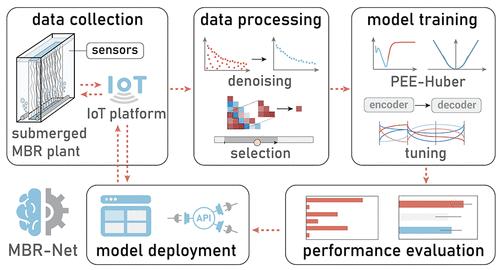
膜污染是膜生物反应器(mbr)运行中的一个重要挑战。工厂操作人员在很大程度上依赖于噪声传感器数据对过滤性能的观察,以评估膜污染状况和基于实验室的工厂维护方案,这往往导致对未来性能的不准确估计和延迟的膜清洁。将现有复杂机制模型与污水处理厂(WWTPs)的物联网(IoT)系统集成的难度进一步加剧了这一挑战。通过利用从污水处理厂获得的数据,以及创新的数据去噪和模型训练策略,我们开发了一个机器学习应用程序(MBR- net),该应用程序能够实时预测全规模浸没式MBR工厂的膜污染,如渗透率所示。研究表明,在不同期望通量、清洗条件和给水条件下,训练后的模型可以有效预测不可逆结垢一天前的变化(使用MAPE <;6.45%, MAE <;3.71 LMH bar-1, R2 >;在两个独立测试集上为0.87)。尽管数据的可用性在模型开发过程中存在一定的局限性,但目前的结果表明,机器学习在膜污染预测和为全面污水处理厂的污染缓解策略提供决策支持方面具有重要价值。
Predicting Membrane Fouling of Submerged Membrane Bioreactor Wastewater Treatment Plants Using Machine Learning
Membrane fouling remains a significant challenge in the operation of membrane bioreactors (MBRs). Plant operators rely heavily on observations of filtration performance from noisy sensor data to assess membrane fouling conditions and lab-based protocols for plant maintenance, often leading to inaccurate estimations of future performance and delayed membrane cleaning. This challenge is further compounded by the difficulty in integrating existing complex mechanistic models with the Internet of Things (IoT) systems of wastewater treatment plants (WWTPs). By harnessing data obtained from WWTPs, along with innovative data denoising and model training strategies, we developed a machine learning application (MBR-Net) that is capable of forecasting membrane fouling, as indicated by permeability, for a full-scale submerged MBR plant in real time. We show that the trained model can effectively predict one-day-ahead changes in irreversible fouling under different desired fluxes, cleaning conditions and feedwater conditions (with MAPE < 6.45%, MAE < 3.71 LMH bar–1, and R2 > 0.87 on two independent testing sets). Although data availability presented certain limitations in the model development process, the current results demonstrate the significant value of machine learning in membrane fouling predictions and in providing decision support for fouling mitigation strategies in full-scale WWTPs.
期刊介绍:
Environmental Science & Technology (ES&T) is a co-sponsored academic and technical magazine by the Hubei Provincial Environmental Protection Bureau and the Hubei Provincial Academy of Environmental Sciences.
Environmental Science & Technology (ES&T) holds the status of Chinese core journals, scientific papers source journals of China, Chinese Science Citation Database source journals, and Chinese Academic Journal Comprehensive Evaluation Database source journals. This publication focuses on the academic field of environmental protection, featuring articles related to environmental protection and technical advancements.




 京公网安备 11010802042870号
京ICP备2023020795号-1
京公网安备 11010802042870号
京ICP备2023020795号-1

 分享
分享
 求助内容:
求助内容: 应助结果提醒方式:
 扫码关注我们
