Zhenjin Xu, Wei Xiao, Keqi Deng, Yang Zhang, Tingting Shen, Xin Liu, Zhengmao Ding, Qiulin Tan, Dezhi Wu
{"title":"分层裂纹工程-支持高线性和超灵敏应变传感器","authors":"Zhenjin Xu, Wei Xiao, Keqi Deng, Yang Zhang, Tingting Shen, Xin Liu, Zhengmao Ding, Qiulin Tan, Dezhi Wu","doi":"10.1021/acssensors.4c03572","DOIUrl":null,"url":null,"abstract":"Growing imperative for intelligent transformation of electro-ionic actuators in soft robotics has necessitated self-perception for accurately mapping their nonlinear dynamic responses. Despite the promise of integrating crack-based strain sensors for such a purpose, significant challenges remain in controlling crack propagation to prevent the induction of through-cracks, resulting in lower sensitivity, linearity, and poor detection limits. Herein, we propose a hierarchical crack-based synergistic enhancement structure by incorporating conductive poly(pyrrole)-coated polystyrene nanospheres and Ti<sub>3</sub>C<sub>2</sub>T<sub><i>x</i></sub> MXene to induce cross-long sensing cracks via point-to-plane contacts, along with silver nanowires for positively engineering networked microcracks for linearity tuning. The prepared microstrain sensor achieves high linearity (GF = 152.4, <i>R</i><sup>2</sup> = 0.99) regulation within ∼6% strain range, ultralow detection limit of 0.02%, and ultrafast response/recovery time of 31 ms/32 ms under 0.2%. Notably, state-of-the-art sensing performance by detecting minimal strain changes down to one millionth, i.e., ∼1 microstrain, has been demonstrated by voiceprint recognition, while maintaining superior dynamic measurement capability and long-term stability for mechanical vibrations up to 100 Hz with a response time of 5 ms. Moreover, the introduction of an adhesive and cross-linking layer facilitates robust bonding between the actuator and sensing structure, enabling real-time tracking of the actuation strain without structural interference by a resistance change resolution of 0.01%, providing significant insights for empowering soft robotics with integrated perception and intelligence.","PeriodicalId":24,"journal":{"name":"ACS Sensors","volume":"36 1","pages":""},"PeriodicalIF":9.1000,"publicationDate":"2025-03-05","publicationTypes":"Journal Article","fieldsOfStudy":null,"isOpenAccess":false,"openAccessPdf":"","citationCount":"0","resultStr":"{\"title\":\"Hierarchical Crack Engineering-Enabled High-Linearity and Ultrasensitive Strain Sensors\",\"authors\":\"Zhenjin Xu, Wei Xiao, Keqi Deng, Yang Zhang, Tingting Shen, Xin Liu, Zhengmao Ding, Qiulin Tan, Dezhi Wu\",\"doi\":\"10.1021/acssensors.4c03572\",\"DOIUrl\":null,\"url\":null,\"abstract\":\"Growing imperative for intelligent transformation of electro-ionic actuators in soft robotics has necessitated self-perception for accurately mapping their nonlinear dynamic responses. Despite the promise of integrating crack-based strain sensors for such a purpose, significant challenges remain in controlling crack propagation to prevent the induction of through-cracks, resulting in lower sensitivity, linearity, and poor detection limits. Herein, we propose a hierarchical crack-based synergistic enhancement structure by incorporating conductive poly(pyrrole)-coated polystyrene nanospheres and Ti<sub>3</sub>C<sub>2</sub>T<sub><i>x</i></sub> MXene to induce cross-long sensing cracks via point-to-plane contacts, along with silver nanowires for positively engineering networked microcracks for linearity tuning. The prepared microstrain sensor achieves high linearity (GF = 152.4, <i>R</i><sup>2</sup> = 0.99) regulation within ∼6% strain range, ultralow detection limit of 0.02%, and ultrafast response/recovery time of 31 ms/32 ms under 0.2%. Notably, state-of-the-art sensing performance by detecting minimal strain changes down to one millionth, i.e., ∼1 microstrain, has been demonstrated by voiceprint recognition, while maintaining superior dynamic measurement capability and long-term stability for mechanical vibrations up to 100 Hz with a response time of 5 ms. Moreover, the introduction of an adhesive and cross-linking layer facilitates robust bonding between the actuator and sensing structure, enabling real-time tracking of the actuation strain without structural interference by a resistance change resolution of 0.01%, providing significant insights for empowering soft robotics with integrated perception and intelligence.\",\"PeriodicalId\":24,\"journal\":{\"name\":\"ACS Sensors\",\"volume\":\"36 1\",\"pages\":\"\"},\"PeriodicalIF\":9.1000,\"publicationDate\":\"2025-03-05\",\"publicationTypes\":\"Journal Article\",\"fieldsOfStudy\":null,\"isOpenAccess\":false,\"openAccessPdf\":\"\",\"citationCount\":\"0\",\"resultStr\":null,\"platform\":\"Semanticscholar\",\"paperid\":null,\"PeriodicalName\":\"ACS Sensors\",\"FirstCategoryId\":\"92\",\"ListUrlMain\":\"https://doi.org/10.1021/acssensors.4c03572\",\"RegionNum\":1,\"RegionCategory\":\"化学\",\"ArticlePicture\":[],\"TitleCN\":null,\"AbstractTextCN\":null,\"PMCID\":null,\"EPubDate\":\"\",\"PubModel\":\"\",\"JCR\":\"Q1\",\"JCRName\":\"CHEMISTRY, ANALYTICAL\",\"Score\":null,\"Total\":0}","platform":"Semanticscholar","paperid":null,"PeriodicalName":"ACS Sensors","FirstCategoryId":"92","ListUrlMain":"https://doi.org/10.1021/acssensors.4c03572","RegionNum":1,"RegionCategory":"化学","ArticlePicture":[],"TitleCN":null,"AbstractTextCN":null,"PMCID":null,"EPubDate":"","PubModel":"","JCR":"Q1","JCRName":"CHEMISTRY, ANALYTICAL","Score":null,"Total":0}
Hierarchical Crack Engineering-Enabled High-Linearity and Ultrasensitive Strain Sensors
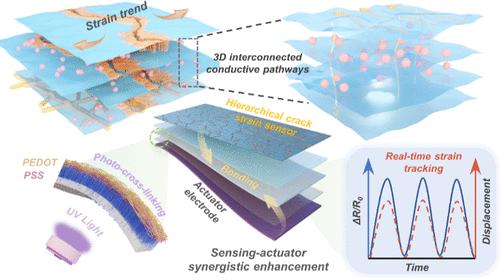
Growing imperative for intelligent transformation of electro-ionic actuators in soft robotics has necessitated self-perception for accurately mapping their nonlinear dynamic responses. Despite the promise of integrating crack-based strain sensors for such a purpose, significant challenges remain in controlling crack propagation to prevent the induction of through-cracks, resulting in lower sensitivity, linearity, and poor detection limits. Herein, we propose a hierarchical crack-based synergistic enhancement structure by incorporating conductive poly(pyrrole)-coated polystyrene nanospheres and Ti3C2Tx MXene to induce cross-long sensing cracks via point-to-plane contacts, along with silver nanowires for positively engineering networked microcracks for linearity tuning. The prepared microstrain sensor achieves high linearity (GF = 152.4, R2 = 0.99) regulation within ∼6% strain range, ultralow detection limit of 0.02%, and ultrafast response/recovery time of 31 ms/32 ms under 0.2%. Notably, state-of-the-art sensing performance by detecting minimal strain changes down to one millionth, i.e., ∼1 microstrain, has been demonstrated by voiceprint recognition, while maintaining superior dynamic measurement capability and long-term stability for mechanical vibrations up to 100 Hz with a response time of 5 ms. Moreover, the introduction of an adhesive and cross-linking layer facilitates robust bonding between the actuator and sensing structure, enabling real-time tracking of the actuation strain without structural interference by a resistance change resolution of 0.01%, providing significant insights for empowering soft robotics with integrated perception and intelligence.
期刊介绍:
ACS Sensors is a peer-reviewed research journal that focuses on the dissemination of new and original knowledge in the field of sensor science, particularly those that selectively sense chemical or biological species or processes. The journal covers a broad range of topics, including but not limited to biosensors, chemical sensors, gas sensors, intracellular sensors, single molecule sensors, cell chips, and microfluidic devices. It aims to publish articles that address conceptual advances in sensing technology applicable to various types of analytes or application papers that report on the use of existing sensing concepts in new ways or for new analytes.





 京公网安备 11010802042870号
京ICP备2023020795号-1
京公网安备 11010802042870号
京ICP备2023020795号-1

 分享
分享
 求助内容:
求助内容: 应助结果提醒方式:
 扫码关注我们
