Tao Wang , Cheng Zhang , Huajuan Ye , Han Jie , Yu Qiu , Ning Li , Junyang Zhuang
{"title":"基于酪胺- dna级联信号扩增的双相电化学免疫分析法检测人唾液样本中的白细胞介素-8","authors":"Tao Wang , Cheng Zhang , Huajuan Ye , Han Jie , Yu Qiu , Ning Li , Junyang Zhuang","doi":"10.1016/j.microc.2025.113240","DOIUrl":null,"url":null,"abstract":"<div><div>Oral cancer poses a significant global public health challenge. The sensitive detection of salivary biomarkers, such as interleukin-8 (IL-8), holds promise for the early diagnosis of oral cancer. In this work, we developed a novel biphasic electrochemical immunoassay (BEIA) method for highly sensitive IL-8 detection in human saliva samples by integrating the conventional immunoassay method with homogeneous electrochemical sensing model. The recognition of IL-8 is achieved through a sandwich immunoreaction on the surface of magnetic beads (MBs). Subsequently, tyramide signal amplification (TSA) is performed to capture a large number of trigger DNA probes on MBs. These trigger DNA probes then initiate an exonuclease III-assisted signal amplification (EASA) reaction, resulting in the hydrolysis of numerous methylene blue (MB)-labeled signal DNA strands and release of MB into solution phase. The electrochemical signal of MB in solution phase is then monitored on an indium tin oxide (ITO) electrode using square wave voltammetry (SWV). With the introduction of TSA-EASA cascade signal amplification, IL-8 can be detected with high sensitivity. The developed method demonstrates a good linear relationship with IL-8 in the concentration range of 1.0 pg mL<sup>−1</sup> to 1000 pg mL<sup>−1</sup> and achieves a detection limit of 0.28 pg mL<sup>−1</sup> (S/N = 3). Additionally, the developed method exhibits high selectivity and can accurately determine IL-8 levels in clinical salivary samples, offering a promising alternative for point-of-care testing and early-stage diagnosis of oral cancer. Furthermore, the method can be easily adapted for the detection of other targets through the simple substitution of antibody pairs.</div></div>","PeriodicalId":391,"journal":{"name":"Microchemical Journal","volume":"212 ","pages":"Article 113240"},"PeriodicalIF":4.9000,"publicationDate":"2025-05-01","publicationTypes":"Journal Article","fieldsOfStudy":null,"isOpenAccess":false,"openAccessPdf":"","citationCount":"0","resultStr":"{\"title\":\"Biphasic electrochemical immunoassay based on tyramine-DNA cascade signal amplification for detection of interleukin-8 in human saliva samples\",\"authors\":\"Tao Wang , Cheng Zhang , Huajuan Ye , Han Jie , Yu Qiu , Ning Li , Junyang Zhuang\",\"doi\":\"10.1016/j.microc.2025.113240\",\"DOIUrl\":null,\"url\":null,\"abstract\":\"<div><div>Oral cancer poses a significant global public health challenge. The sensitive detection of salivary biomarkers, such as interleukin-8 (IL-8), holds promise for the early diagnosis of oral cancer. In this work, we developed a novel biphasic electrochemical immunoassay (BEIA) method for highly sensitive IL-8 detection in human saliva samples by integrating the conventional immunoassay method with homogeneous electrochemical sensing model. The recognition of IL-8 is achieved through a sandwich immunoreaction on the surface of magnetic beads (MBs). Subsequently, tyramide signal amplification (TSA) is performed to capture a large number of trigger DNA probes on MBs. These trigger DNA probes then initiate an exonuclease III-assisted signal amplification (EASA) reaction, resulting in the hydrolysis of numerous methylene blue (MB)-labeled signal DNA strands and release of MB into solution phase. The electrochemical signal of MB in solution phase is then monitored on an indium tin oxide (ITO) electrode using square wave voltammetry (SWV). With the introduction of TSA-EASA cascade signal amplification, IL-8 can be detected with high sensitivity. The developed method demonstrates a good linear relationship with IL-8 in the concentration range of 1.0 pg mL<sup>−1</sup> to 1000 pg mL<sup>−1</sup> and achieves a detection limit of 0.28 pg mL<sup>−1</sup> (S/N = 3). Additionally, the developed method exhibits high selectivity and can accurately determine IL-8 levels in clinical salivary samples, offering a promising alternative for point-of-care testing and early-stage diagnosis of oral cancer. Furthermore, the method can be easily adapted for the detection of other targets through the simple substitution of antibody pairs.</div></div>\",\"PeriodicalId\":391,\"journal\":{\"name\":\"Microchemical Journal\",\"volume\":\"212 \",\"pages\":\"Article 113240\"},\"PeriodicalIF\":4.9000,\"publicationDate\":\"2025-05-01\",\"publicationTypes\":\"Journal Article\",\"fieldsOfStudy\":null,\"isOpenAccess\":false,\"openAccessPdf\":\"\",\"citationCount\":\"0\",\"resultStr\":null,\"platform\":\"Semanticscholar\",\"paperid\":null,\"PeriodicalName\":\"Microchemical Journal\",\"FirstCategoryId\":\"92\",\"ListUrlMain\":\"https://www.sciencedirect.com/science/article/pii/S0026265X25005946\",\"RegionNum\":2,\"RegionCategory\":\"化学\",\"ArticlePicture\":[],\"TitleCN\":null,\"AbstractTextCN\":null,\"PMCID\":null,\"EPubDate\":\"2025/3/4 0:00:00\",\"PubModel\":\"Epub\",\"JCR\":\"Q1\",\"JCRName\":\"CHEMISTRY, ANALYTICAL\",\"Score\":null,\"Total\":0}","platform":"Semanticscholar","paperid":null,"PeriodicalName":"Microchemical Journal","FirstCategoryId":"92","ListUrlMain":"https://www.sciencedirect.com/science/article/pii/S0026265X25005946","RegionNum":2,"RegionCategory":"化学","ArticlePicture":[],"TitleCN":null,"AbstractTextCN":null,"PMCID":null,"EPubDate":"2025/3/4 0:00:00","PubModel":"Epub","JCR":"Q1","JCRName":"CHEMISTRY, ANALYTICAL","Score":null,"Total":0}
引用次数: 0
摘要
口腔癌是一项重大的全球公共卫生挑战。唾液生物标志物的灵敏检测,如白细胞介素-8 (IL-8),为口腔癌的早期诊断带来了希望。在这项工作中,我们建立了一种新的双相电化学免疫分析(BEIA)方法,将传统的免疫分析方法与均相电化学传感模型相结合,用于人唾液样品中IL-8的高灵敏度检测。IL-8的识别是通过磁珠(mb)表面的夹心免疫反应实现的。随后,进行酪酰胺信号放大(TSA)以捕获mb上的大量触发DNA探针。然后,这些触发DNA探针启动外切酶iii辅助信号扩增(EASA)反应,导致大量亚甲基蓝(MB)标记的信号DNA链水解并将MB释放到溶液中。利用方波伏安法(SWV)在氧化铟锡(ITO)电极上监测了MB在溶液中的电化学信号。通过引入TSA-EASA级联信号放大,可以高灵敏度地检测IL-8。该方法在1.0 pg mL - 1 ~ 1000 pg mL - 1的浓度范围内与IL-8具有良好的线性关系,检测限为0.28 pg mL - 1 (S/N = 3)。此外,该方法具有高选择性,可准确测定临床唾液样品中的IL-8水平,为口腔癌的即时检测和早期诊断提供了一种有希望的替代方法。此外,通过简单的抗体对替换,该方法可以很容易地适用于检测其他靶标。
Biphasic electrochemical immunoassay based on tyramine-DNA cascade signal amplification for detection of interleukin-8 in human saliva samples
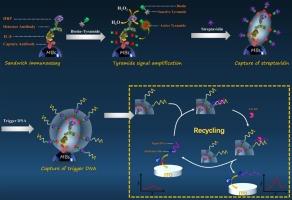
Oral cancer poses a significant global public health challenge. The sensitive detection of salivary biomarkers, such as interleukin-8 (IL-8), holds promise for the early diagnosis of oral cancer. In this work, we developed a novel biphasic electrochemical immunoassay (BEIA) method for highly sensitive IL-8 detection in human saliva samples by integrating the conventional immunoassay method with homogeneous electrochemical sensing model. The recognition of IL-8 is achieved through a sandwich immunoreaction on the surface of magnetic beads (MBs). Subsequently, tyramide signal amplification (TSA) is performed to capture a large number of trigger DNA probes on MBs. These trigger DNA probes then initiate an exonuclease III-assisted signal amplification (EASA) reaction, resulting in the hydrolysis of numerous methylene blue (MB)-labeled signal DNA strands and release of MB into solution phase. The electrochemical signal of MB in solution phase is then monitored on an indium tin oxide (ITO) electrode using square wave voltammetry (SWV). With the introduction of TSA-EASA cascade signal amplification, IL-8 can be detected with high sensitivity. The developed method demonstrates a good linear relationship with IL-8 in the concentration range of 1.0 pg mL−1 to 1000 pg mL−1 and achieves a detection limit of 0.28 pg mL−1 (S/N = 3). Additionally, the developed method exhibits high selectivity and can accurately determine IL-8 levels in clinical salivary samples, offering a promising alternative for point-of-care testing and early-stage diagnosis of oral cancer. Furthermore, the method can be easily adapted for the detection of other targets through the simple substitution of antibody pairs.
期刊介绍:
The Microchemical Journal is a peer reviewed journal devoted to all aspects and phases of analytical chemistry and chemical analysis. The Microchemical Journal publishes articles which are at the forefront of modern analytical chemistry and cover innovations in the techniques to the finest possible limits. This includes fundamental aspects, instrumentation, new developments, innovative and novel methods and applications including environmental and clinical field.
Traditional classical analytical methods such as spectrophotometry and titrimetry as well as established instrumentation methods such as flame and graphite furnace atomic absorption spectrometry, gas chromatography, and modified glassy or carbon electrode electrochemical methods will be considered, provided they show significant improvements and novelty compared to the established methods.




 京公网安备 11010802042870号
京ICP备2023020795号-1
京公网安备 11010802042870号
京ICP备2023020795号-1

 分享
分享
 求助内容:
求助内容: 应助结果提醒方式:
 扫码关注我们
